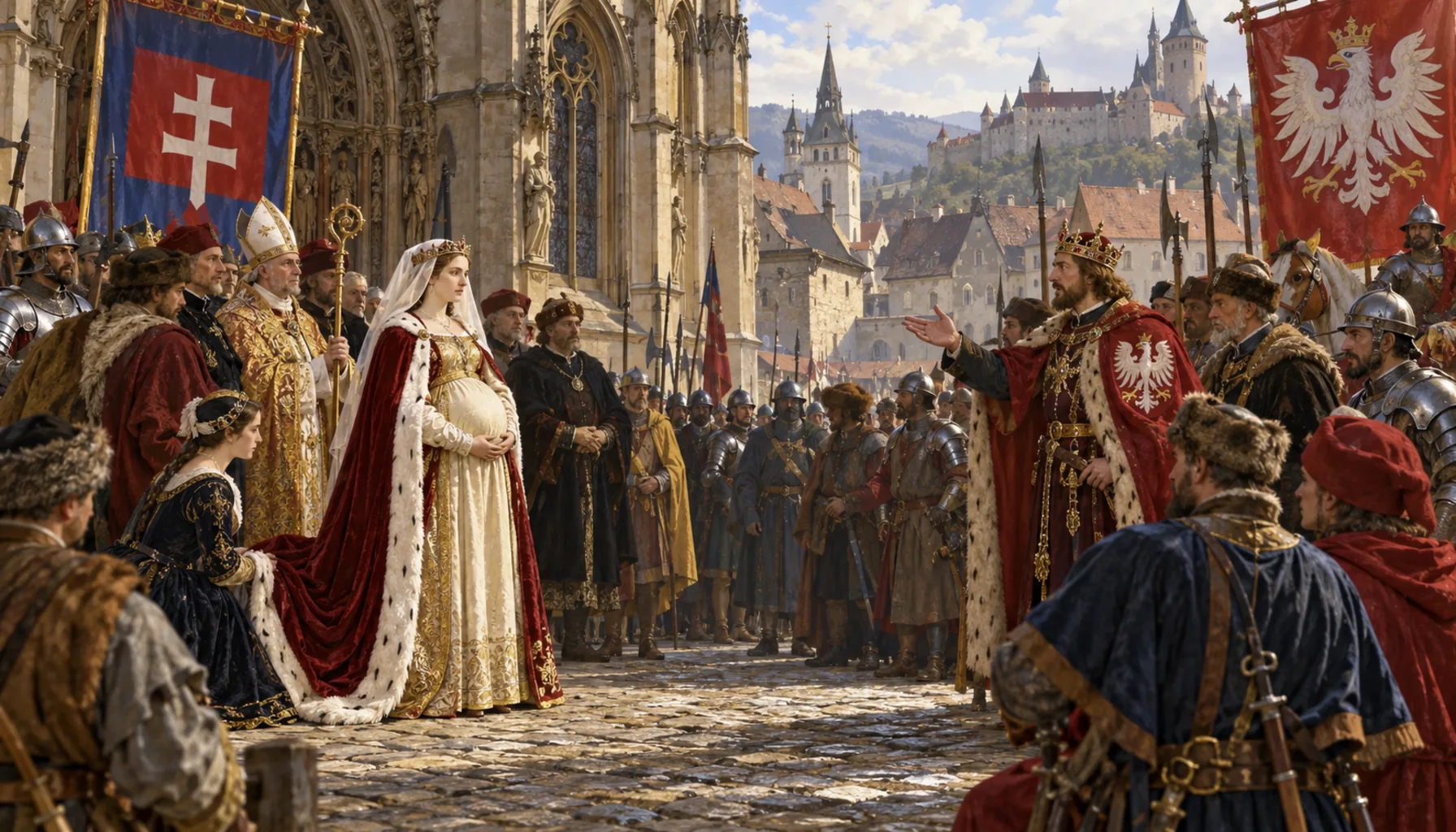
King Albert died in 1439 leaving a pregnant widow, and the kingdom split between those who wanted her unborn son — Ladislaus the Posthumous — and those who elected the Polish king Vladislav instead. The queen hired a Czech captain, Ján Jiskra of Brandýs, and he held the whole north and east of the kingdom for the child, commanding from Zvolen and from Košice with several thousand professional soldiers, many of them veterans of the Hussite wars. Košice was attacked in 1441 and held; in 1449 Jiskra's mercenaries beat a Hungarian force sent against him. For twenty years this half of the kingdom answered to a mercenary captain rather than to Buda, and it ended only when Jiskra came to terms with Matthias Corvinus in 1461 and the town came over with him. It is a useful thing for a student to see: a state can lose control of a region without losing a war.Kráľ Albrecht zomrel v roku 1439 a zanechal tehotnú vdovu; kráľovstvo sa rozdelilo na tých, čo chceli jej nenarodeného syna — Ladislava Pohrobka — a tých, čo si zvolili poľského kráľa Vladislava. Kráľovná si najala českého kapitána Jána Jiskru z Brandýsa a ten držal celý sever a východ kráľovstva pre dieťa; velil zo Zvolena a z Košíc a mal niekoľko tisíc žoldnierov, mnohí z nich boli veteráni husitských vojen. Košice boli v roku 1441 napadnuté a odolali, v roku 1449 Jiskrovi žoldnieri porazili uhorské vojsko vyslané proti nemu. Dvadsať rokov sa táto polovica kráľovstva zodpovedala žoldnierskemu kapitánovi, nie Budínu, a skončilo sa to až vtedy, keď sa Jiskra v roku 1461 dohodol s Matejom Korvínom a mesto prešlo s ním. Je to poučné: štát môže stratiť kontrolu nad krajom aj bez toho, aby prehral vojnu.