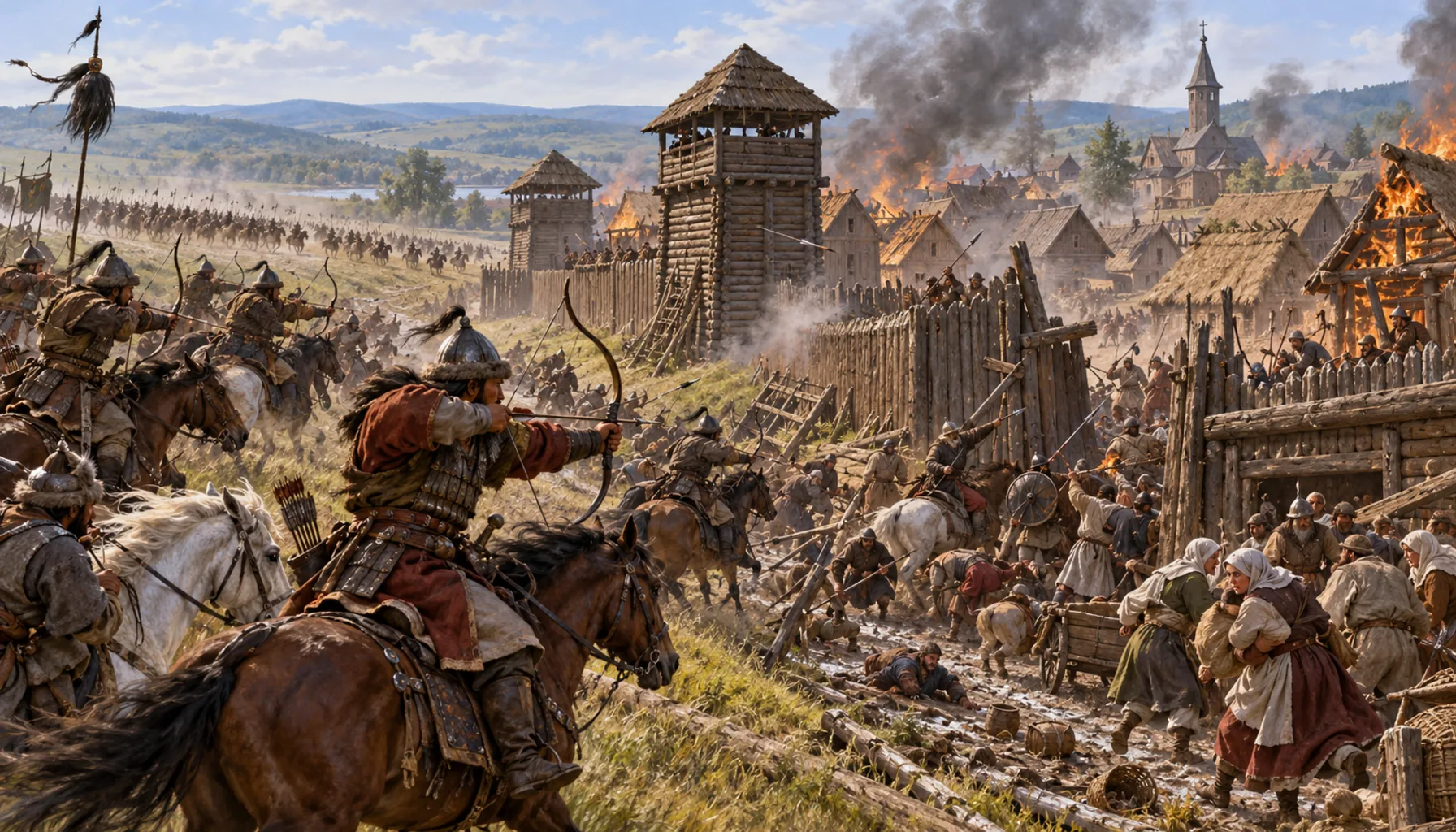
In 1241 a Mongol army destroyed the Hungarian king's forces at the river Slaná, a day's ride south-west of here, and rode across the kingdom. What the invasion did to the village at the Hornád crossing is nowhere recorded — what it did to the country is the story. King Béla IV came back to a kingdom he had to rebuild, and his answer was stone castles on the hilltops and settlers, mostly German-speaking, invited in with privileges to hold and work ground that was thinly held. Košice grew out of exactly that policy: within two generations the royal village had become a walled town of German and Hungarian burghers straddling the trade road, and by 1290 it held the first town privileges we know of. So the correct sentence is not that the Mongols destroyed Košice. It is that Košice, as a town, is one of the things the Mongol invasion caused.V roku 1241 rozdrvilo mongolské vojsko uhorské sily pri rieke Slanej, deň jazdy na juhozápad odtiaľto, a prehnalo sa krajinou. Čo vpád urobil s dedinou pri brode na Hornáde, nikde zapísané nie je — príbehom je to, čo urobil s kráľovstvom. Kráľ Belo IV. sa vrátil do krajiny, ktorú musel postaviť nanovo, a jeho odpoveďou boli kamenné hrady na kopcoch a osadníci, väčšinou nemecky hovoriaci, pozvaní s výsadami, aby držali a obrábali riedko osídlenú zem. Košice vyrástli presne z tejto politiky: za dve generácie sa z kráľovskej osady stalo hradbami obohnané mesto nemeckých a maďarských mešťanov na obchodnej ceste a v roku 1290 už malo prvé známe mestské výsady. Správna veta teda neznie, že Mongoli Košice zničili. Znie tak, že Košice ako mesto sú jedným z následkov mongolského vpádu.