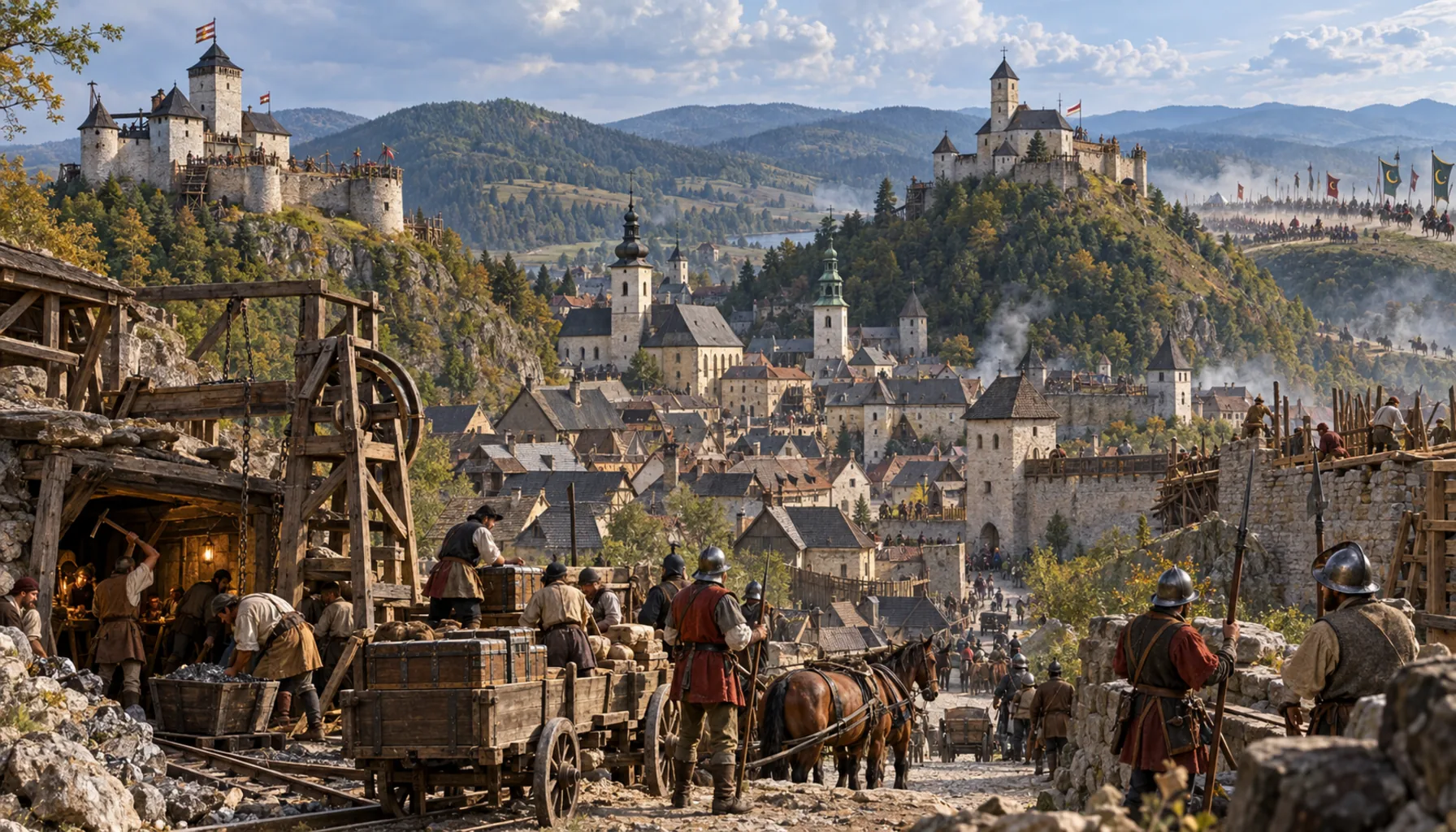
After the Hungarian army was destroyed at Mohács in 1526 the Ottoman frontier moved north, and a treasury that had just lost half its country was not going to lose its silver as well. The town walled itself, and between 1546 and 1559 it turned its Romanesque church of the Virgin Mary into a fortress: that is the Old Castle, a church with gun platforms. Then it built a second one from scratch between 1564 and 1571 — the white New Castle on the opposite slope, a watchtower whose job was to see a raiding party coming from the south and pass the signal on. The Ottomans never took Banská Štiavnica. The two castles still look at each other across the roofs, which is the clearest thing in town about how frightened the sixteenth century was.Keď roku 1526 padlo uhorské vojsko pri Moháči, osmanská hranica sa posunula na sever — a komora, ktorá práve prišla o polovicu krajiny, nemienila prísť aj o striebro. Mesto sa opevnilo a v rokoch 1546 – 1559 prestavalo svoj románsky kostol Panny Márie na pevnosť: to je Starý zámok, kostol s delovými baštami. Druhý postavilo nanovo v rokoch 1564 – 1571 — biely Nový zámok na protiľahlom svahu, strážnu vežu, ktorej úlohou bolo včas zbadať jazdcov od juhu a podať znamenie ďalej. Turci Banskú Štiavnicu nikdy nedobyli. Tie dva hrady si dodnes hľadia z očí ponad strechy — a to je najzreteľnejší doklad toho, aké vystrašené bolo 16. storočie.