Mines, guilds and the EnlightenmentBane, cechy a osvietenstvo
1749 – 1770Banská Štiavnica teaches the world to mineBanská Štiavnica učí svet baníctvu
SlovakiaSlovensko
Banská Štiavnica teaches the world to mineBanská Štiavnica učí svet baníctvu
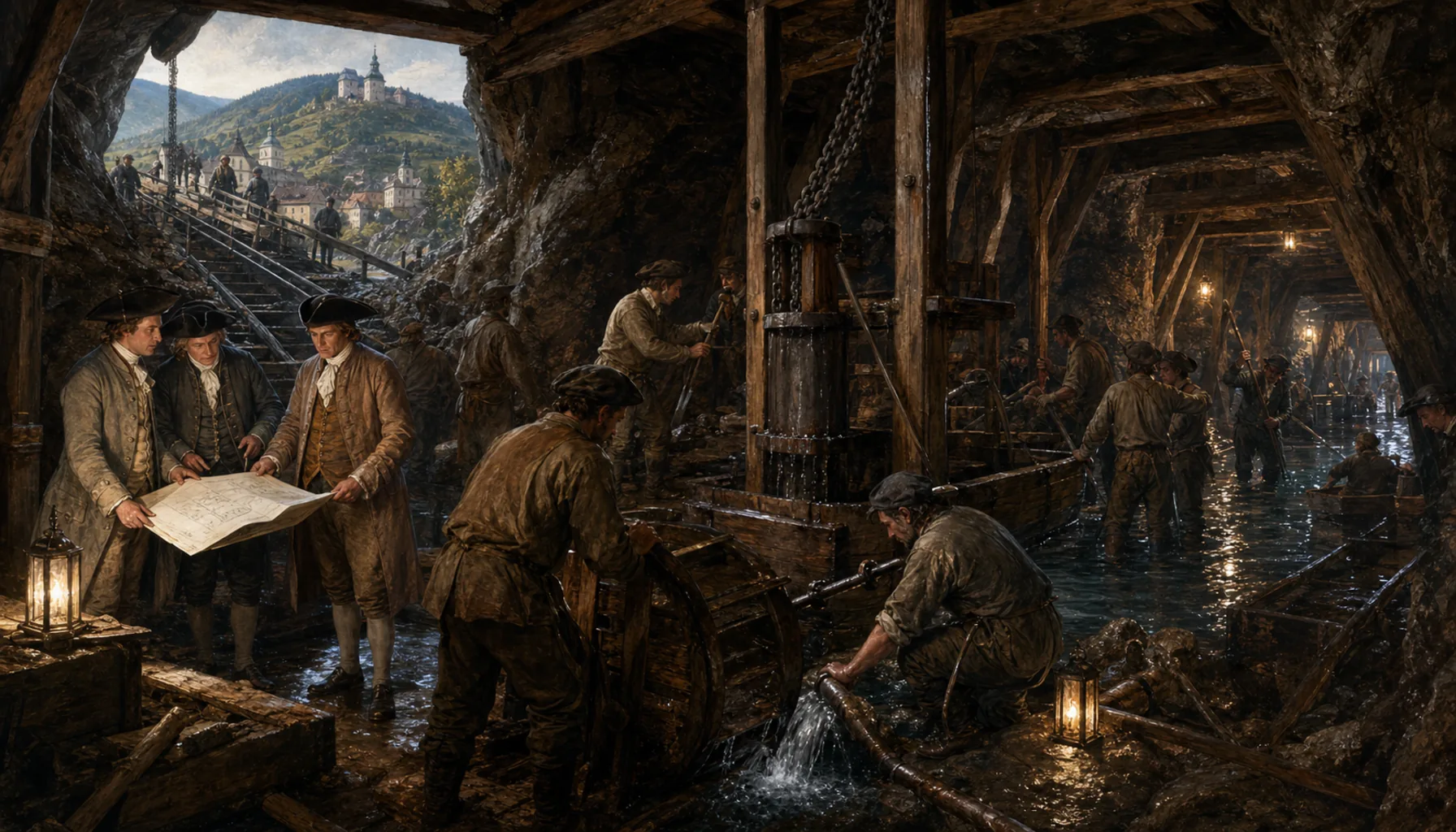
Banská Štiavnica had been one of Europe's great silver towns since the Middle Ages, and by the eighteenth century its problem was water: the shafts had gone below the water table and kept drowning. The answer was engineering — a system of reservoirs on the hills above the town, the tajchy, linked by tens of kilometres of channels to drive pumps and hoists, and in 1749 Jozef Karol Hell built the first of his water-column pumping engines in the Leopold shaft; eight of them were working by 1770. Teaching followed the machinery: a mining school was set up here in 1735 with Samuel Mikovíni as its first professor, Vienna decided in 1762 to raise it into an academy for the whole monarchy, and Maria Theresa's statute of 1770 gave it the name Mining Academy. It was the first school of its kind in the world, and for more than a century students came from across Europe to learn inside a working mining district.Banská Štiavnica patrila od stredoveku k najväčším strieborným mestám Európy a v 18. storočí mala jeden hlavný problém — vodu: šachty klesli pod hladinu spodnej vody a znova a znova sa topili. Odpoveďou bola technika: sústava nádrží na kopcoch nad mestom, tajchy, pospájaná desiatkami kilometrov jarkov, ktorá poháňala čerpadlá a ťažné stroje, a roku 1749 postavil Jozef Karol Hell v šachte Leopold prvý zo svojich vodnostĺpcových čerpacích strojov; do roku 1770 ich pracovalo osem. Po strojoch prišlo školstvo: banská škola tu vznikla roku 1735 a jej prvým profesorom bol Samuel Mikovíni, roku 1762 rozhodla Viedeň povýšiť ju na akadémiu pre celú monarchiu a štatút Márie Terézie z roku 1770 jej dal meno Banícka akadémia. Bola prvou školou svojho druhu na svete a vyše storočia sem chodili študenti z celej Európy učiť sa priamo v živom banskom revíri.
ReferencesZdroje
Where this came fromOdkiaľ to pochádza
Sources consulted while researching this page. Follow them to read further — and to check us.Zdroje, z ktorých sme pri príprave tejto stránky vychádzali. Kliknite a čítajte ďalej — aj si nás overte.
Černová massacre — Wikipediadate, 15 killed and 12 seriously wounded, gendarmes' own nationalitydate, 15 killed and 12 seriously wounded, gendarmes' own nationality
Magyarization — Wikipediathe 1907 Apponyi education laws, the closing of the Slovak grammar schools and of Matica slovenská in April 1875the 1907 Apponyi education laws, the closing of the Slovak grammar schools and of Matica slovenská in April 1875
Žiadosti slovenského národa — Wikipédia10 May 1848, fourteen points, the arrest warrants of May–June 184810 May 1848, fourteen points, the arrest warrants of May–June 1848
Slovak Uprising of 1848–49 — Wikipediathe three volunteer campaigns and the disbanding of the corps on 21 November 1849the three volunteer campaigns and the disbanding of the corps on 21 November 1849
Pittsburgh Agreement — Wikipediathe Cleveland Agreement of 22 October 1915 and the text of the Pittsburgh promisesthe Cleveland Agreement of 22 October 1915 and the text of the Pittsburgh promises
Slovak–Hungarian War — Wikipediathe 'Little War' of March 1939 and the 1,697 km² ceded on 4 April 1939the 'Little War' of March 1939 and the 1,697 km² ceded on 4 April 1939
Slovak National Uprising — Wikipediainsurgent numbers, territory held, the fall of Banská Bystrica on 27 October 1944insurgent numbers, territory held, the fall of Banská Bystrica on 27 October 1944
Kremnička and Nemecká massacres — Wikipedia747 victims at Kremnička, about 900 at Nemecká, the units responsible747 victims at Kremnička, about 900 at Nemecká, the units responsible
Masaker v Kľakovskej doline — Wikipédia21 January 1945, 148 civilians including 48 children under eighteen21 January 1945, 148 civilians including 48 children under eighteen
Battle of the Dukla Pass — Wikipedia8 September – 28 October 1944 and the casualty figures8 September – 28 October 1944 and the casualty figures
Kalinov — Wikipédiathe first village in Slovakia liberated, 21 September 1944the first village in Slovakia liberated, 21 September 1944
Slovak Greek Catholic Church — Wikipediathe staged Prešov assembly of April 1950, Bishop Gojdič, the 1968 restorationthe staged Prešov assembly of April 1950, Bishop Gojdič, the 1968 restoration