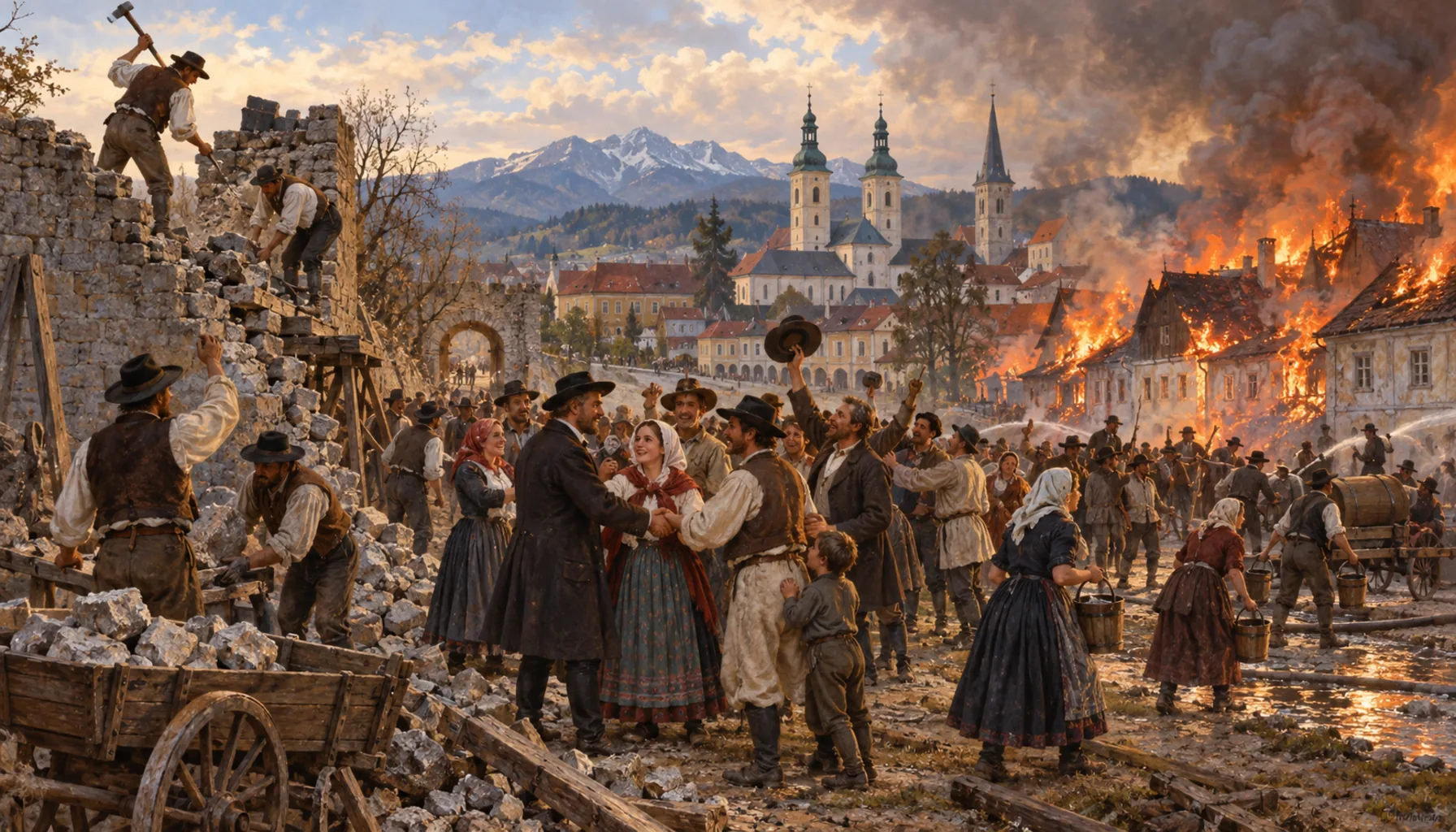
In March 1848 serfdom was abolished across the kingdom and Žilina became a small free town. In the same year a great fire went through it — and the rebuilding was used to pull down the town walls, which for the first time let Žilina grow outwards instead of only inwards. Slovak volunteers beat Hungarian national guards in a fight at Budatín, just across the Váh. On 4 January 1849 Ľudovít Štúr and Jozef Miloslav Hurban stood in front of the old pharmacy house on today's Mariánske námestie and called on the people of Žilina to join the national cause. And then, for twenty years, very little: in 1850 the town had 2,326 inhabitants, its crafts were stagnating and Žilina counted as economically unimportant.V marci 1848 bolo v celom kráľovstve zrušené poddanstvo a zo Žiliny sa stalo malé slobodné mesto. V tom istom roku ju zachvátil veľký požiar — a pri obnove padli mestské hradby, takže Žilina mohla po prvý raz rásť von, a nie iba dovnútra. Slovenskí dobrovoľníci porazili maďarské gardy v boji pri Budatíne hneď za Váhom. Štvrtého januára 1849 vystúpili Ľudovít Štúr a Jozef Miloslav Hurban pred domom bývalej lekárne na dnešnom Mariánskom námestí a vyzvali Žilinčanov, aby sa pridali k národnej veci. A potom dvadsať rokov takmer nič: v roku 1850 malo mesto 2 326 obyvateľov, remeslá stagnovali a Žilina platila za hospodársky bezvýznamnú.