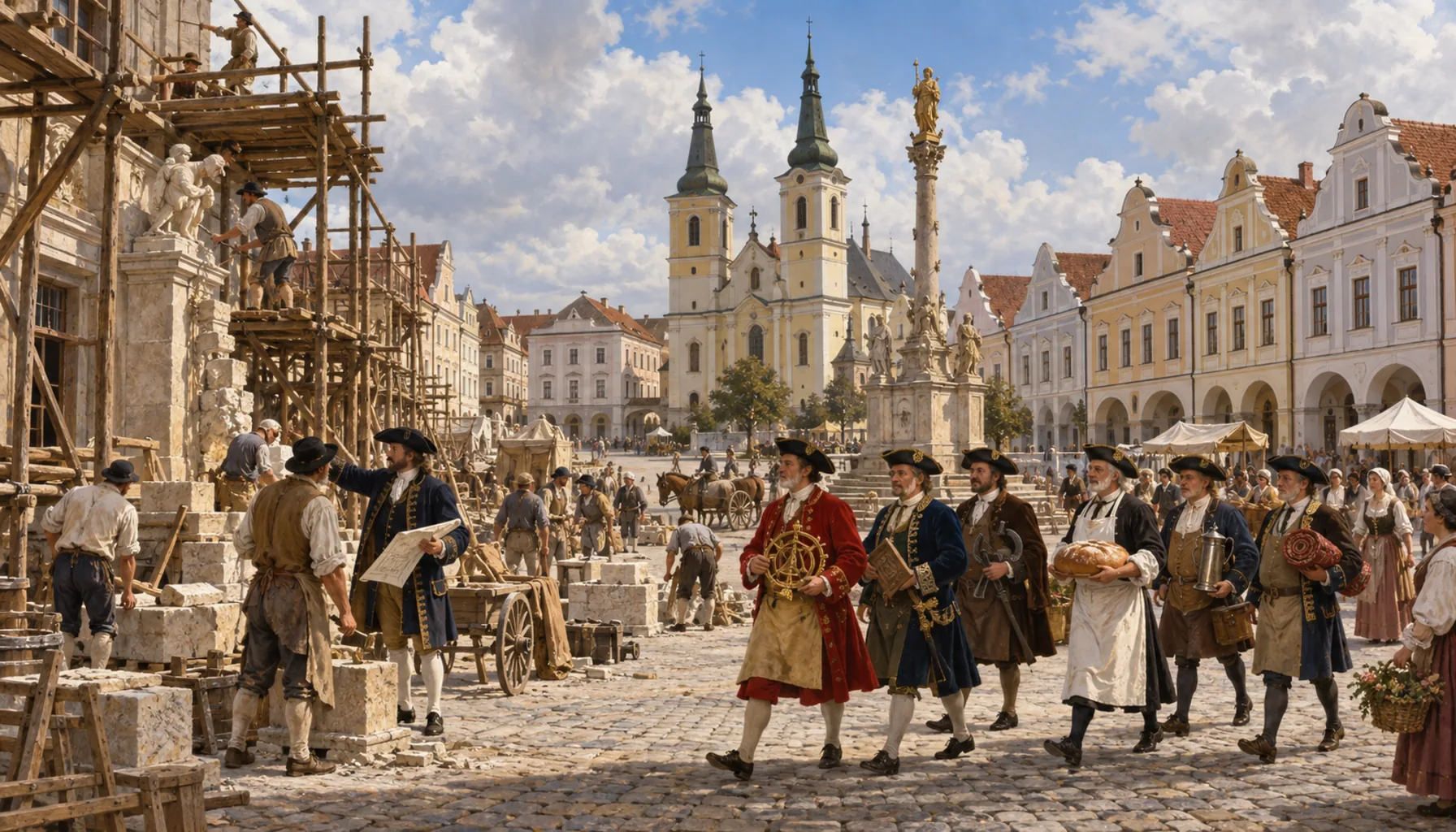
The eighteenth century rebuilt the square into the shape you still walk around. The Franciscans began the church of St Barbara in 1723, a Jesuit church and monastery went up on the market square itself twenty years later, and in 1738 the town raised the statue of the Immaculata — the Virgin Mary — to mark the end of the re-Catholicisation; it is still there, and it is why the square is called Mariánske. Fire came again in 1744 and 1756. By mid-century the guilds could no longer compete, and manufactories — early factories where hired workers each did one part of the job — began to replace them; one of the first in the district was a linen manufactory at Teplička nad Váhom in 1760. Cholera struck in 1831, and Bishop Jozef Vurum set up an orphanage in the old grammar-school building.Osemnáste storočie prestavalo námestie do podoby, po ktorej sa chodí dodnes. Františkáni začali v roku 1723 stavať Kostol svätej Barbory, o dvadsať rokov neskôr vyrástol priamo na rínku jezuitský kostol s kláštorom a v roku 1738 dalo mesto postaviť sochu Immaculaty — Nepoškvrnenej Panny Márie — na pamiatku zavŕšenia rekatolizácie; stojí tam dodnes a práve po nej sa námestie volá Mariánske. Znova horelo v rokoch 1744 a 1756. V polovici storočia už cechy nedokázali konkurovať a začali ich nahrádzať manufaktúry, teda rané továrne, v ktorých najatí robotníci robili každý len časť práce; jednou z prvých v okolí bola manufaktúra na plátno v Tepličke nad Váhom z roku 1760. V roku 1831 udrela cholera a biskup Jozef Vurum zriadil v budove bývalého gymnázia sirotinec.