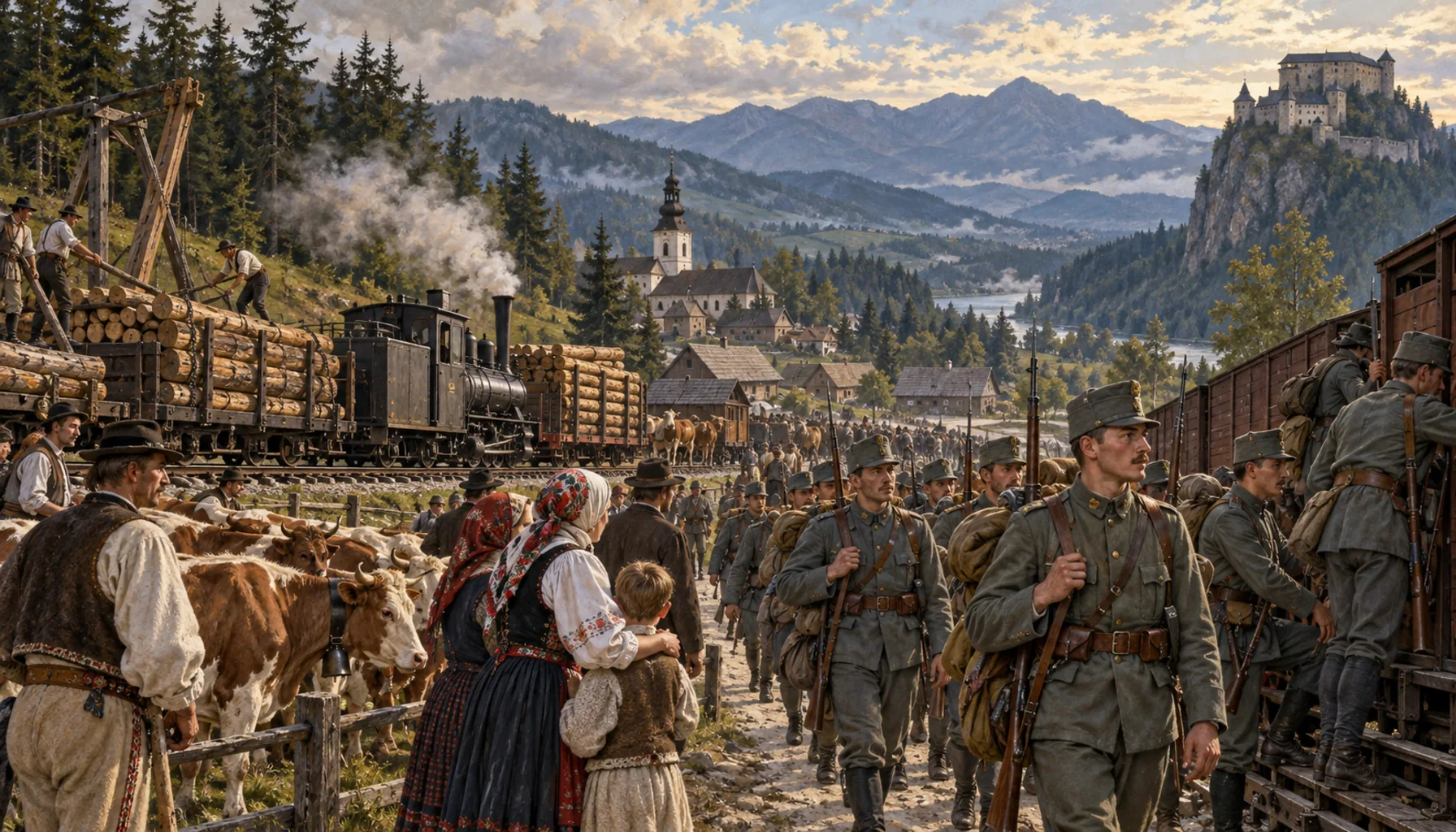
Orava's men went to the Russian, Serbian and Italian fronts in Austro-Hungarian uniform, and the county gave the army what it had: timber, cattle, and its sons. During the war a narrow-gauge forest railway was pushed across the high ground from Kysuce into Orava, to get timber out of forests no road could reach; where the slope was too steep to take in curves, the line was built as a series of reversals — the train runs up one leg into a dead end, the points change behind it, and it backs up the next. In Dolný Kubín the old judge Hviezdoslav answered the war with Krvavé sonety, the Bloody Sonnets, a cycle attacking the war itself and the idea that a Christian Europe could do this to itself. They could not be printed in wartime Hungary and appeared only after it was over.Oravskí muži šli v rakúsko-uhorských uniformách na ruský, srbský a taliansky front a stolica dala armáde, čo mala: drevo, dobytok a synov. Počas vojny prerazili cez hrebeň z Kysúc na Oravu úzkorozchodnú lesnú železnicu, aby dostali drevo z lesov, kam sa cesta nedostala; tam, kde bol svah prikrý na oblúky, postavili trať ako sústavu úvratí — vlak vyjde jedným ramenom do slepého konca, za ním sa prehodí výhybka a cúva ďalším. V Dolnom Kubíne odpovedal starý sudca Hviezdoslav na vojnu Krvavými sonetmi, cyklom, ktorý útočí na vojnu samu a na predstavu, že si to kresťanská Európa môže urobiť. V uhorskej vojnovej cenzúre ich vytlačiť nemohli a vyšli až po jej konci.