Only what belongs to Trnava — each on its own page.Len to, čo patrí k mestu Trnava — každé s vlastnou stránkou.
Pick a year to see what was happening here then.Vyberte rok a uvidíte, čo sa tu vtedy dialo.
Trnava has no castle rock. It sits on flat, fertile loess plain west of the Little Carpathians, and that single fact shapes everything that follows: a town here can grow rich on a road, but it can never retreat uphill. The region's prehistoric people did have a stronghold — Molpír above Smolenice, a fortified hill settlement of about twelve hectares from the Hallstatt period, later used by Celts and then by Slavs — but it is up in the hills, an hour away, not here. Where Trnava stands there was farmland and a stream called the Trnávka, whose thorn thickets almost certainly gave the town its Slovak name. Everything Trnava later became — market, walled town, church capital — it had to build for itself out of brick, because the landscape gave it nothing to stand on.Trnava nemá hradnú skalu. Leží na rovnej úrodnej sprašovej rovine západne od Malých Karpát a z tejto jedinej okolnosti vyplýva všetko ostatné: mesto tu môže zbohatnúť na ceste, ale nikdy sa nemá kam stiahnuť do kopca. Praveké obyvateľstvo kraja svoje hradisko malo — Molpír nad Smolenicami, opevnené výšinné sídlisko s rozlohou asi dvanásť hektárov z halštatskej doby, ktoré neskôr využívali Kelti a po nich Slovania — lenže to je hodinu cesty odtiaľto, hore v horách. Tam, kde stojí Trnava, boli polia a potok Trnávka, podľa ktorého tŕnistých húštin dostalo mesto takmer isto svoje slovenské meno. Všetko, čím sa Trnava neskôr stala — trhovisko, opevnené mesto, cirkevná metropola —, si musela postaviť sama z tehly, lebo krajina jej nedala nič, na čom by sa dalo stáť.
Great Moravia is the first state that ruled this territory, and its centres were on the rivers — Nitra in the east of it, Mikulčice and Devín on the Morava and the Danube. Trnava is not named in any Great Moravian source, and no one should pretend otherwise. The nearest thing the region has is astonishing all the same: at Kopčany, out on the Morava floodplain, a tiny early-medieval church still stands, tied by archaeology to the great stronghold of Mikulčice on the far bank — one of the very few buildings anywhere that may have been standing when Cyril and Methodius were alive. So the ninth century happened here, in the fields and villages of the plain; it simply left its stone somewhere else.Veľká Morava je prvý štát, ktorý na tomto území vládol, a jej centrá ležali pri riekach — Nitra na východe, Mikulčice a Devín na Morave a Dunaji. Trnava sa v žiadnom veľkomoravskom prameni nespomína a netreba to zakrývať. Najbližšie, čo kraj má, je aj tak pozoruhodné: v Kopčanoch na moravskej nive dodnes stojí drobný ranostredoveký kostolík, ktorý archeológia spája s veľkým hradiskom v Mikulčiciach na druhom brehu — jedna z mála stavieb na svete, ktorá mohla stáť už za života Cyrila a Metoda. Deviate storočie sa teda odohralo aj tu, na poliach a v dedinách roviny; len svoj kameň nechalo inde.
The road from the Danube crossing at Bratislava north-east toward Moravia, Bohemia and Poland runs straight across this plain, and somewhere on it a market grew. Its market day was Saturday, which is why the Hungarian name for the town is Nagyszombat, 'great Saturday'; the German name Tyrnau simply copies the Slovak one. The first time anyone wrote the place down was in 1211, in a deed of Archbishop John of Esztergom concerning the income of the local church — a document about a church, issued by the very office whose successors would one day move in and stay for three centuries. That mention is a fact about a document, not about when people arrived: beside the later basilica stand the remains of a Romanesque round karner, a charnel house where bones from the graveyard were kept, and it is the oldest thing in Trnava — proof of a church and a burying ground here before any charter was written.Cesta od dunajského brodu pri Bratislave na severovýchod na Moravu, do Čiech a do Poľska vedie rovno cez túto rovinu a kdesi na nej vyrástol trh. Trhovým dňom bola sobota — preto sa mesto po maďarsky volá Nagyszombat, teda „veľká sobota“; nemecké Tyrnau len opakuje slovenský názov. Prvý raz niekto toto miesto zapísal v roku 1211, v listine ostrihomského arcibiskupa Jána o príjmoch miestneho kostola — listina o kostole, vydaná práve tým úradom, ktorého nástupcovia sa sem raz nasťahujú na tri storočia. Tá zmienka hovorí o dokumente, nie o tom, kedy sem prišli ľudia: vedľa neskoršej baziliky stoja zvyšky románskeho okrúhleho karnera, kostnice, kam ukladali kosti z cintorína, a je to najstaršia pamiatka Trnavy — dôkaz, že tu kostol aj pohrebisko stáli skôr, než vznikla akákoľvek výsadná listina.
In 1238 King Béla IV granted Trnava the privileges of a free royal town — its own judge and council, its own market and tolls, and a lord who was the king himself and nobody nearer. It was the first town on the territory of today's Slovakia to get them, and note the date: this is three years before the Mongol armies arrived, so the privileges are not a reward for surviving them. What the invasion of 1241–42 changed was the walls. Afterwards the king brought German settlers in to refill and rebuild the towns, and Trnava — with no hill and no rock — spent the next century enclosing itself in brick instead: a circuit of roughly three kilometres around some 56 hectares, one of the oldest brick fortification systems in Slovakia, of which about two thirds still stands. You can walk up onto it today in Park Bella IV., a small walled park named after the king who signed the charter.V roku 1238 udelil kráľ Belo IV. Trnave výsady slobodného kráľovského mesta — vlastného richtára a radu, vlastný trh a mýta a jediného pána, ktorým bol sám kráľ a nikto bližší. Bolo prvým mestom na území dnešného Slovenska, ktoré ich dostalo, a všimnite si ten rok: sú to tri roky pred príchodom mongolských vojsk, takže výsady nie sú odmenou za to, že ich mesto prežilo. Vpád rokov 1241 – 1242 zmenil niečo iné — hradby. Kráľ po ňom pozval do vyľudnených miest nemeckých osadníkov a Trnava, ktorá nemá kopec ani skalu, sa nasledujúce storočie obopínala tehlou: okruh dlhý zhruba tri kilometre okolo asi 56 hektárov, jedno z najstarších tehlových opevnení na Slovensku, z ktorého dodnes stoja asi dve tretiny. Vyjsť naň môžete v Parku Bella IV., malom parku pri hradbách pomenovanom po kráľovi, ktorý listinu podpísal.
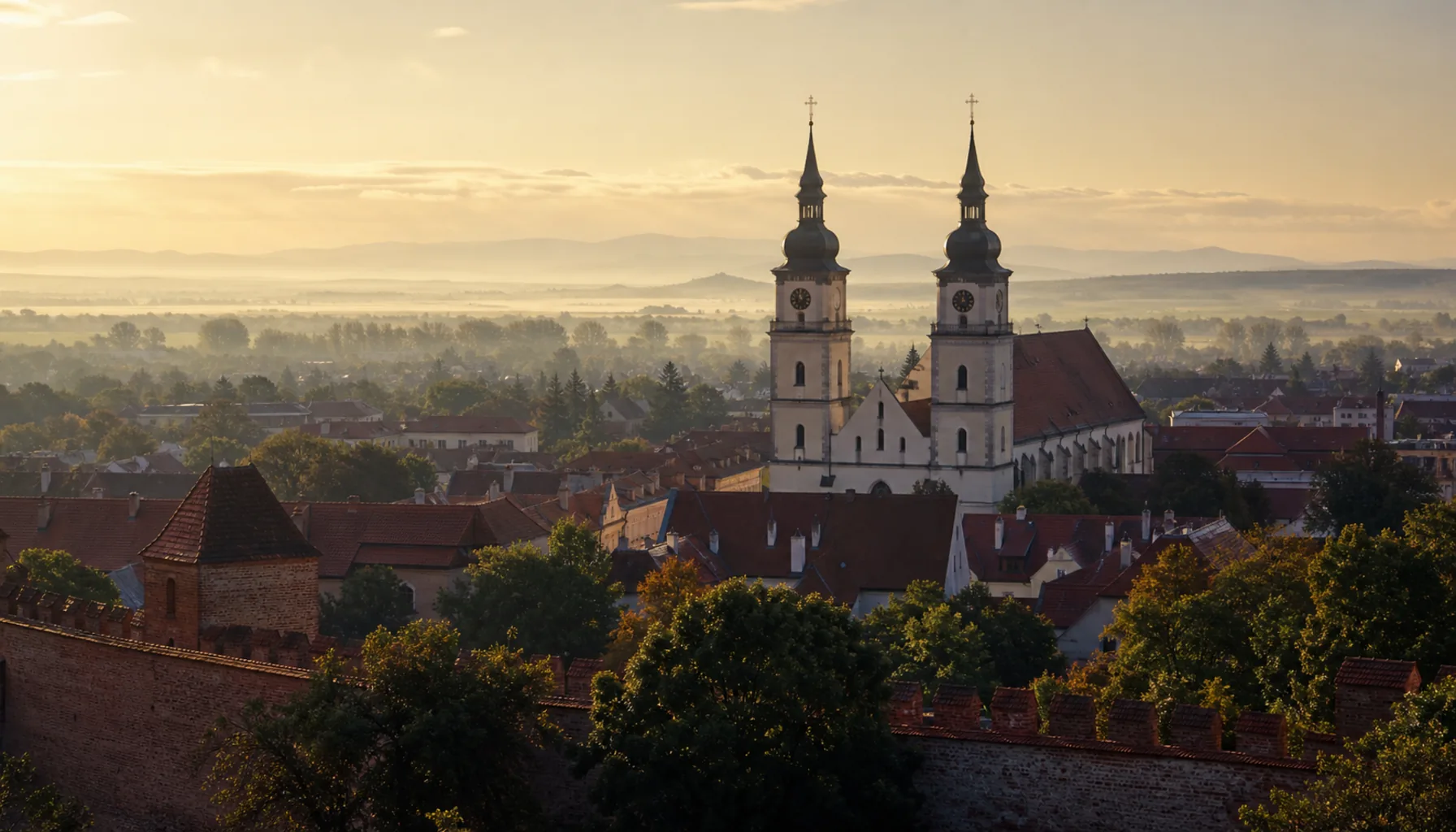
A town on the main road between Buda and Prague is a convenient place for two kings to meet halfway, and Trnava became exactly that. In 1327 Charles I of Hungary and John of Luxembourg, king of Bohemia, agreed a currency treaty here; in 1360 Louis I signed a pact of friendship with Emperor Charles IV in the town. Louis came back for the last time in 1382 — he died in Trnava, which is a rare distinction for a town with no royal castle. None of this made Trnava powerful; it made it useful, and useful towns get charters confirmed, walls finished and churches enlarged. The twin-towered Gothic parish church of St Nicholas, on the highest point inside the walls, grew in these centuries into the building that would later be treated as a cathedral.Mesto na hlavnej ceste medzi Budínom a Prahou je pohodlné miesto, kde sa dvaja králi stretnú na polceste — a presne tým sa Trnava stala. V roku 1327 tu uzavreli menovú zmluvu uhorský kráľ Karol I. a český kráľ Ján Luxemburský, v roku 1360 podpísal Ľudovít I. v meste dohodu o priateľstve s cisárom Karolom IV. Ľudovít sa sem naposledy vrátil v roku 1382 — v Trnave zomrel, čo je na mesto bez kráľovského hradu vzácnosť. Nič z toho neurobilo Trnavu mocnou; urobilo ju užitočnou, a užitočným mestám sa výsady potvrdzujú, hradby dostavujú a kostoly zväčšujú. Dvojvežový gotický farský Kostol sv. Mikuláša na najvyššom mieste vnútri hradieb vyrástol práve v týchto storočiach na stavbu, s ktorou sa neskôr bude zaobchádzať ako s katedrálou.
The Hussites were the armies of the Czech religious reform movement, and their columns raided deep into the kingdom for two decades. On 28 April 1430 a Hussite force beat a Hungarian army near Trnava, and then on 24 June 1432 a party of them got inside the walls disguised as tradesmen and took the town outright. They held it until 1435 and used it as their base in north-western Hungary — three years in which a free royal town of the Catholic kingdom was run by Czech heretics. Afterwards the town's German-speaking majority thinned and Slovak speech gained ground; historians link the two, though how directly is still argued. Remember this the next time you hear that a Slovak town was 'destroyed by the Turks': the thing that actually changed Trnava most in the Middle Ages came from the north-west, spoke a language close to its own, and got in by lying at the gate.Husiti boli vojská českého náboženského reformného hnutia a ich oddiely dve desaťročia podnikali výpravy hlboko do kráľovstva. 28. apríla 1430 porazilo husitské vojsko pri Trnave uhorskú armádu a 24. júna 1432 sa skupina husitov dostala za hradby prezlečená za kupcov a mesto rovno obsadila. Držali ho až do roku 1435 a robili si z neho základňu v severozápadnom Uhorsku — tri roky, počas ktorých slobodné kráľovské mesto katolíckeho kráľovstva spravovali českí kacíri. Nemecky hovoriaca väčšina sa potom v meste stenčila a slovenčina získala prevahu; historici to spolu spájajú, hoci ako priamo, o tom sa dodnes vedie spor. Spomeňte si na to, keď zase raz budete počuť, že slovenské mesto „zničili Turci“: to, čo Trnavu v stredoveku zmenilo najviac, prišlo od severozápadu, hovorilo jazykom blízkym jej vlastnému a dostalo sa dnu tak, že pri bráne klamalo.
After the Hungarian army was destroyed at Mohács in 1526 the Ottoman frontier moved steadily north. Esztergom, seat of the archbishop who was the highest churchman in the kingdom, fell to the Ottomans in 1543, and the archbishop and his chapter — the college of senior priests who ran the cathedral and its estates — crossed the Danube and settled in Trnava. They stayed for nearly three hundred years. Bratislava got the parliament and the coronations; Trnava got the church, and with it the schools, the printers, the libraries and the money that follow a church around. St Nicholas became the working cathedral of the archbishops of Esztergom until 1820, church after church went up inside the small walled circuit, and people began calling the place the little Rome — the nickname the town still uses today.Po zničení uhorského vojska pri Moháči v roku 1526 sa osmanská hranica posúvala stále na sever. Ostrihom, sídlo arcibiskupa, ktorý bol najvyšším cirkevným hodnostárom kráľovstva, padol Osmanom v roku 1543 a arcibiskup so svojou kapitulou — zborom vyšších kňazov, ktorý spravoval katedrálu a jej majetky — prešiel cez Dunaj a usadil sa v Trnave. Zostali tu takmer tristo rokov. Bratislava dostala snem a korunovácie, Trnava dostala cirkev — a s ňou školy, tlačiarne, knižnice a peniaze, ktoré cirkev všade sprevádzajú. Kostol sv. Mikuláša slúžil ako katedrála ostrihomských arcibiskupov až do roku 1820, vnútri malého hradbového okruhu pribúdal kostol za kostolom a ľudia začali mestu hovoriť malý Rím — prezývka, ktorú Trnava používa dodnes.
The man who turned a refuge into a capital was Archbishop Mikuláš Oláh. On 18 August 1561 work began on a Jesuit college — the Jesuits were the new teaching order of the Catholic Reformation, and their weapon was the classroom, in a kingdom where most towns and most nobles had by then turned Lutheran. From 1562 Oláh built himself an Archbishop's Palace, and in 1566 he founded a seminary to train priests; that seminary building now houses the Museum of Book Culture, which is exactly the right subject for it, because in 1577 the priest Mikuláš Telegdi set up a printing house in the town. The citizens meanwhile began their own Renaissance city tower over the main square in 1574; its viewing gallery is 143 steps up and still open. Within a generation Trnava had a school system, a press and a skyline — the physical equipment of a church capital.Človek, ktorý z útočiska urobil metropolu, bol arcibiskup Mikuláš Oláh. 18. augusta 1561 sa začalo so stavbou jezuitského kolégia — jezuiti boli nová učiteľská rehoľa katolíckej reformácie a ich zbraňou bola trieda, a to v kráľovstve, kde už väčšina miest i šľachty prestúpila na luteránstvo. Od roku 1562 si Oláh staval arcibiskupský palác a v roku 1566 založil seminár na výchovu kňazov; v jeho budove dnes sídli Múzeum knižnej kultúry, čo je preň presne správna téma, lebo v roku 1577 zriadil v meste tlačiareň kňaz Mikuláš Telegdi. Mešťania si medzitým v roku 1574 začali stavať vlastnú renesančnú mestskú vežu nad hlavným námestím; na jej vyhliadkový ochodzu vedie 143 schodov a chodí sa naň dodnes. Za jednu generáciu mala Trnava školský systém, tlačiareň a panorámu — celú výbavu cirkevnej metropoly.
On 12 May 1635 Cardinal Péter Pázmány founded a university in Trnava, with faculties of philosophy and theology; law was added in 1667 and medicine in 1769. For 142 years it was the only university in the whole Kingdom of Hungary, and its press turned Trnava into the printing capital of the country — including books written in a Slovakised literary language, which is one reason the university matters to Slovak history and not only to Catholic history. Pázmány had already endowed a hostel in 1619, the Adalbertinum, so that poorer students could afford to come; it is the only building of the old university still used for teaching today. Beside the college rose the university church of St John the Baptist, built 1629–1637 — the first Baroque church in Slovakia, with a carved wooden main altar 20.3 metres high and 14.8 metres wide, among the largest early-Baroque altars in Europe.12. mája 1635 založil kardinál Peter Pázmaň v Trnave univerzitu s filozofickou a teologickou fakultou; právnická pribudla v roku 1667 a lekárska v roku 1769. Stoštyridsaťdva rokov bola jedinou univerzitou v celom Uhorskom kráľovstve a jej tlačiareň spravila z Trnavy tlačiarenskú metropolu krajiny — vychádzali tu aj knihy v poslovenčenej spisovnej reči, a práve preto patrí táto univerzita do slovenských dejín, nielen do dejín katolíckej cirkvi. Pázmaň už v roku 1619 založil konvikt Adalbertinum, aby si štúdium mohli dovoliť aj chudobnejší žiaci; je to jediná budova starej univerzity, v ktorej sa učí dodnes. Vedľa kolégia vyrástol univerzitný Kostol sv. Jána Krstiteľa, stavaný v rokoch 1629 – 1637 — prvý barokový kostol na Slovensku, s dreveným hlavným oltárom vysokým 20,3 metra a širokým 14,8 metra, jedným z najväčších ranobarokových oltárov v Európe.
The seventeenth century punished Trnava twice over. On 23 June 1666 a fire burned through almost the whole town and killed sixteen people; a town packed inside three kilometres of wall is a town that burns well. Then came the kuruc risings — the revolts of Hungarian nobles and their peasant soldiers against Habsburg rule — and on 26 December 1704 the army of Francis II Rákóczi was decisively beaten by imperial troops near Trnava, one of the turning points of that war. You can read the religious side of the same struggle in a single building: the church on Kapitulská was begun in 1635 as a Calvinist hall church without a tower, was only finished in 1646 after repeated bans, and in 1671 was taken from the Protestants and handed to the Catholic Pauline order. Plague swept the kingdom in 1709–1710 on the heels of the fighting, as it always did.Sedemnáste storočie potrestalo Trnavu dvakrát. 23. júna 1666 prehorel mestom požiar, ktorý zničil takmer celé a usmrtil šestnásť ľudí; mesto natlačené do trojkilometrového hradbového okruhu horí dobre. Potom prišli kuruci — povstalecké vojská uhorskej šľachty a jej sedliackych vojakov proti habsburskej vláde — a 26. decembra 1704 cisárske vojsko pri Trnave rozhodujúco porazilo armádu Františka II. Rákociho, čo bol jeden zo zlomov tejto vojny. Náboženskú stránku toho istého zápasu si môžete prečítať na jedinej stavbe: kostol na Kapitulskej sa začal stavať v roku 1635 ako kalvínsky bezvežový sieňový kostol, dokončili ho pre opakované zákazy až v roku 1646 a v roku 1671 ho protestantom vzali a odovzdali katolíckej reholi paulínov. Po bojoch prešiel v rokoch 1709 – 1710 kráľovstvom mor, ako vždy.
Almost everything a visitor photographs in Trnava was built in this long Catholic century. The Holy Trinity statuary went up on the main square in 1695 — locals call it simply Trojička, and the square is named after it. The Trinitarian church was begun in 1720 and carries a huge main-altar canvas by the Austrian painter F. A. Maulbertsch; the Ursuline nuns laid the foundation stone of St Anne's, the youngest church in the centre, in 1774. The Franciscan church of St James, rebuilt in 1633–1640 and topped with its tower in 1712–1717, holds fourteen altars, more than any other church in town. Even the town hall got its present face — a street balcony on heavy stone columns — in the rebuilding of 1791.Takmer všetko, čo si návštevník v Trnave odfotí, vzniklo v tomto dlhom katolíckom storočí. Súsošie Najsvätejšej Trojice postavili na hlavnom námestí v roku 1695 — Trnavčania mu hovoria jednoducho Trojička a námestie sa volá podľa neho. Kostol Najsvätejšej Trojice začali stavať v roku 1720 a visí v ňom veľké oltárne plátno rakúskeho maliara F. A. Maulbertscha; uršulínky položili základný kameň Kostola sv. Anny, najmladšieho kostola v centre, v roku 1774. Františkánsky Kostol sv. Jakuba, prestavaný v rokoch 1633 – 1640 a zavŕšený vežou v rokoch 1712 – 1717, má štrnásť oltárov — viac než ktorýkoľvek iný kostol v meste. Aj radnica dostala svoju dnešnú tvár, uličný balkón na mohutných kamenných stĺpoch, pri prestavbe v roku 1791.
In 1773 the pope dissolved the Jesuit order across Europe, and the university lost the men who had run it for nearly a century and a half. Four years later, in 1777, Maria Theresa ordered the whole university moved to Buda, closer to the centre of her kingdom. It never came back. A town of perhaps a few thousand people lost its students, its professors, its press orders and the trade that fed on all of them in a single administrative decision — and today's Eötvös Loránd University in Budapest still dates its founding to 1635 in a Slovak town. If you want a lesson in how a place can be unmade without a war, this is it.V roku 1773 pápež zrušil jezuitskú rehoľu v celej Európe a univerzita prišla o ľudí, ktorí ju takmer poldruha storočia viedli. O štyri roky neskôr, v roku 1777, dala Mária Terézia celú univerzitu presťahovať do Budína, bližšie k stredu kráľovstva. Späť sa už nikdy nevrátila. Mesto s možno niekoľkými tisíckami obyvateľov stratilo jediným úradným rozhodnutím študentov, profesorov, tlačiarenské zákazky aj celý obchod, ktorý sa na nich živil — a dnešná Univerzita Loránda Eötvösa v Budapešti si dodnes počíta založenie od roku 1635 v slovenskom meste. Ak chcete príklad, ako sa dá mesto zlomiť bez vojny, toto je on.
Modern Slovak nationhood begins with a grammar book, and the grammar book begins in this region. The Catholic priest Anton Bernolák standardised a written Slovak in 1787, and he built it on the western dialects spoken around Trnava — the everyday speech of the plain, plus the Slovakised literary language the Trnava presses and seminary had been using for generations. In 1792 he founded the Slovenské učené tovarišstvo, the Slovak Learned Society, with its headquarters in Trnava: the first organisation set up for the single purpose of publishing books in Slovak, for Slovak readers. Bernolák's standard did not win in the end — in the 1840s Ľudovít Štúr's central-Slovak version replaced it — but it proved the thing could be done at all. Trnava's three centuries of priests and printers are the reason the first attempt happened here rather than anywhere else.Moderný slovenský národ sa začína gramatikou a tá gramatika sa začína v tomto kraji. Katolícky kňaz Anton Bernolák uzákonil spisovnú slovenčinu v roku 1787 a postavil ju na západoslovenských nárečiach spod Trnavy — na bežnej reči roviny a na poslovenčenej spisovnej reči, ktorú trnavské tlačiarne a seminár používali celé generácie. V roku 1792 založil Slovenské učené tovarišstvo so sídlom v Trnave: prvý spolok, ktorý vznikol jedine preto, aby vydával knihy po slovensky pre slovenských čitateľov. Bernolákova slovenčina nakoniec neprevládla — v 40. rokoch 19. storočia ju nahradila stredoslovenská štúrovčina —, ale dokázala, že sa to vôbec dá. Tri storočia trnavských kňazov a tlačiarov sú dôvod, prečo sa prvý pokus odohral práve tu.
In 1820 Archbishop Alexander Rudnay moved the seat of the archbishopric back to Esztergom, at the emperor's personal request. Trnava had now lost both the things that made it: the university in 1777, the church in 1820. Rudnay is worth knowing anyway — he was born at Považany, he made sure Slovak parishes got Slovak priests, and the sentence attributed to him is one every Slovak schoolchild meets: Slavus sum, et si in cathedra Petri forem, Slavus ero, 'I am a Slav, and I shall remain a Slav even if I sit in the chair of St Peter.' The decades that followed were hard: between 1 August and 24 September 1831 a cholera epidemic killed over 800 people in the town in two months. The one bright thing was that the citizens paid out of their own pockets for a theatre in 1831 — the oldest purpose-built theatre of its kind in Slovakia, still working today — and in December 1848 Austrian troops drove the Hungarian revolutionary army of Richárd Guyon back from the town.V roku 1820 preniesol arcibiskup Alexander Rudnay sídlo arcibiskupstva späť do Ostrihomu — na osobnú žiadosť cisára. Trnava tak prišla o obe veci, ktoré ju robili Trnavou: o univerzitu v roku 1777 a o cirkev v roku 1820. Rudnaya si aj tak treba pamätať: narodil sa v Považanoch, dbal na to, aby slovenské farnosti mali slovenských kňazov, a veta, ktorá sa mu pripisuje, patrí k tým, čo pozná každý slovenský školák: Slavus sum, et si in cathedra Petri forem, Slavus ero — „Slovák som, a keby som mal sedieť na Petrovom stolci, Slovákom zostanem.“ Ďalšie desaťročia boli ťažké: od 1. augusta do 24. septembra 1831 zabila v meste epidémia cholery za dva mesiace vyše 800 ľudí. Jediné svetlé miesto bolo, že si mešťania v roku 1831 z vlastných peňazí postavili divadlo — najstaršie účelovo postavené divadlo svojho druhu na Slovensku, ktoré hrá dodnes — a v decembri 1848 odrazili rakúske vojská od mesta maďarskú revolučnú armádu Richárda Guyona.
Trnava was rescued not by a king but by a railway. The Kingdom of Hungary's first railway line was a horse-drawn one out of Bratislava: the first stretch, to Svätý Jur, opened in 1840, the line reached Trnava on 1 June 1846, and it was pushed on to Sereď that December. Horses pulled the wagons along iron rails at walking pace — cheap, slow and revolutionary. On 1 May 1873 the first steam train ran into Trnava station on the rebuilt line, and from then on the town was ninety minutes from the capital. Factories followed the rails, the population went from 7,741 in 1857 to 11,500 in 1890 to 15,163 by 1910, and Trnava turned from a shrinking church town into an industrial one — the shape it still has.Trnavu nezachránil kráľ, ale železnica. Prvou železničnou traťou v Uhorsku bola konská dráha z Bratislavy: prvý úsek do Svätého Jura otvorili v roku 1840, do Trnavy dorazila trať 1. júna 1846 a v decembri toho roku pokračovala do Serede. Vozne ťahali po železných koľajniciach kone krokom — lacno, pomaly a prevratne. 1. mája 1873 vošiel do trnavskej stanice po prestavanej trati prvý parný vlak a mesto bolo odvtedy hodinu a pol od hlavného mesta. Za koľajnicami prišli fabriky, počet obyvateľov stúpol zo 7 741 v roku 1857 na 11 500 v roku 1890 a na 15 163 v roku 1910 a z upadajúceho cirkevného mesta sa stalo priemyselné — a tú podobu má dodnes.
Austria-Hungary after 1867 pushed hard to make everyone in the Hungarian half Hungarian — Slovak grammar schools were closed, Matica slovenská was shut down in 1875, and school laws punished teaching in Slovak. Against that, the Spolok svätého Vojtecha — the St Adalbert Society — was founded in Trnava in 1870 to publish Slovak books, calendars and prayer books for ordinary Catholic readers; for decades it was the most important Slovak-language institution left standing, and it is still based in the town. In 1900 the town laid out its third calvary, fourteen stations by the architect Jozef Kadlec, on the site of a Baroque cemetery of 1747.Rakúsko-Uhorsko po roku 1867 tvrdo presadzovalo, aby sa z každého v uhorskej polovici stal Maďar — slovenské gymnáziá zatvorili, Maticu slovenskú v roku 1875 zrušili a školské zákony trestali vyučovanie po slovensky. Proti tomu vznikol v roku 1870 v Trnave Spolok svätého Vojtecha, aby vydával slovenské knihy, kalendáre a modlitebné knižky pre obyčajných katolíckych čitateľov; celé desaťročia bol najdôležitejšou slovenskou inštitúciou, ktorá zostala stáť, a sídli v meste dodnes. V roku 1900 si mesto vybudovalo tretiu kalváriu so štrnástimi zastaveniami od architekta Jozefa Kadleca na mieste barokového cintorína z roku 1747.
No front line came near Trnava, and no battle was fought here. What the First World War meant in a town like this was conscription — the men went into Austro-Hungarian regiments and a large number of them did not come back — plus requisitioning, shortages and four years of a war economy on the railway that had just made the town prosperous. The censuses on either side of it are almost flat: 15,163 people in 1910, 15,599 in 1919. The real change was not to the town but to the state it belonged to: in the autumn of 1918 Austria-Hungary collapsed, and Trnava, which had been in the Kingdom of Hungary for nine hundred years, found itself in Czechoslovakia without moving an inch.K Trnave sa nepriblížil nijaký front a nebola tu zvedená ani jedna bitka. Prvá svetová vojna znamenala v takomto meste odvody — muži narukovali do rakúsko-uhorských plukov a mnohí sa nevrátili —, k tomu rekvirácie, nedostatok a štyri roky vojnového hospodárstva na železnici, ktorá mestu práve priniesla blahobyt. Sčítania po oboch stranách vojny sú takmer rovnaké: 15 163 obyvateľov v roku 1910, 15 599 v roku 1919. Skutočná zmena sa netýkala mesta, ale štátu, do ktorého patrilo: na jeseň 1918 sa Rakúsko-Uhorsko rozpadlo a Trnava, ktorá bola deväťsto rokov súčasťou Uhorska, sa ocitla v Československu bez toho, aby sa čo len pohla.
Czechoslovakia was good to Trnava. Slovak became the language of the schools and the offices, which in this town meant an existing Slovak-speaking majority finally being educated in its own language, and the factories along the railway made Trnava one of the most industrialised towns in the republic and its third-largest city in Slovakia. The population climbed from about 15,000 in 1910 to about 26,000 by 1940. The town built for itself in the new style: the three-towered Lutheran church of 1924 by the architect Jozef Marko, laid out in a semicircle so that everything faces the pulpit and carrying the only carillon in Trnava, and the fifty-metre concrete water tower by Emil Belluš, the founder of modern Slovak architecture, which still supplies the city today. This was also the era of the composer Mikuláš Schneider-Trnavský, who put the town's name into his own.Československo bolo k Trnave dobré. Slovenčina sa stala jazykom škôl a úradov, čo v tomto meste znamenalo, že už existujúca slovenská väčšina sa konečne mohla vzdelávať vo vlastnej reči, a fabriky pri železnici spravili z Trnavy jedno z najpriemyselnejších miest republiky a tretie najväčšie mesto na Slovensku. Počet obyvateľov stúpol z približne 15 000 v roku 1910 na asi 26 000 do roku 1940. Mesto si stavalo v novom slohu: trojvežový evanjelický kostol z roku 1924 od architekta Jozefa Marka, vnútri polkruhový, aby všetko smerovalo ku kazateľnici, s jedinou zvonkohrou v Trnave, a päťdesiatmetrový betónový vodojem od Emila Belluša, zakladateľa modernej slovenskej architektúry, ktorý mesto zásobuje vodou dodnes. Bola to aj éra skladateľa Mikuláša Schneidra-Trnavského, ktorý si meno mesta pridal k vlastnému.
On 14 March 1939, under direct pressure from Hitler, Slovakia declared itself an independent state. It was a client of Nazi Germany, with one legal party, a uniformed militia — the Hlinka Guard — on the streets, and German advisers inside its ministries.14. marca 1939 vyhlásilo Slovensko pod priamym Hitlerovým nátlakom samostatný štát. Bol to klient nacistického Nemecka: jediná povolená strana, uniformovaná Hlinkova garda na uliciach a nemeckí poradcovia vo vnútri ministerstiev.
The Slovak National Uprising broke out on 29 August 1944, centred on Banská Bystrica in the mountains. Western Slovakia was flat, full of German troops and impossible to hold — and yet on 30 August 1944 the Trnava garrison became the only garrison in western Slovakia to join the uprising in an organised way, before German forces took control of the whole west within days. The uprising itself was crushed in October, and the last months of the war were the worst: German occupation, the Gestapo, and reprisals against anyone who had helped. The front reached Trnava at the very end — the town was taken by troops of the Soviet 2nd Ukrainian Front on 1 April 1945, and the war in Europe ended five weeks later.Slovenské národné povstanie vypuklo 29. augusta 1944 a jeho centrom bola Banská Bystrica v horách. Západné Slovensko bolo rovina plná nemeckých vojsk a udržať sa nedalo — a predsa sa 30. augusta 1944 trnavská posádka ako jediná západoslovenská posádka organizovane zapojila do povstania, kým Nemci celý západ v priebehu niekoľkých dní neovládli. Samo povstanie potlačili v októbri a posledné mesiace vojny boli najhoršie: nemecká okupácia, gestapo a odplata voči každému, kto pomáhal. Front sa k Trnave dostal celkom na konci — mesto obsadili vojská sovietskeho 2. ukrajinského frontu 1. apríla 1945 a vojna v Európe sa skončila o päť týždňov neskôr.
After the communist takeover of 1948 the factories were nationalised and Trnava was rebuilt as an industrial town. The Trnavské automobilové závody — the Trnava car works, best known for the boxy little Škoda 1203 van — became the town's signature plant, and around the old walls rose the concrete housing estates that most of the city still lives in: Družba, Linčianska, Prednádražie. Twenty-five kilometres away Czechoslovakia built its first nuclear power station at Jaslovské Bohunice: reactor A-1, begun in 1958, went into operation on 25 December 1972 and was shut down for good after a serious accident in February 1977; the newer V-1 units started up from 1978 and were closed in 2006 and 2008 as a condition of Slovakia joining the European Union. Bohunice has been an employer, a worry and an argument in this district for fifty years.Po komunistickom prevrate v roku 1948 fabriky znárodnili a Trnavu prebudovali na priemyselné mesto. Trnavské automobilové závody — najznámejšie hranatou dodávkou Škoda 1203 — sa stali podnikom, s ktorým sa mesto stotožnilo, a okolo starých hradieb vyrástli panelové sídliská, na ktorých býva väčšina Trnavčanov dodnes: Družba, Linčianska, Prednádražie. Dvadsaťpäť kilometrov odtiaľto postavilo Československo svoju prvú atómovú elektráreň v Jaslovských Bohuniciach: reaktor A-1, začatý v roku 1958, spustili 25. decembra 1972 a po ťažkej havárii vo februári 1977 ho natrvalo odstavili; novšie bloky V-1 nabehli od roku 1978 a zatvorili ich v rokoch 2006 a 2008 ako podmienku vstupu Slovenska do Európskej únie. Bohunice sú v tomto okrese päťdesiat rokov zamestnávateľom, obavou aj témou sporu.
For six seasons around 1970 the best football team in Czechoslovakia came from a town of forty thousand people. Spartak Trnava, founded in 1923 and nicknamed the White Angels, won five Czechoslovak league titles between 1968 and 1973 and reached the semi-final of the European Cup — the competition now called the Champions League — in the 1968–69 season. In a country where almost everything was decided in Prague or Bratislava, this was a thing Trnava had entirely for itself, and it is still the first thing many Slovaks think of when the town is named. The ground is now the Anton Malatinský Stadium, and what the town eventually built around it is the strangest thing on this whole timeline.Šesť sezón okolo roku 1970 mal najlepší futbalový klub Československa štyridsaťtisícové mesto. Spartak Trnava, založený v roku 1923 a prezývaný bieli anjeli, získal v rokoch 1968 až 1973 päť československých majstrovských titulov a v sezóne 1968/69 sa prebojoval do semifinále Pohára majstrov európskych krajín — súťaže, ktorá sa dnes volá Liga majstrov. V krajine, kde sa takmer všetko rozhodovalo v Prahe alebo Bratislave, to bola vec, ktorú mala Trnava celkom pre seba, a mnohým Slovákom sa pri mene mesta vybaví ako prvá. Ihrisko sa dnes volá Štadión Antona Malatinského a to, čo okolo neho mesto napokon postavilo, je najzvláštnejšia vec na celej tejto časovej osi.
Here is something few people expect from the communist years. Slovak dioceses were still formally attached to Esztergom in Hungary — a leftover of the old kingdom that had survived the end of Austria-Hungary by nearly sixty years. In 1977 Pope Paul VI cut that link and created a Slovak church province with its metropolitan seat at Trnava, the town where the archbishops of Esztergom had lived in exile from 1543 to 1820. So Trnava got its archbishop back, 157 years after losing him, and it happened under a government that was officially atheist and had spent the 1950s imprisoning priests and dissolving religious orders. The seat of the metropolitan moved on to Bratislava in 2008, but Trnava remains an archdiocese.Toto by od komunistických čias málokto čakal. Slovenské diecézy stále formálne patrili pod Ostrihom v Maďarsku — pozostatok starého kráľovstva, ktorý prežil zánik Rakúsko-Uhorska o takmer šesťdesiat rokov. V roku 1977 pápež Pavol VI. túto väzbu prerušil a zriadil slovenskú cirkevnú provinciu s metropolitným sídlom v Trnave — v meste, kde ostrihomskí arcibiskupi v exile žili od roku 1543 do roku 1820. Trnava tak dostala arcibiskupa späť 157 rokov po tom, čo oň prišla, a stalo sa to za vlády, ktorá bola oficiálne ateistická a v 50. rokoch väznila kňazov a rušila rehole. Sídlo metropolitu sa v roku 2008 presunulo do Bratislavy, Trnava však zostáva arcibiskupstvom.
In November 1989 the crowds that brought down the communist government in Prague and Bratislava gathered in Trnava too, on Trojičné námestie under the city tower. What the town did with its freedom says a great deal about it: within three years it had a university again. Trnava University was re-established in 1992, taking the name and the descent of Pázmány's foundation of 1635 — and it teaches in the Adalbertinum, the student hostel of 1619, which makes that building's teaching history one of the longest in Central Europe. The University of Ss. Cyril and Methodius followed in 1997. After 215 years, a town that had lost its university to an imperial decree simply started another one.V novembri 1989 sa davy, ktoré v Prahe a Bratislave zvrhli komunistickú vládu, zišli aj v Trnave — na Trojičnom námestí pod mestskou vežou. Čo mesto so slobodou urobilo, o ňom veľa hovorí: do troch rokov malo znova univerzitu. Trnavská univerzita bola obnovená v roku 1992, prevzala meno aj tradíciu Pázmaňovho založenia z roku 1635 — a učí v Adalbertine, študentskom konvikte z roku 1619, čím sa tá budova radí k stavbám s najdlhšou nepretržitou učiteľskou minulosťou v strednej Európe. V roku 1997 pribudla Univerzita sv. Cyrila a Metoda. Po 215 rokoch si mesto, ktoré o univerzitu prišlo cisárskym rozhodnutím, jednoducho založilo ďalšiu.
Slovakia became independent on 1 January 1993, and on 25 August 1996 Trnava became the capital of one of its new regions. The socialist car works had collapsed, and the town's biggest gamble was to bet on cars a second time: the French group PSA Peugeot Citroën chose the site in January 2003, laid the first stone that June, and volume production began in May 2006. The plant — now part of Stellantis — was designed for 300,000 cars a year and passed that in 2015; it employs several thousand people, which in a town this size shapes everything from the housing market to the bus timetable. And in 2015 the town did something nobody else has: it built the City Aréna, where a shopping centre and the stands of Spartak's first-division stadium are one and the same building, a few hundred metres from a walled old town so full of churches it has been called the Slovak Rome for four hundred years.Slovensko sa osamostatnilo 1. januára 1993 a 25. augusta 1996 sa Trnava stala krajským mestom. Socialistická automobilka medzitým zanikla a najväčšia stávka mesta bola vsadiť na autá druhý raz: francúzska skupina PSA Peugeot Citroën si pozemok vybrala v januári 2003, v júni položila základný kameň a sériová výroba sa rozbehla v máji 2006. Závod — dnes súčasť koncernu Stellantis — bol projektovaný na 300 000 áut ročne a v roku 2015 tento počet prekonal; zamestnáva niekoľko tisíc ľudí, čo v meste tejto veľkosti ovplyvňuje všetko od cien bývania po cestovné poriadky autobusov. A v roku 2015 mesto urobilo niečo, čo nikto iný: postavilo City Arénu, kde sú nákupné centrum a tribúny ligového štadióna Spartaka jedna a tá istá stavba — pár sto metrov od opevneného starého mesta, ktoré je pre množstvo kostolov už štyristo rokov nazývané slovenským Rímom.
Sources consulted while researching this page. Follow them to read further — and to check us.Zdroje, z ktorých sme pri príprave tejto stránky vychádzali. Kliknite a čítajte ďalej — aj si nás overte.
Sixteen videos — history, Trnava.Šestnásť videí — dejiny, Trnava.