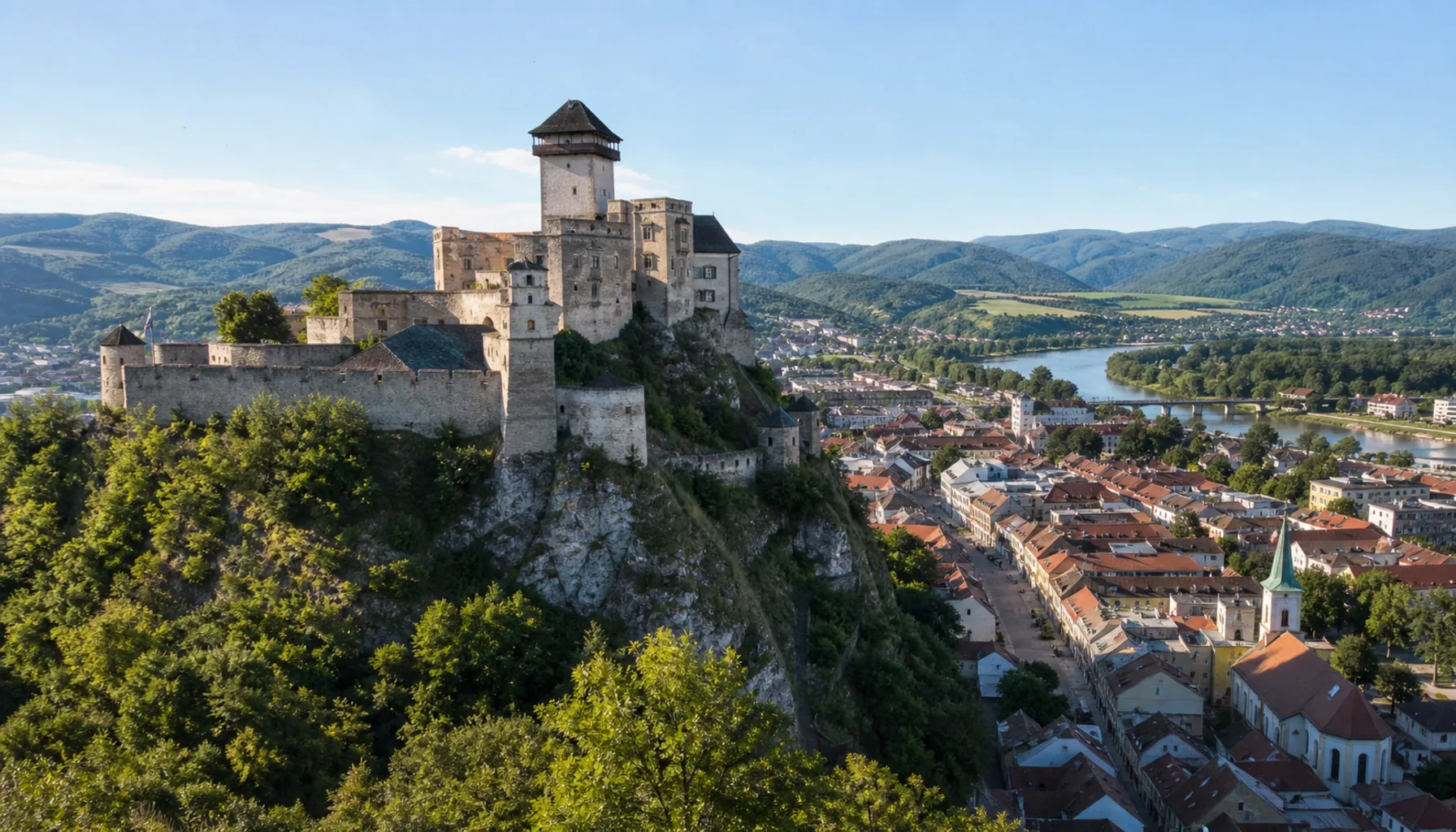
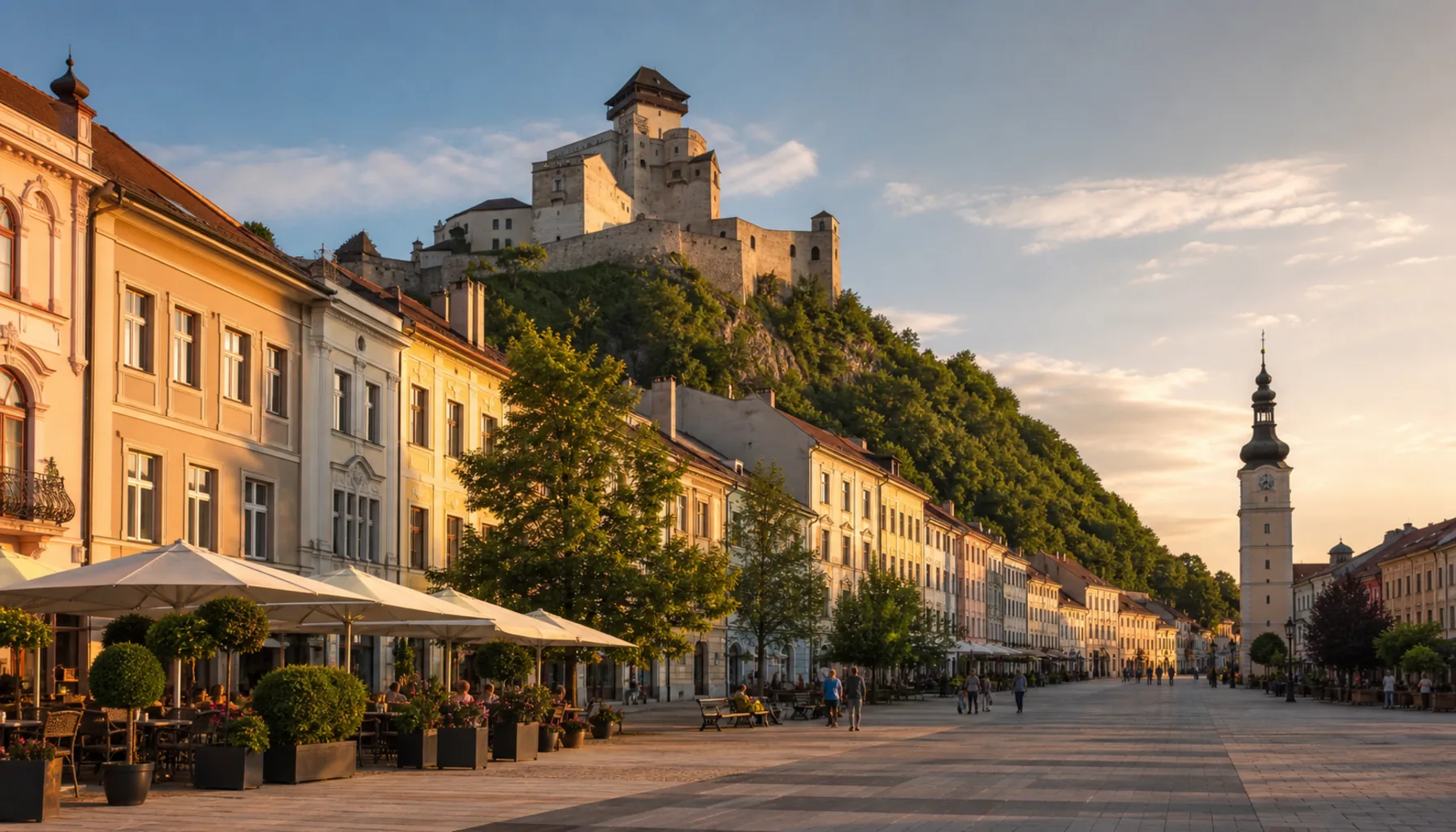
Only what belongs to Trenčín — each on its own page.Len to, čo patrí k mestu Trenčín — každé s vlastnou stránkou.
Pick a year to see what was happening here then.Vyberte rok a uvidíte, čo sa tu vtedy dialo.
Rome never ruled this valley — the frontier of the empire stayed down on the Danube. But during the Marcomannic Wars, the long fight against the Germanic Quadi and Marcomanni, a detachment of the Second Legion wintered here in the year 179 at a place the Romans called Laugaricio, and had a victory inscription cut into the cliff below the castle rock. It records 855 soldiers and the officer who ordered the work, the legion's commander Maximianus. That panel is the oldest written record of a place on Slovak soil that still stands exactly where it was cut — not in a museum, not copied into a chronicle, but on the rock it names. A building later grew against the cliff and now encloses it, so seeing the inscription means asking downstairs in the town rather than buying a castle ticket.Rím toto údolie nikdy neovládol — hranica ríše zostala dole na Dunaji. Počas markomanských vojen, dlhého zápasu s germánskymi Kvádmi a Markomanmi, tu však v roku 179 prezimoval oddiel II. légie na mieste, ktoré Rimania volali Laugaricio, a dal do skaly pod hradným bralom vytesať nápis o víťazstve. Spomína 855 vojakov a dôstojníka, ktorý nápis dal zhotoviť — veliteľa légie Maximiána. Je to najstarší písomný záznam o mieste na Slovensku, ktorý sa zachoval presne tam, kde ho vytesali: nie v múzeu a nie odpísaný v kronike, ale na skale, ktorú pomenúva. Ku skale neskôr pribudla budova, ktorá nápis uzatvára, takže sa zaň nechodí cez hradnú pokladnicu — treba sa pýtať dole v meste.
After Rome, the rock kept its job: it watches the road up the Váh, and whoever sat on it controlled the valley. In the ninth century, the century of Great Moravia, a small round church with four apses — shallow niches set round the circle — stood up here. Slovak archaeologists date it to that Great Moravian century and treat it as the oldest building on the hill; other descriptions call it Romanesque, which would make it some two hundred years younger. Both readings are in print, and the honest answer is that bare footings are hard to date. It is worth knowing that historians argue like this — a ruin does not come with a label on it.Po Rimanoch si bralo svoju úlohu podržalo: stráži cestu proti prúdu Váhu a kto na ňom sedel, ovládal celé údolie. V 9. storočí, v storočí Veľkej Moravy, tu stál malý okrúhly kostolík so štyrmi apsidami — plytkými výklenkami rozloženými po obvode. Slovenskí archeológovia ho datujú práve do veľkomoravského storočia a pokladajú ho za najstaršiu stavbu na kopci; inde sa opisuje ako románsky, čo by ho omladilo asi o dvesto rokov. Obe verzie sa dajú nájsť v literatúre a poctivá odpoveď znie, že holé základy sa datujú ťažko. Aj toto sa oplatí vedieť: zrúcanina neprichádza s menovkou.
When the kingdom of Hungary divided the country into counties, Trenčín got one of them, and the castle on the rock became its seat — the place where the king's župan, the county count, held court, collected dues and kept order. The name of the town appears in writing for the first time in the two Zobor charters of 1111 and 1113, the oldest documents preserved in Slovakia, in the forms Treinchen and Trenciniensis. Be careful with a date like that: it tells you when a monk wrote the name down, not when people arrived. The settlement under the rock was already old by then, living off the road and the river crossing.Keď sa Uhorské kráľovstvo rozdelilo na stolice, Trenčín dostal jednu z nich a hrad na brale sa stal jej sídlom — miestom, kde kráľovský župan súdil, vyberal dávky a dbal na poriadok. Meno mesta sa po prvý raz objavuje v písomnostiach v dvoch zoborských listinách z rokov 1111 a 1113, najstarších dokumentoch zachovaných na Slovensku, v tvaroch Treinchen a Trenciniensis. S takýmto dátumom treba narábať opatrne: hovorí o tom, kedy meno zapísal mních, nie o tom, odkedy tu ľudia žijú. Osada pod bralom bola vtedy už dávno stará a živila sa cestou a brodom cez Váh.
In 1241 the Mongol armies destroyed the royal army at Mohi and then spent a year riding across the kingdom, burning whatever would burn. The town of Trenčín was built of wood and was among the places they wrecked; the castle on the rock, held for the king by a count remembered as Bohumír, was not taken. That difference is the whole lesson of 1241. King Béla IV came back from hiding and pushed the kingdom to build in stone, and the Váh valley above and below Trenčín filled with the stone castles you can still walk to today — Beckov, Čachtice, Tematín, Považský hrad. Most of them are there because of the Mongols, not in spite of them.V roku 1241 rozdrvili mongolské vojská kráľovskú armádu pri Mohi a potom celý rok prechádzali krajinou a pálili všetko, čo horelo. Trenčianske mesto bolo drevené a ľahlo popolom; hrad na brale, ktorý pre kráľa držal župan pripomínaný ako Bohumír, nedobyli. V tom rozdiele je celé poučenie roku 1241. Kráľ Belo IV. sa vrátil z úkrytu a prinútil krajinu stavať z kameňa — a Považie nad Trenčínom aj pod ním sa zaplnilo kamennými hradmi, ku ktorým sa dá dodnes vyjsť pešo: Beckov, Čachtice, Tematín, Považský hrad. Väčšina z nich stojí kvôli Mongolom, nie napriek nim.
The castle came to the Čák family after 1275, and under Matúš Čák it became the capital of something very close to a private country. Historians call men like him oligarchs: great lords who ran whole provinces as their own, with their own officials, their own armies and their own courts, obeying the king only when it suited them. Matúš held the office of palatine — the highest post in the kingdom — twice, and ignored the crown in between. On 15 June 1312 King Charles Robert beat him at Rozhanovce near Košice, and after that he could never attack the king again, though his lands stayed his until he died here on 18 March 1321. The royal army took the whole domain back within months; what survived was the title Slovak tradition gave him, the Lord of the Váh and the Tatras.Hrad sa po roku 1275 dostal Čákovcom a za Matúša Čáka sa z neho stalo hlavné mesto čohosi, čo sa už veľmi podobalo na samostatnú krajinu. Historici takýchto pánov nazývajú oligarchami: veľmoži, ktorí spravovali celé kraje ako svoje vlastné, s vlastnými úradníkmi, vojskom aj súdmi, a kráľa poslúchali len vtedy, keď sa im to hodilo. Matúš bol dvakrát palatínom — najvyšším hodnostárom kráľovstva — a medzitým na panovníka nedbal. 15. júna 1312 ho kráľ Karol Róbert porazil pri Rozhanovciach neďaleko Košíc a odvtedy už na kráľa zaútočiť nedokázal, hoci jeho panstvo mu zostalo až do smrti 18. marca 1321 práve tu, v Trenčíne. Kráľovské vojsko získalo celé územie do niekoľkých mesiacov späť; prežil titul, ktorý mu dala slovenská tradícia — pán Váhu a Tatier.
With Čák gone, the king had to make the town useful rather than dangerous. In 1324 its people were freed from paying tolls, which for a market town on the main road north was worth more than any length of wall. Eleven years later Trenčín was chosen as the place to settle a quarrel between three kings: in 1335 the envoys of Bohemia, Poland and Hungary agreed here that the Polish king would drop his claim to Silesia and the Bohemian king his claim to the Polish crown. The bargain was confirmed at the famous meeting of the three kings at Visegrád later that same year. A town is picked for something like that when it is safe, reachable and important — Trenčín was all of those.Po Čákovi musel kráľ z mesta urobiť skôr oporu než hrozbu. V roku 1324 oslobodil jeho obyvateľov od platenia mýta, čo pre trhové mesto na hlavnej ceste na sever znamenalo viac než ktorýkoľvek kus hradieb. O jedenásť rokov neskôr si Trenčín vybrali za miesto, kde sa urovná spor troch kráľov: v roku 1335 sa tu vyslanci Čiech, Poľska a Uhorska dohodli, že poľský kráľ sa vzdá nárokov na Sliezsko a český kráľ nárokov na poľskú korunu. Dohodu ešte v tom istom roku potvrdilo slávne stretnutie troch kráľov vo Visegráde. Na takúto vec si mesto vyberú vtedy, keď je bezpečné, dostupné a dôležité — a Trenčín taký vtedy bol.
In 1412 King Sigismund of Luxembourg raised Trenčín to a free royal town and gave it the same rights the citizens of Buda enjoyed. The words matter more than they look. A free royal town answered to the king alone and to no local lord; it elected its own council, ran its own court, held its own markets and built its own walls. For the burghers under the rock that meant the man up in the castle could no longer treat them as his tenants. Trenčín kept that rank for four and a half centuries, until the reforms of the nineteenth century swept the old charters away.V roku 1412 povýšil kráľ Žigmund Luxemburský Trenčín na slobodné kráľovské mesto a dal mu tie isté práva, aké mali mešťania Budína. Na tých slovách záleží viac, než sa zdá. Slobodné kráľovské mesto sa zodpovedalo iba kráľovi, nie miestnemu zemepánovi; volilo si vlastnú radu, súdilo si samo, malo vlastné trhy a stavalo si vlastné hradby. Pre mešťanov pod bralom to znamenalo, že pán hore na hrade s nimi už nemohol zaobchádzať ako so svojimi poddanými. Túto hodnosť si Trenčín udržal štyri a pol storočia — až kým staré výsady nezmietli reformy 19. storočia.
Sigismund gave the castle to his wife, Queen Barbara of Cilli, and in the first third of the fifteenth century had a new palace and chapel built for her; the wing on the upper courtyard still carries her name, alongside Louis's Palace and the Zápoľský Palace. It was not a peaceful century. Hussite columns — the armies of the Czech religious reform — raided deep into the kingdom through the 1420s and 1430s, fighting with field guns and wagon forts, and Trenčín spent decades thickening its defences instead of raising prettier towers. The castle stayed in royal hands until the end of the century, when it passed to Stephen Zápoľský, whose family rebuilt it on a grand scale.Žigmund daroval hrad svojej manželke, kráľovnej Barbore Celjskej, a v prvej tretine 15. storočia jej tu dal postaviť nový palác a kaplnku; krídlo na hornom nádvorí nesie jej meno dodnes, popri Ľudovítovom a Zápoľského paláci. Pokojné storočie to nebolo. Husitské výpravy — vojská českej náboženskej reformy — vpadávali cez dvadsiate a tridsiate roky hlboko do kráľovstva, bojovali s poľnými delami a vozovými hradbami, a Trenčín preto celé desaťročia radšej zosilňoval opevnenie, než by staval krajšie veže. Hrad zostal v kráľovských rukách až do konca storočia, keď ho získal Štefan Zápoľský, a jeho rod ho vo veľkom prestaval.
After the Ottomans destroyed the Hungarian army at Mohács in 1526, two men were crowned king of the same kingdom: Ferdinand of Habsburg and John Zápoľský. Trenčín belonged to the Zápoľský family, so it was on the losing side. Ferdinand's general Katzianer took the castle and the town by force — sources give the year as 1527 or 1528 and do not agree with each other. The Zápoľský palace in the upper courtyard keeps the family's name anyway, which is how castles usually remember their owners: by the rooms they built, not by the way they lost the place.Keď Osmani v roku 1526 pri Moháči zničili uhorské vojsko, dali sa korunovať za kráľa toho istého kráľovstva hneď dvaja muži: Ferdinand Habsburský a Ján Zápoľský. Trenčín patril Zápoľskovcom, takže stál na strane, ktorá prehrala. Ferdinandov generál Katzianer hrad aj mesto dobyl — pramene uvádzajú raz rok 1527, raz 1528, a navzájom si odporujú. Zápoľského palác na hornom nádvorí si napriek tomu meno rodu podržal; hrady si svojich pánov pamätajú práve takto — podľa toho, čo postavili, nie podľa toho, ako o hrad prišli.
A castle on a crag has one permanent weakness: water. Every drop had to be carried up the cliff, which is merely tiresome in peacetime and decisive in a siege. Digging began around 1557 and the shaft was finished between 1564 and 1570, driven straight down through solid limestone — a serious piece of engineering for its day. Trenčín prefers to tell a love story about it instead: a Turkish nobleman named Omar cutting the well by hand to ransom Fatima, and telling the lord at the end, you have your water, but you still have no heart. Historians credit the castle's own garrisons; the legend and the hole in the rock have simply grown together.Hrad na brale má jednu trvalú slabinu: vodu. Každú kvapku bolo treba vyniesť hore po skale, čo je v čase mieru len otravné, ale pri obliehaní rozhoduje o všetkom. S hĺbením začali okolo roku 1557 a šachtu dokončili v rokoch 1564 – 1570; razili ju rovno nadol tvrdým vápencom, čo bol na tú dobu poriadny stavebný výkon. Trenčín si o nej však radšej rozpráva príbeh o láske: turecký šľachtic Omar vraj kopal studňu holými rukami, aby vykúpil Fatimu, a pánovi hradu na konci povedal — vodu máš, srdce nie. Historici prácu pripisujú hradným posádkam; povesť a diera v skale jednoducho zrástli dohromady.
Trenčín was never an Ottoman town — the frontier ran far to the south. But in September 1663 the great fortress of Nové Zámky surrendered, the defensive line came apart, and raiding parties pushed up the Váh valley. On 2 October 1663 the townspeople beat off the biggest Turkish raid ever to reach Trenčín. Remember that the next time you hear that some ruin in the northern hills was 'destroyed by the Turks': in this part of the country the Ottomans were a raid, not an occupation, and most of the wrecking was done later, by other people.Trenčín nikdy nebol tureckým mestom — hranica viedla ďaleko na juhu. V septembri 1663 však kapitulovala veľká pevnosť Nové Zámky, obranná línia sa rozsypala a lúpežné oddiely prenikli hore Považím. 2. októbra 1663 obyvatelia odrazili najväčší turecký výpad, aký sa k Trenčínu kedy dostal. Spomeňte si na to vždy, keď o niektorej zrúcanine v severných kopcoch počujete, že ju „zničili Turci“: v tejto časti krajiny boli Osmani nájazdom, nie okupáciou, a väčšinu škôd narobil neskôr niekto celkom iný.
The uprising of Francis II Rákóczi against the Habsburgs began in 1703, and for years his kuruc armies — that was the name the rebels went by — held most of what is now Slovakia. Trenčín spent the years 1704 to 1708 blockaded and fought over. On 3 August 1708 the two armies met just outside the town, in the fields between Soblahov, Trenčianska Turná and Mníchova Lehota; the imperial commander Sigbert Heister broke Rákóczi's army there and it never recovered. This battle is also the reason so many Slovak castles are ruins. Once the war was over, imperial officers systematically blew up or pulled down fortresses a rebel garrison might use again — far more castles were lost that way than to any Turkish army.Povstanie Františka II. Rákócziho proti Habsburgovcom sa začalo v roku 1703 a jeho kuruci — tak sa povstalcom hovorilo — roky ovládali väčšinu dnešného Slovenska. Trenčín bol v rokoch 1704 – 1708 blokovaný a bojovalo sa oň. 3. augusta 1708 sa obe vojská stretli hneď za mestom, na poliach medzi Soblahovom, Trenčianskou Turnou a Mníchovou Lehotou; cisársky veliteľ Sigbert Heister tam Rákócziho armádu zlomil a tá sa už nespamätala. Práve táto bitka je zároveň dôvodom, prečo je na Slovensku toľko hradných zrúcanín. Po vojne dali cisárski dôstojníci systematicky vyhodiť do vzduchu alebo zbúrať hrady, ktoré by povstalecká posádka mohla znova použiť — takto ich zaniklo omnoho viac než pri ktoromkoľvek tureckom vpáde.
The war was followed by the plague. The epidemic of 1710 killed 1,600 people in Trenčín — a catastrophic number for a town of this size, and it emptied streets that the fighting had already emptied once. In 1712 the survivors raised a plague column on the main square, and it still stands in the middle of Mierové námestie among the café tables. Baroque plague columns stand in market squares all over central Europe for the same reason: they are not decoration, they are a town's gravestone for its own dead.Po vojne prišiel mor. Epidémia v roku 1710 si v Trenčíne vyžiadala 1 600 životov — na mesto takejto veľkosti katastrofálne číslo — a vyľudnila ulice, ktoré predtým raz vyprázdnili už boje. V roku 1712 postavili tí, čo prežili, na hlavnom námestí morový stĺp; stojí tam dodnes, uprostred Mierového námestia medzi stolíkmi kaviarní. Barokové morové stĺpy stoja na námestiach po celej strednej Európe z tej istej príčiny: nie sú ozdobou, sú náhrobkom, ktorý si mesto postavilo svojim mŕtvym.
In 1790 a fire broke out in the town, ran through the wooden roofs and climbed the rock into the castle. Both burned. The town was rebuilt — the pastel fronts along Mierové námestie date from after this — but the castle never was. By 1790 a fortress on a crag had no military purpose left and would have cost a fortune to roof again; its owners lived comfortably in manor houses down in the valley and did not come back. That single fire is the reason Trenčín has a ruin above it rather than a furnished château like Bojnice, and why the upper castle stood open to the weather for the next hundred and fifty years.V roku 1790 vypukol v meste požiar, prebehol po drevených strechách a vyšplhal sa po brale až na hrad. Zhorelo oboje. Mesto sa obnovilo — pastelové fasády na Mierovom námestí sú práve z čias po ňom — hrad však už nie. V roku 1790 nemala pevnosť na skale nijaký vojenský zmysel a nové strechy by stáli majetok; jej majitelia pohodlne bývali v kaštieľoch dole v údolí a nevrátili sa. Práve tento jeden požiar je dôvod, prečo má Trenčín nad sebou zrúcaninu, a nie zariadený zámok ako Bojnice, a prečo horný hrad ďalších stopäťdesiat rokov stál otvorený vetru a dažďu.
In 1867 Trenčín lost its ancient rank of free royal town and became simply a town with municipal government: the charter of 1412 had finally run out. What replaced it was the railway. Building along the Váh began in 1875, the line reached Nové Mesto nad Váhom on 1 June 1876 and Istebník opposite the town in 1879, and it ran through to Žilina on 28 October 1883, with a branch over the hills into Moravia in 1888 and another to Topoľčany in 1901. Factories followed the track — textile mills, distilleries, a rubber works, sawmills, an explosives plant. Trenčín had 2,602 inhabitants in 1850 and 7,011 by 1900.V roku 1867 stratil Trenčín svoju starobylú hodnosť slobodného kráľovského mesta a stal sa obyčajným mestom s municipálnou správou: výsada z roku 1412 sa tým definitívne skončila. Nahradila ju železnica. Stavať sa začalo v roku 1875, 1. júna 1876 trať dosiahla Nové Mesto nad Váhom, v roku 1879 Istebník oproti mestu a 28. októbra 1883 prešla až do Žiliny; v roku 1888 pribudla odbočka cez kopce na Moravu a v roku 1901 trať do Topoľčian. Za koľajnicami prišli fabriky — textilky, liehovary, spracovanie gumy, píly, výroba výbušnín. V roku 1850 mal Trenčín 2 602 obyvateľov, v roku 1900 už 7 011.
In the autumn of 1918 Austria-Hungary collapsed and Trenčín found itself in a new country, Czechoslovakia, without having moved an inch. The change was felt first in ordinary places: the offices, the courts and the schools began working in Slovak instead of Hungarian, after fifty years in which the state had pushed Hungarian at the expense of everything else. The town did well between the wars — a district centre on a main railway, with a growing textile and clothing trade — and its population climbed from 7,011 in 1900 to 11,809 by 1930. Then, across 1938 and 1939, the republic that had made all of it possible was taken apart in six months.Na jeseň 1918 sa Rakúsko-Uhorsko rozpadlo a Trenčín sa ocitol v novom štáte, v Československu, bez toho, aby sa čo len pohol z miesta. Zmenu bolo najskôr cítiť na celkom obyčajných miestach: úrady, súdy a školy začali fungovať po slovensky namiesto po maďarsky — po päťdesiatich rokoch, keď štát presadzoval maďarčinu na úkor všetkého ostatného. Medzivojnovému Trenčínu sa darilo: okresné centrum na hlavnej železnici s rastúcim textilným a odevným priemyslom, počet obyvateľov stúpol zo 7 011 v roku 1900 na 11 809 v roku 1930. Potom, v rokoch 1938 a 1939, republiku, ktorá to všetko umožnila, za pol roka rozobrali.
On 14 March 1939 Slovakia declared itself independent under the protection of Nazi Germany, and from 1940 to 1945 Trenčín was the seat of one of the new state's counties.14. marca 1939 sa Slovensko vyhlásilo za samostatné pod ochranou nacistického Nemecka a Trenčín bol v rokoch 1940 – 1945 sídlom jednej zo žúp nového štátu.
The Slovak National Uprising broke out on 29 August 1944, and German troops occupied Trenčín the very next day, on 30 August. The town was not inside the insurgent territory; it lay behind the German line, and the occupation ran the region from here. After the war seven mass graves were opened on Brezina, the wooded hill above the town, holding 69 murdered members of the resistance. Romanian and Soviet troops took the left-bank part of Trenčín on 10 April 1945. Brezina is the town's forest park today and people walk there every afternoon; the graves were found under those trees.Slovenské národné povstanie vypuklo 29. augusta 1944 a nemecké vojská obsadili Trenčín hneď na druhý deň, 30. augusta. Mesto nebolo na povstaleckom území; ležalo za nemeckou líniou a okupačná moc odtiaľ riadila celý kraj. Po vojne odkryli na Brezine, zalesnenom kopci nad mestom, sedem masových hrobov so 69 zavraždenými odbojármi. Rumunské a sovietske vojská obsadili ľavobrežnú časť Trenčína 10. apríla 1945. Brezina je dnes mestským lesoparkom a ľudia sa tam chodia prechádzať každé popoludnie; hroby sa našli práve pod tými stromami.
After the communist takeover of 1948 the textile trade was nationalised and rebuilt as a few very large state enterprises — the clothing works, the Merina wool mill, Kara — and Trenčín became what it still calls itself: the town of fashion, with textile and clothing fairs held here for decades. The factories needed workers and the workers needed flats, so the population went from 13,647 in 1940 to 47,887 in 1980, and whole new districts appeared: Juh, Soblahovská, Sihoť. The old town paid for it. In the 1970s the historic centre was cut about by insensitive building, which is why the streets around Mierové námestie are not all of a piece.Po komunistickom prevrate v roku 1948 textilný priemysel znárodnili a preorganizovali na niekoľko veľmi veľkých štátnych podnikov — odevné závody, vlnársku Merinu, Karu — a z Trenčína sa stalo to, čím sa nazýva dodnes: mesto módy, s textilnými a odevnými veľtrhmi, ktoré sa tu konali desaťročia. Fabriky potrebovali robotníkov a robotníci byty, takže počet obyvateľov stúpol z 13 647 v roku 1940 na 47 887 v roku 1980 a vyrástli celé nové štvrte: Juh, Soblahovská, Sihoť. Zaplatilo za to staré mesto. V sedemdesiatych rokoch zasiahla do historického jadra necitlivá výstavba, a preto ulice okolo Mierového námestia nie sú celistvé.
The same decades did one thing for Trenčín that is hard to argue with: they started rebuilding the castle. From the end of the 1950s a complete restoration got under way, wing by wing, on a complex that had been a burnt shell since 1790, and in 1961 the castle was declared a national cultural monument. The work has never really stopped — it is still going on, which is why a visitor today can climb the Matúš Tower and walk through roofed palace rooms instead of picking over rubble. Restoration on this scale is slow, expensive and never quite finished. That is normal, not a failure.Tie isté desaťročia urobili pre Trenčín jednu vec, ktorá sa spochybňuje ťažko: začali obnovovať hrad. Od konca 50. rokov sa rozbehla komplexná obnova, krídlo po krídle, na komplexe, ktorý bol od roku 1790 vyhoreným torzom, a v roku 1961 vyhlásili hrad za národnú kultúrnu pamiatku. Práce sa v podstate nikdy nezastavili — pokračujú dodnes, a práve preto môže dnešný návštevník vyjsť na Matúšovu vežu a prejsť zastrešenými palácovými sálami namiesto toho, aby sa prehŕňal v sutine. Obnova takéhoto rozsahu je pomalá, drahá a nikdy nie je celkom hotová. To je normálne, nie zlyhanie.
The Velvet Revolution of November 1989 ended forty-one years of one-party rule without a shot being fired, and the strike committees and public meetings that started in Prague and Bratislava reached the regional towns within days. What followed in Trenčín is visible rather than dramatic: since 1990 the historic centre has been steadily restored, the exact opposite of what the 1970s had done to it. The change was harder on the factories. The big state clothing and wool works had been built to fill a plan rather than to win customers, and after 1989 they had to go and find those customers on an open market.Nežná revolúcia v novembri 1989 ukončila štyridsaťjeden rokov vlády jednej strany bez jediného výstrelu a štrajkové výbory a zhromaždenia, ktoré sa začali v Prahe a Bratislave, sa v priebehu niekoľkých dní dostali aj do krajských miest. To, čo prišlo v Trenčíne potom, nie je dramatické, ale je to vidieť: od roku 1990 sa historické jadro sústavne obnovuje — presný opak toho, čo s ním urobili sedemdesiate roky. Ťažšie to mali fabriky. Veľké štátne odevné a vlnárske podniky boli postavené na plnenie plánu, nie na získavanie zákazníkov, a po roku 1989 si tých zákazníkov museli nájsť na otvorenom trhu.
Czechoslovakia split peacefully on 1 January 1993 and Slovakia became an independent state. Three years later the new republic redrew its administrative map, and since 1996 Trenčín has been the seat of the Trenčín Region and the Trenčín District — the same job the castle did for the county eight hundred years earlier, moved down off the rock and into an office. The city had 55,505 inhabitants in 2011 and 54,107 in 2022; like most Slovak cities it has stopped growing. Slovakia joined the European Union in 2004, which put the factories of the Váh valley inside a single market for the first time.Československo sa 1. januára 1993 pokojne rozdelilo a Slovensko sa stalo samostatným štátom. O tri roky neskôr nová republika prekreslila správnu mapu a od roku 1996 je Trenčín sídlom Trenčianskeho kraja aj okresu — robí teda presne to, čo pre stolicu robil hrad o osemsto rokov skôr, len sa to presťahovalo z brala do kancelárie. V roku 2011 mal 55 505 obyvateľov, v roku 2022 už 54 107; ako väčšina slovenských miest prestal rásť. V roku 2004 vstúpilo Slovensko do Európskej únie a považské fabriky sa tým prvý raz ocitli na jednom spoločnom trhu.
Since 2004 the Pohoda festival has been held each July on the grass of the Trenčín airfield. It began in 1997 as a single day at the town stadium, put together by the musician Michal Kaščák, and grew into the largest festival in Slovakia, with books, theatre and public argument billed alongside the bands. In 2026 Trenčín holds the title of European Capital of Culture, shared with Oulu in Finland, under the motto Cultivating Curiosity. It is a fair place to stop a timeline that began with a Roman inscription: the same rock, the same gate in the valley, and a town still finding new reasons for people to come to it.Od roku 2004 sa každý júl koná na tráve trenčianskeho letiska festival Pohoda. Začal sa v roku 1997 ako jediný deň na mestskom štadióne, dal ho dokopy hudobník Michal Kaščák a vyrástol z neho najväčší festival na Slovensku, kde sa popri kapelách rovnocenne uvádzajú knihy, divadlo aj verejné debaty. V roku 2026 je Trenčín Európskym hlavným mestom kultúry, spoločne s fínskym Oulu, pod heslom Cultivating Curiosity — pestovať zvedavosť. Je to slušné miesto, kde zastaviť časovú os, ktorá sa začala rímskym nápisom: to isté bralo, tá istá brána v údolí a mesto, ktoré si stále hľadá nové dôvody, prečo doň prísť.
Sources consulted while researching this page. Follow them to read further — and to check us.Zdroje, z ktorých sme pri príprave tejto stránky vychádzali. Kliknite a čítajte ďalej — aj si nás overte.
Sixteen videos — history, Trenčín.Šestnásť videí — dejiny, Trenčín.