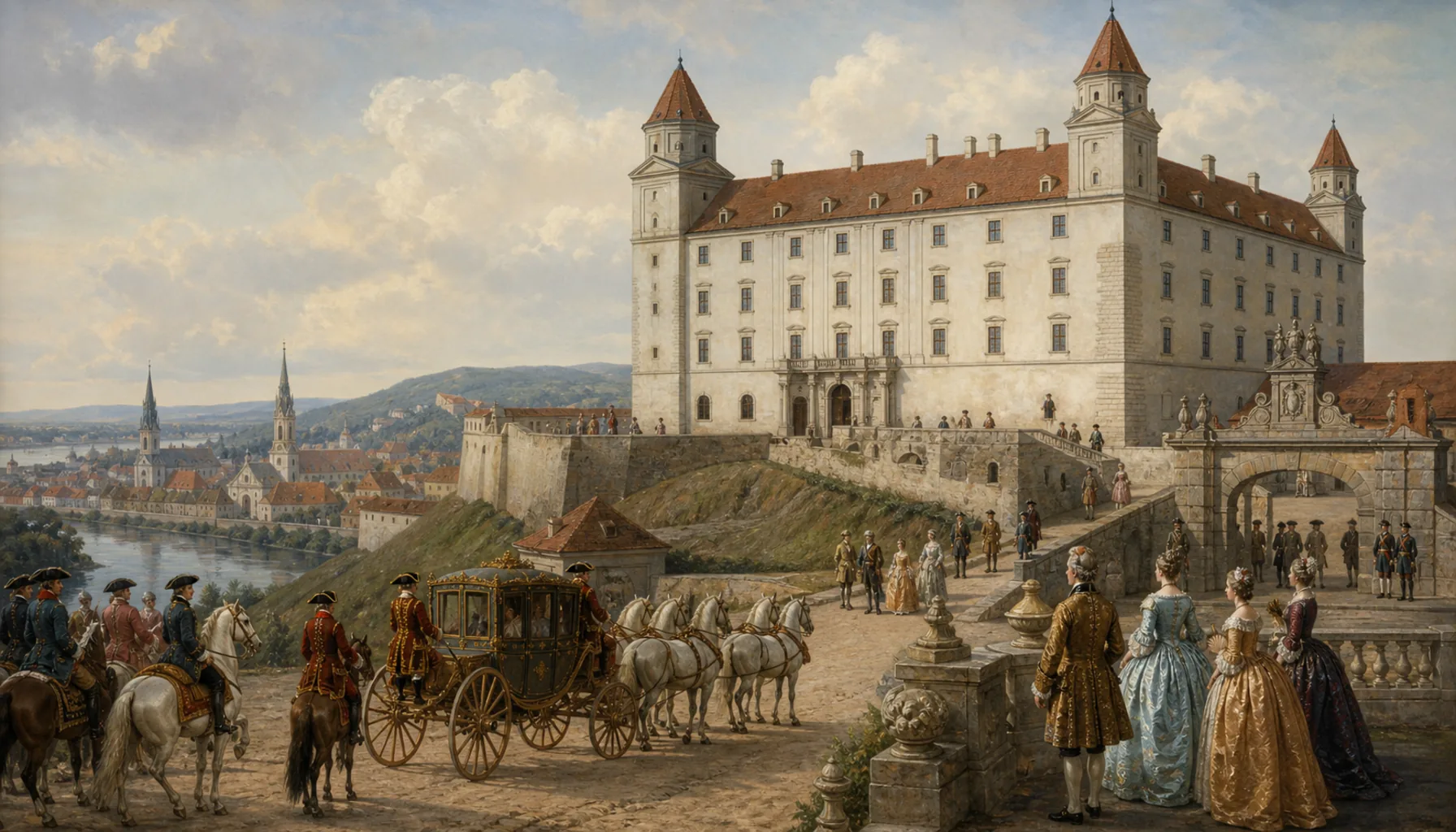
Maria Theresa was crowned in St Martin's in 1741 and decided the castle should be somewhere a ruler could actually live. Between 1761 and 1766 her architects, above all Franz Anton Hillebrandt, rebuilt it as a court residence; in 1767 a covered riding school and a winter garden were added, with ceiling paintings by Franz Anton Maulbertsch, and a new wing called the Theresianum was raised on the Danube side. The governor who lived here from 1766 was the queen's son-in-law, Albert of Saxe-Teschen, and the prints and drawings he collected in these rooms became the founding core of the Albertina in Vienna, one of the great graphic-art collections in Europe. For about twenty years the old fortress was the most fashionable address in the kingdom.Mária Terézia sa dala v roku 1741 korunovať v Dóme svätého Martina a rozhodla, že hrad má byť miestom, kde sa dá naozaj bývať. V rokoch 1761 – 1766 ho jej architekti, predovšetkým Franz Anton Hillebrandt, prestavali na dvorské sídlo; v roku 1767 pribudla krytá jazdiareň a zimná záhrada s maľbami Franza Antona Maulbertscha a na dunajskej strane vyrástlo nové krídlo — Tereziánum. Miestodržiteľom, ktorý tu od roku 1766 býval, bol kráľovnin zať Albert Sasko-Tešínsky; grafika a kresby, ktoré v týchto miestnostiach zhromaždil, sa stali základom viedenskej Albertiny, jednej z najväčších grafických zbierok Európy. Zo starej pevnosti sa na dvadsať rokov stala najmódnejšia adresa v kráľovstve.