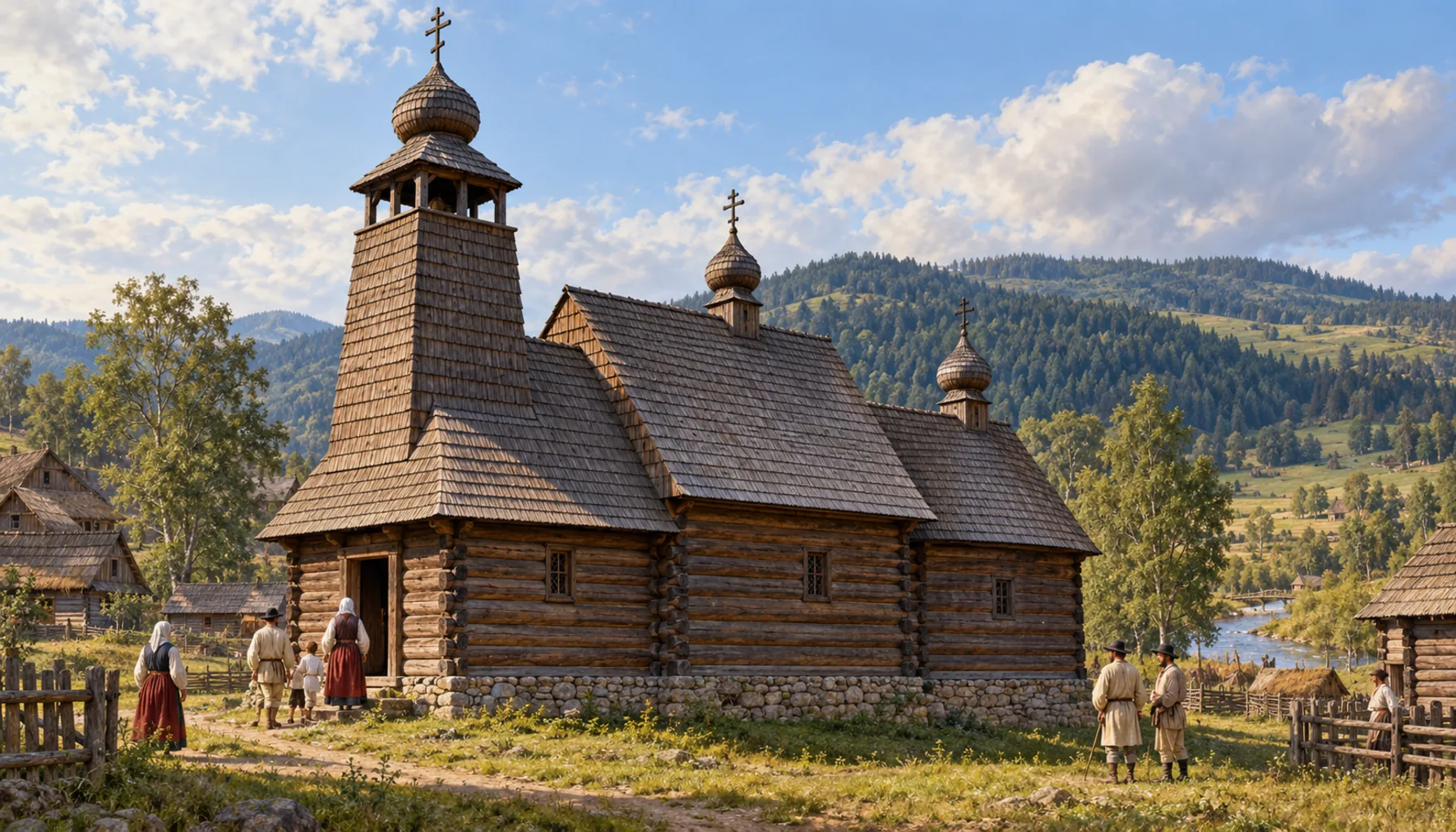
Between about 1720 and 1730 the village built its church of the Translation of the Relics of Saint Nicholas out of jointed logs, on the three-part Eastern plan: sanctuary, nave and vestibule in a single line, each under its own roof, a tower over the western end, and shingles from the stone footing to the onion dome. There was nothing unusual about that at the time — it is how nearly every village in these hills built. What is unusual is that it is still standing. Wooden churches survived precisely where the parish stayed too small and too poor to replace one in masonry, and Ruská Bystrá was both, for two hundred and fifty years.V rokoch približne 1720 – 1730 si obec postavila zo zrubu chrám Prenesenia ostatkov svätého Mikuláša na trojdielnom východnom pôdoryse: svätyňa, loď a predsieň v jednej osi, každá pod vlastnou strechou, veža nad západným koncom a šindeľ od kamennej podmurovky až po cibuľovú kupolu. Vtedy na tom nebolo nič výnimočné — takto stavala takmer každá dedina v týchto kopcoch. Výnimočné je, že chrám stojí dodnes. Drevené chrámy sa zachovali práve tam, kde farnosť zostala primalá a prichudobná na to, aby postavila murovaný — a Ruská Bystrá bola oboje, dvestopäťdesiat rokov.