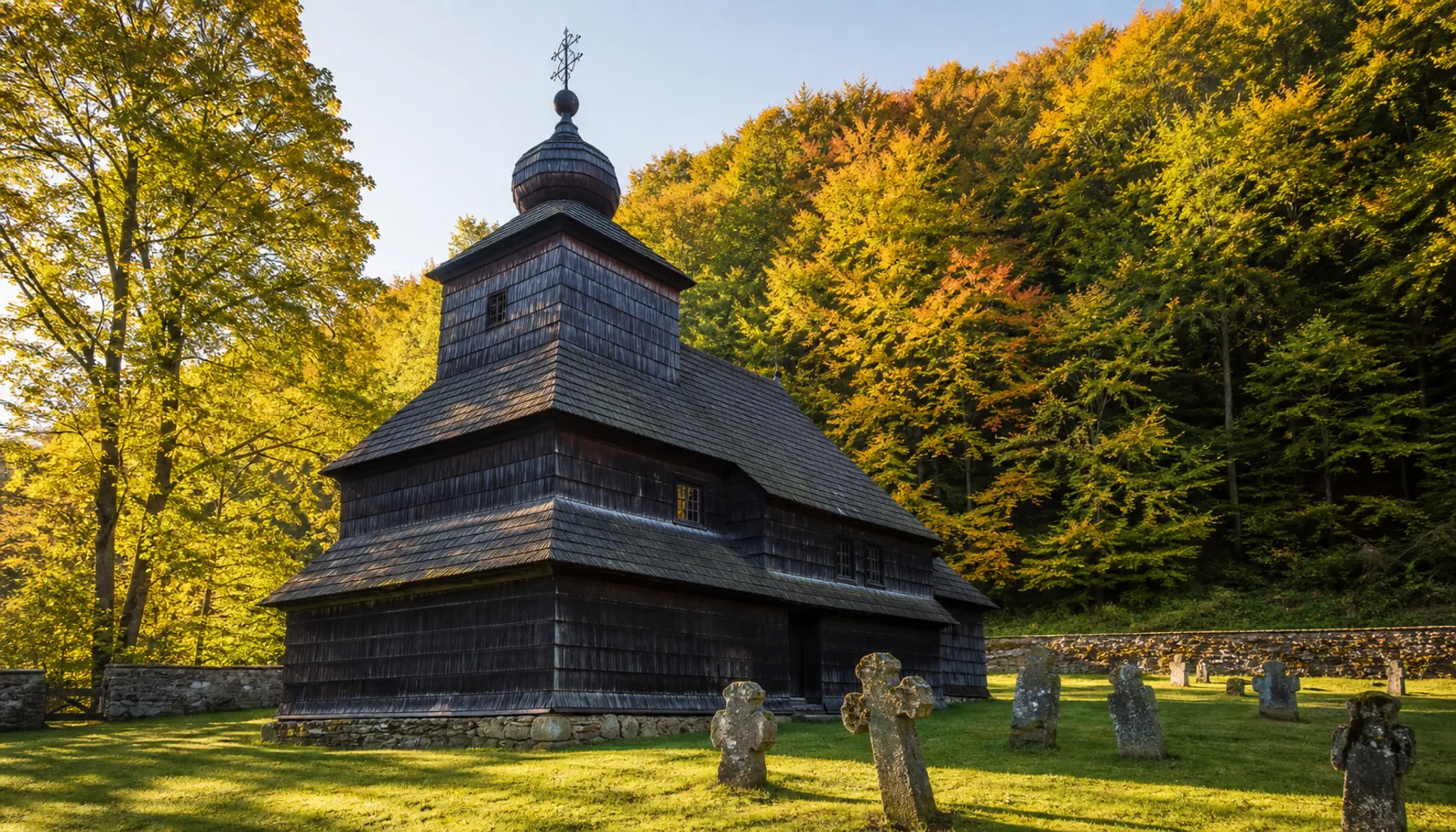
A small village in the hills north of Sobrance with one of the nine wooden churches on Slovakia's UNESCO list — a log-built Greek Catholic church of the early eighteenth century, shingled from footing to dome, and the easternmost of the set.Malá obec v kopcoch severne od Sobraniec s jedným z deviatich drevených chrámov na slovenskom zozname UNESCO — zrubovou gréckokatolíckou cerkvou zo začiatku 18. storočia, ošindľovanou od podmurovky po kupolu, a najvýchodnejšou z celej deviatky.
The shingled Greek Catholic wooden church at Ruská Bystrá in its walled churchyardOšindľovaná gréckokatolícka drevená cerkev v Ruskej Bystrej v ohradenom areáli
Where it standsKde leží
Ruská Bystrá lies in the Sobrance district, in the low wooded hills that run out from the Vihorlat towards the Ukrainian border — the far eastern corner of Slovakia and of the Košice region. The village is small and sits at the head of a side valley; the country around it is pasture, orchard and beech wood.Ruská Bystrá leží v okrese Sobrance, v nízkych zalesnených kopcoch, ktoré sa tiahnu z Vihorlatu smerom k ukrajinskej hranici — v najvýchodnejšom kúte Slovenska aj Košického kraja. Obec je malá a leží v závere bočnej doliny; okolie tvoria pasienky, sady a bučiny.
Nothing here is on a through route. Sobrance is the nearest town, Michalovce the nearest place of any size. The village is reached deliberately, not passed through.Nič tu neleží na prejazdnej trase. Najbližším mestom sú Sobrance, najbližším väčším Michalovce. Do obce sa ide zámerne, cestou nikam inam sa cez ňu neprechádza.
Why it is herePrečo práve tu
The people of these hills were Rusyn and their liturgy was Byzantine. In 1646, at Užhorod — not far east of here, now over an international border — priests of this region accepted communion with Rome while keeping the Eastern rite, the Church Slavonic liturgy and their married clergy. The churches built afterwards are Greek Catholic: eastern in plan, in furnishing and in use.Ľudia v týchto kopcoch boli Rusíni a ich liturgia bola byzantská. V roku 1646 v Užhorode — neďaleko odtiaľto na východ, za dnešnou štátnou hranicou — prijali kňazi tohto regiónu jednotu s Rímom, pričom si ponechali východný obrad, cirkevnoslovanskú liturgiu aj ženatých kňazov. Chrámy postavené potom sú gréckokatolícke: východné pôdorysom, zariadením aj používaním.
The village church, dedicated to Saint Nicholas, was built in the early eighteenth century of jointed logs, on the three-part eastern plan: sanctuary, nave and vestibule in a line, each under its own roof, with a tower rising over the western end. In 2008 UNESCO inscribed it with eight other timber buildings as the Wooden Churches of the Slovak part of the Carpathian Mountain Area.Obecný chrám zasvätený svätému Mikulášovi postavili na začiatku 18. storočia zo zrubu, na trojdielnom východnom pôdoryse: svätyňa, loď a predsieň v jednej osi, každá pod vlastnou strechou, s vežou nad západným koncom. V roku 2008 ho UNESCO zapísalo spolu s ôsmimi ďalšími drevenými stavbami ako Drevené chrámy v slovenskej časti Karpatského oblúka.
Wooden churches survived where villages were too small and too poor to replace them in masonry. Ruská Bystrá was small, poor and out of the way, and it kept its church.Drevené chrámy sa zachovali tam, kde boli obce príliš malé a chudobné na to, aby ich nahradili murovanými. Ruská Bystrá bola malá, chudobná a stranou — a svoj chrám si udržala.
What you actually seeČo naozaj uvidíte
From outside it is a dark, compact building on a slope in a walled churchyard among leaning gravestones. Everything above the low stone footing is timber: log walls, shingle cladding, a roof stepping up in stages to a tower with an onion dome and a forged iron cross. It is small enough to walk round in a minute.Zvonku je to tmavá, uzavretá stavba na svahu v ohradenom areáli medzi naklonenými náhrobkami. Všetko nad nízkou kamennou podmurovkou je z dreva: zrubové steny, šindľové obitie a strecha stúpajúca v stupňoch k veži s cibuľovou kupolou a kovaným krížom. Je taká malá, že ju obídete za minútu.
Inside there is one low room, dark with age and smoke, divided across its width by the iconostasis — a painted screen of icons in tiers, of the eighteenth century, closing off the sanctuary. The windows are few and small, the ceiling is close overhead, and the whole interior would be crowded by thirty people.Vnútri je jedna nízka miestnosť, stmavnutá vekom a dymom, po celej šírke rozdelená ikonostasom — maľovanou stenou ikon v radoch, z 18. storočia, ktorá uzatvára svätyňu. Okien je málo a sú malé, strop je nízko nad hlavou a celý priestor by zaplnilo tridsať ľudí.
It is worth knowing what this is not. There is no stone, no vaulting and no scale; the interest is all in carpentry and in an iconostasis standing in a room the size of a barn. Of the three Greek Catholic churches on the UNESCO list — Bodružal, Ladomirová and this one — Ruská Bystrá is the smallest and the furthest from anywhere.Oplatí sa vedieť, čím to nie je. Niet tu kameňa, klenieb ani veľkosti; celý záujem je v tesárskej práci a v ikonostase, ktorý stojí v miestnosti veľkosti stodoly. Z troch gréckokatolíckych chrámov na zozname UNESCO — Bodružal, Ladomirová a tento — je Ruská Bystrá najmenšia a najďalej od všetkého.
Living village, not a museumŽivá obec, nie skanzen
The church is consecrated and in use, not an exhibit, and it is normally locked. Getting inside means arranging it with the keyholder in the village or with the parish; there is no ticket desk, no posted hours and no guarantee if you simply arrive. Inside, you are in a church, not a gallery.Chrám je vysvätený a stále sa v ňom slúži, nie je to exponát, a bežne býva zamknutý. Dostať sa dnu znamená dohodnúť sa s kľúčnikom v obci alebo s farnosťou; niet tu pokladne, vyvesených otváracích hodín ani akejkoľvek istoty, ak jednoducho prídete. Bohoslužby majú prednosť a vnútri ste v chráme, nie v galérii.
The village has nothing built for visitors. Do not count on finding anywhere to eat or buy anything; bring whatever the day needs with you.Obec nemá nič postavené pre návštevníkov. Nerátajte s tým, že sa tu bude dať najesť alebo niečo kúpiť; všetko potrebné si vezmite so sebou.
Getting thereAko sa tam dostať
There is no railway. The nearest useful station is Michalovce; from there the road runs east through Sobrance and then north on minor roads into the hills. Buses are infrequent, so in practice this is a car journey, and a long one from anywhere. Arrange the key before you set out.Železnica sem nevedie. Najbližšia použiteľná stanica je v Michalovciach, odtiaľ vedie cesta na východ cez Sobrance a potom po vedľajších cestách na sever do kopcov. Autobusy chodia zriedka, takže v praxi ide o cestu autom — a odkiaľkoľvek dlhú. Kľúč si dohodnite pred odchodom.
Explore Ruská BystráObjavujte Ruská Bystrá
Every part of this place with a page of its own.Každá časť tohto miesta, ktorá má vlastnú stránku.