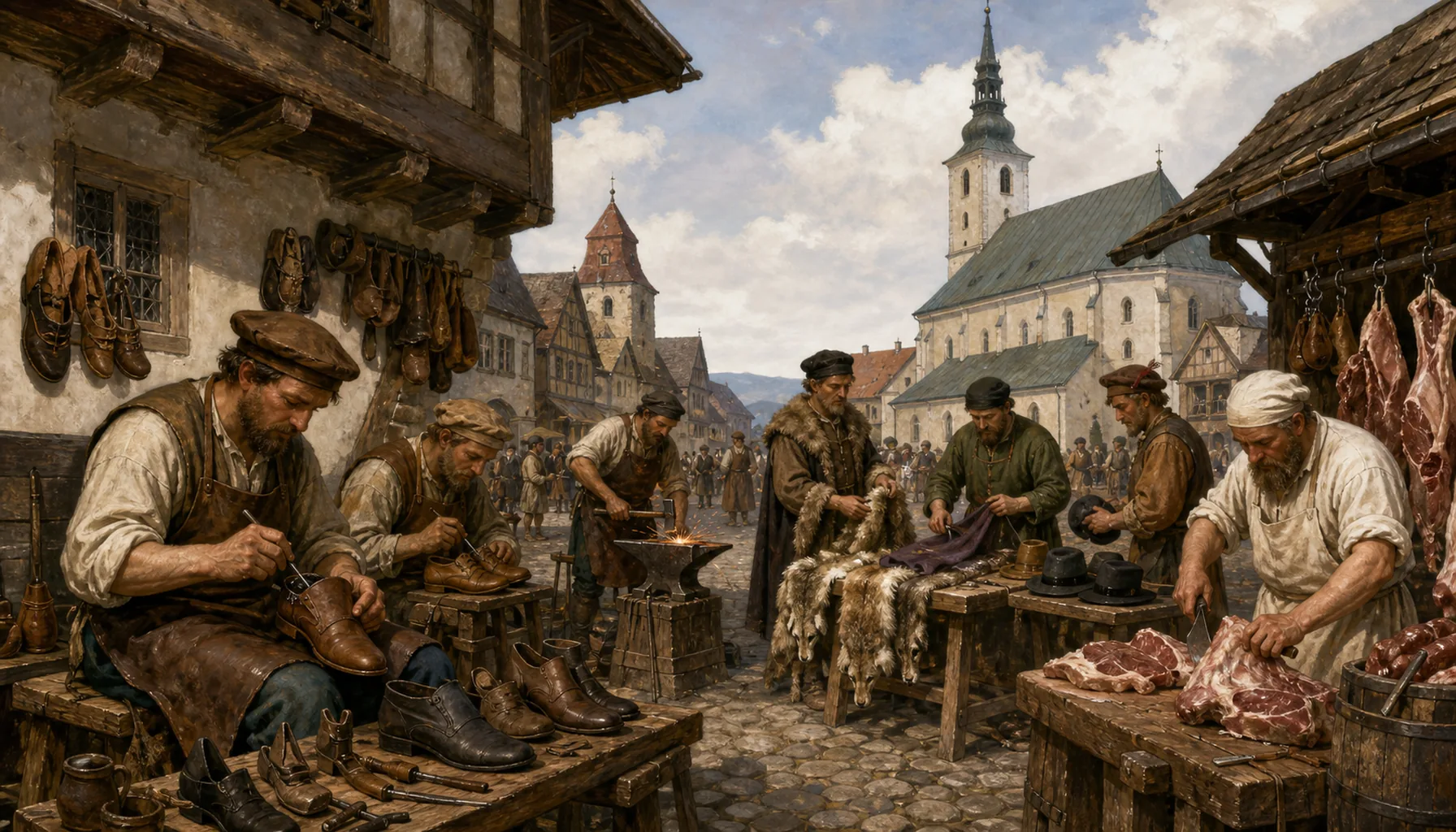
The oldest guild recorded in the town is the shoemakers', mentioned in 1508; there were also smiths, furriers, tailors, hatters and butchers. Shoes and furs mean hides, and leather-working stayed the town's trade for centuries. This was also the century the church changed hands twice. From the Reformation in the mid-1500s until the end of the 1600s St Nicholas was Lutheran, and from 1632 until his death in 1637 its preacher was Juraj Tranovský, a Czech exile whose name is on the hymn-book Slovak Lutherans sang from for the next three hundred years. From 1685 the church was Catholic again. Note what is missing from all this: no Ottoman army ever reached Liptov — the frontier stopped some two hundred kilometres to the south — so the sixteenth century here is a story about religion, not sieges.Najstarším doloženým cechom v meste je obuvnícky, spomínaný v roku 1508; boli tu aj kováči, kožušníci, krajčíri, klobučníci a mäsiari. Topánky a kožuchy znamenajú kože — a spracovanie kože zostalo mestskému remeslu vlastné po stáročia. V tomto storočí zmenil kostol majiteľa hneď dvakrát. Od reformácie v polovici 16. storočia až do konca 17. storočia bol Mikulášsky kostol evanjelický a od roku 1632 až do svojej smrti v roku 1637 v ňom kázal Juraj Tranovský, český exulant, ktorého meno nesie spevník, z ktorého slovenskí evanjelici spievali ďalších tristo rokov. Od roku 1685 je kostol opäť katolícky. Všimnite si, čo v tomto príbehu chýba: do Liptova nikdy nedošlo osmanské vojsko — hranica sa zastavila asi dvesto kilometrov na juh — takže 16. storočie je tu príbehom o viere, nie o obliehaniach.