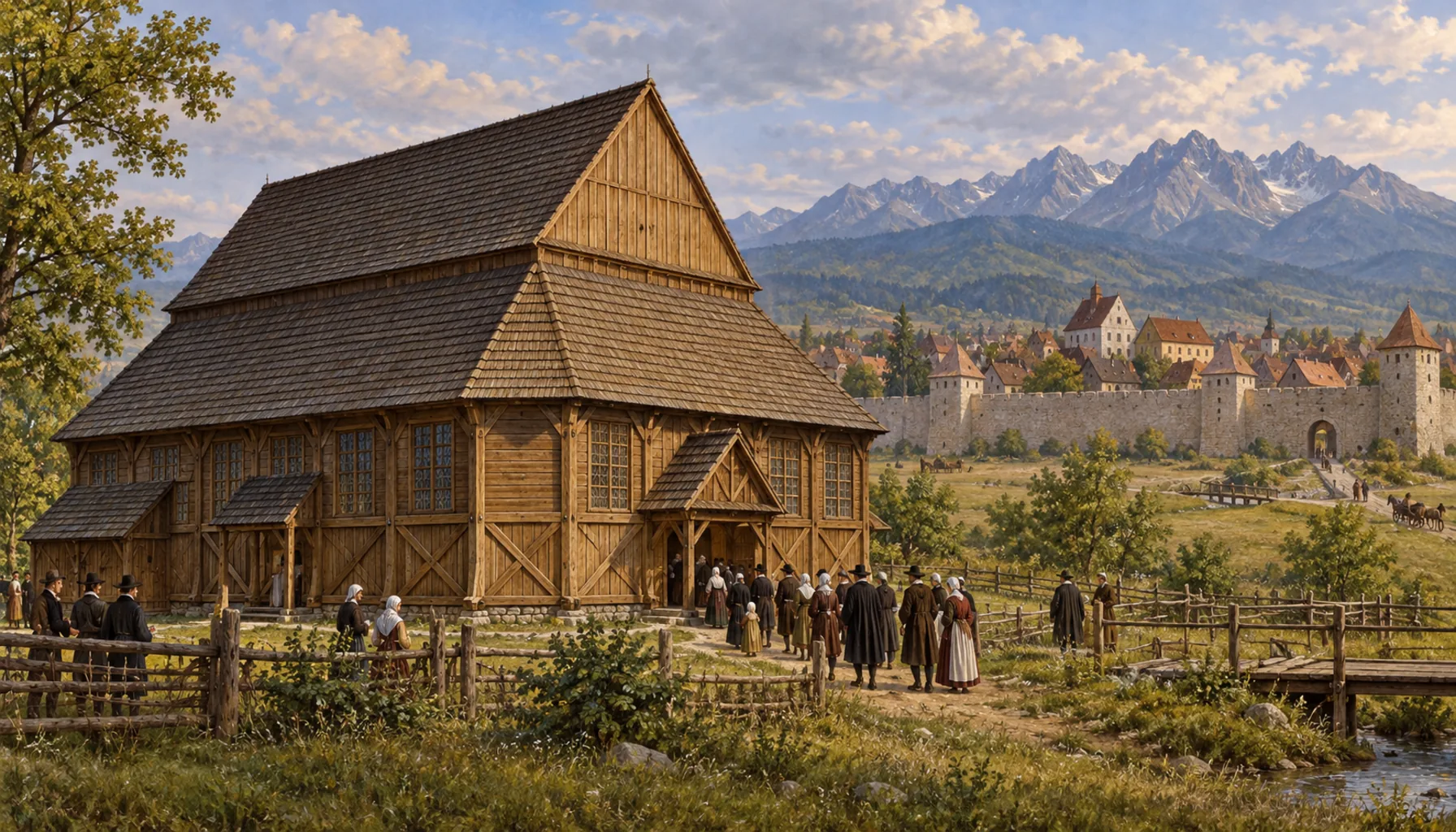
At the Diet of Sopron in 1681 the emperor allowed Protestants in royal Hungary to build churches again, but only under conditions written into articles 25 and 26 — hence articular churches: outside the town walls, of wood, without a tower, and finished within a single year. Kežmarok's Lutherans built to those rules, and the church standing today went up in 1717 to the design of Juraj Müttermann of Poprad: a hall on the plan of a Greek cross, timber pegged together without a single metal nail, big enough for well over a thousand people. Inside, the whole shell is painted — a blue heaven with the twelve apostles and the four evangelists — and the organ of 1717–20 by Vavrinec Čajkovský has pipes made of wood. In 1787 the castle at the other end of the street burned down; the wooden church, built under laws designed to humiliate it, is still standing.Na Šopronskom sneme v roku 1681 povolil cisár protestantom v kráľovskom Uhorsku opäť stavať kostoly, ale len za podmienok zapísaných v článkoch 25 a 26 — odtiaľ artikulárne kostoly: mimo mestských hradieb, z dreva, bez veže a postavené do jedného roka. Kežmarskí luteráni sa tým pravidlám podvolili a kostol, ktorý tu stojí dnes, vyrástol v roku 1717 podľa návrhu popradského staviteľa Juraja Müttermanna: sieň na pôdoryse gréckeho kríža, drevo spájané drevenými klinmi bez jediného kovového klinca, s miestom pre vyše tisíc ľudí. Vnútri je pomaľovaná celá schránka stavby — modrá obloha s dvanástimi apoštolmi a štyrmi evanjelistami — a organ z rokov 1717 – 1720 od Vavrinca Čajkovského má drevené píšťaly. V roku 1787 vyhorel hrad na druhom konci ulice; drevený kostol, postavený podľa zákonov, ktoré ho mali ponížiť, stojí dodnes.