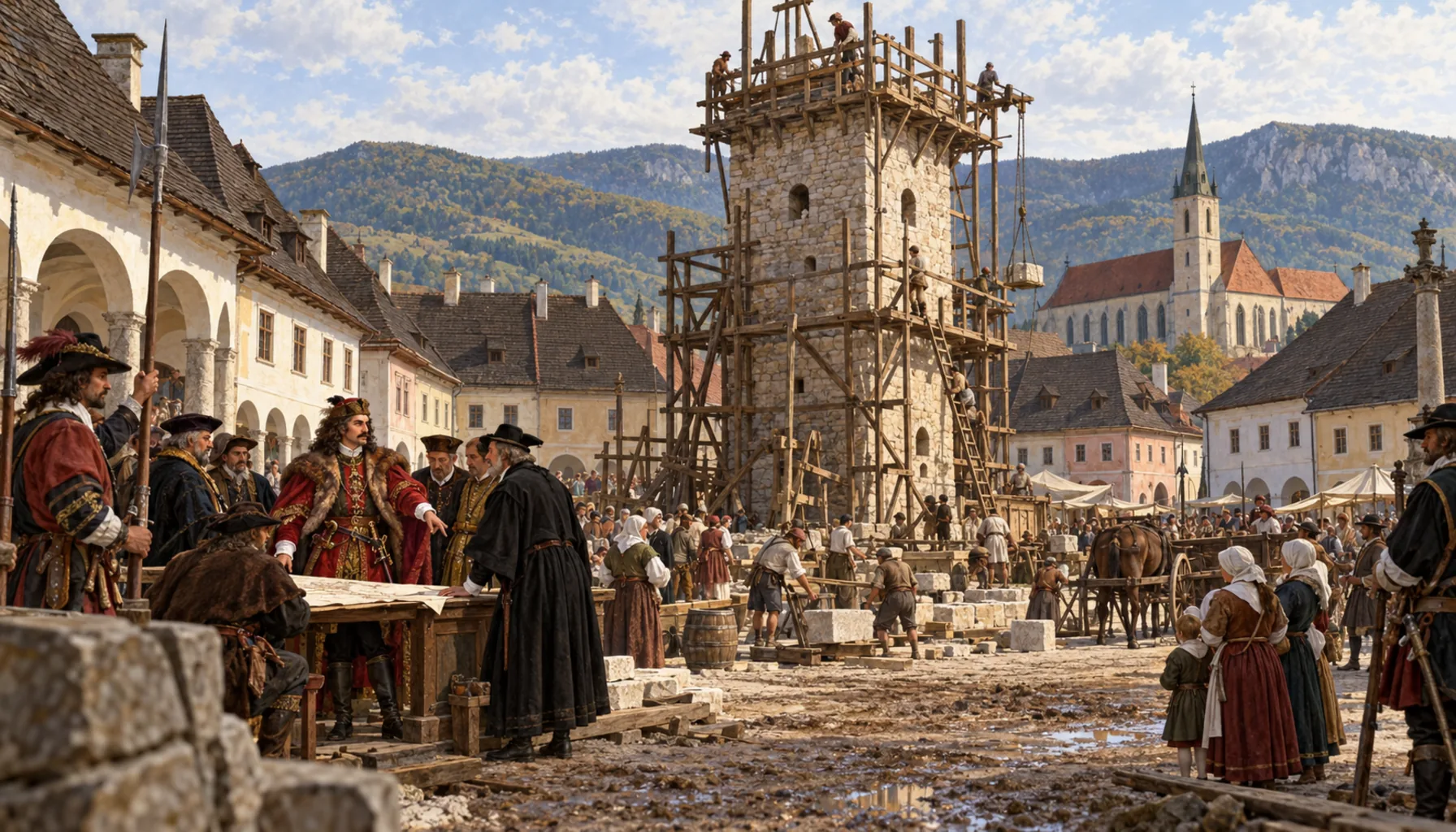
The tower standing free in the middle of Rožňava's square was built between 1643 and 1654, and it explains the century better than any document: a lookout and fire tower, put up by a town that expected to see trouble coming. Trouble came from both directions. Hungarian accounts record a defeat for Imre Thököly's anti-Habsburg rebels at Rožňava on 15 February 1685, and twenty years later the town lay deep inside the territory held by Francis II Rákóczi, whose uprising of 1703–11 was the last great revolt of the Hungarian estates against Vienna. Rákóczi governed from Rožňava in 1706, and it was here on 22 January 1707 that the decision was taken to summon the Diet of Ónod — the assembly that would declare the Habsburgs deposed.Samostatne stojaca veža uprostred rožňavského námestia vyrástla v rokoch 1643 – 1654 a vysvetľuje to storočie lepšie ako hociktorá listina: bola strážnou a požiarnou vežou, ktorú si postavilo mesto počítajúce s tým, že nešťastie uvidí prichádzať. A prichádzalo z oboch strán. Uhorské záznamy uvádzajú, že protihabsburských povstalcov Imricha Thökölyho porazili pri Rožňave 15. februára 1685, a o dvadsať rokov neskôr ležalo mesto hlboko v území, ktoré ovládal František II. Rákóczi — jeho povstanie v rokoch 1703 – 1711 bolo posledným veľkým vzopretím uhorských stavov proti Viedni. Rákóczi v roku 1706 z Rožňavy priamo vládol a práve tu padlo 22. januára 1707 rozhodnutie zvolať onodský snem, ktorý vyhlásil Habsburgovcov za zosadených.