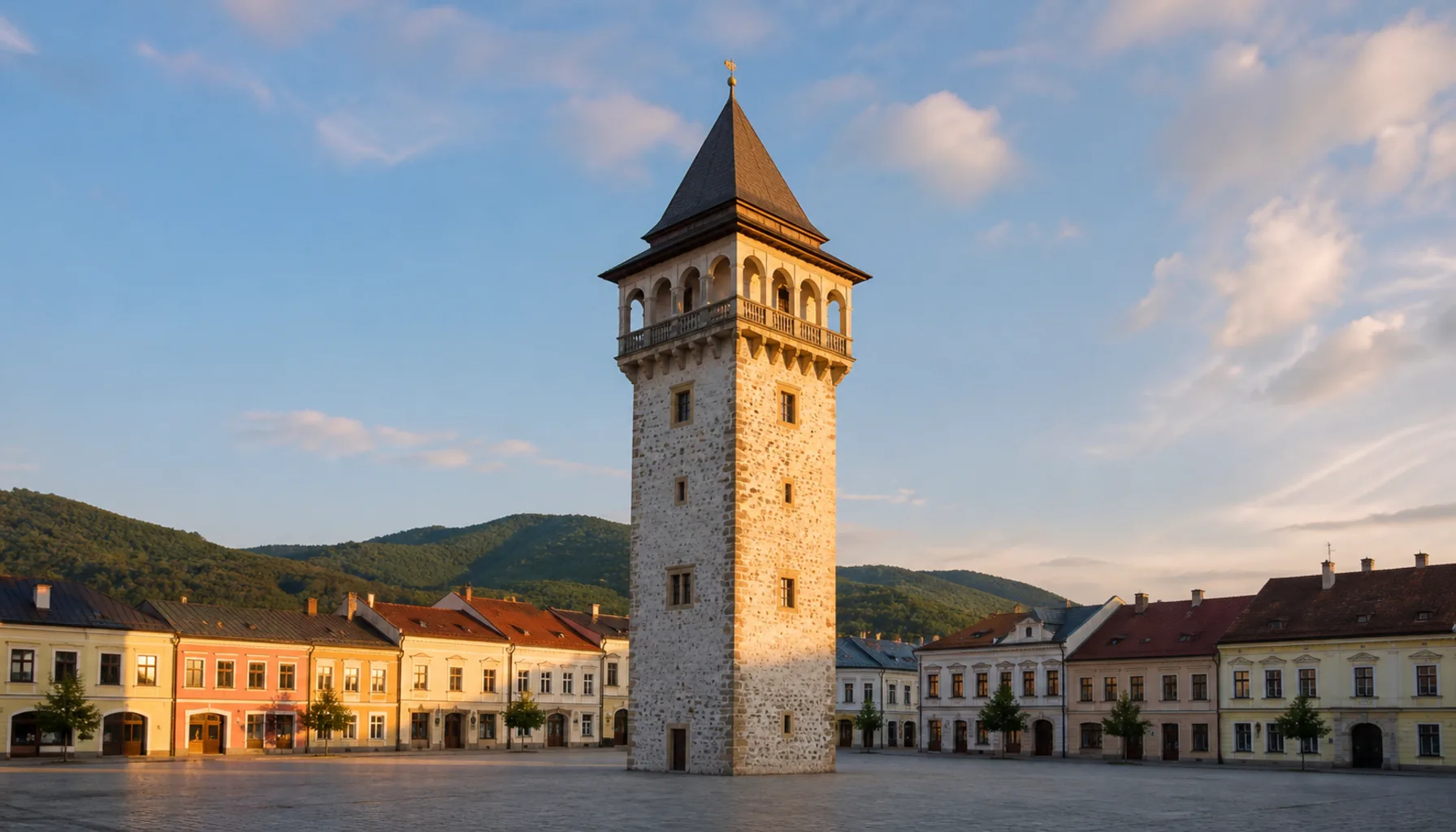
The mining seat of the Gemer, with a watchtower standing alone in the middle of its square, a cathedral holding one of Europe's earliest paintings of miners at work, and the caves and plateaus of the Slovak Karst above the town.Banské sídlo Gemera so strážnou vežou osamote uprostred námestia, s katedrálou, v ktorej visí jedno z najstarších európskych zobrazení baníckej práce, a s jaskyňami a plošinami Slovenského krasu nad mestom.
The seventeenth-century watchtower standing in the middle of the square at RoznavaStrážna veža zo 17. storočia uprostred rožňavského námestia
Where it standsKde leží
Rožňava lies in a basin on the Slaná river between the Slovak Ore Mountains to the north and the limestone plateaus of the Slovak Karst to the south, roughly seventy kilometres west of Košice. The contrast is immediate: wooded, ore-bearing ridges on one side of the town, bare karst tables cut by gorges on the other.Rožňava leží v kotline na rieke Slanej medzi Slovenským rudohorím na severe a vápencovými plošinami Slovenského krasu na juhu, zhruba sedemdesiat kilometrov západne od Košíc. Kontrast je okamžitý: na jednej strane mesta zalesnené rudonosné chrbty, na druhej holé krasové plošiny rozrezané tiesňavami.
It is the natural centre of the Gemer, the historic region whose towns and villages spread west from here, and the town closest to the Andrássy estates at Betliar and Krásna Hôrka.Je prirodzeným centrom Gemera, historického regiónu, ktorého mestá a dediny sa odtiaľto rozbiehajú na západ, a mestom najbližším k andrássyovským panstvám v Betliari a na Krásnej Hôrke.
The storyHistória
Rožňava is first recorded at the end of the thirteenth century as a mining settlement. Gold and silver were taken here first, then iron and copper, and the town rose to become a free royal town with all the privileges that mining brought — its own court, its own market and a guild economy built on metal.Rožňava sa prvýkrát spomína na konci 13. storočia ako banská osada. Najprv sa tu dobývalo zlato a striebro, neskôr železo a meď, a mesto sa vypracovalo na slobodné kráľovské mesto so všetkými výsadami, ktoré baníctvo prinášalo — s vlastným súdom, vlastným trhom a cechovým hospodárstvom postaveným na kove.
Maria Theresa made Rožňava the seat of a Roman Catholic diocese in 1776. The bishop's palace, the seminary and the cathedral date the town's second identity precisely, and the schools that followed the diocese made it a centre of teaching as well as of mining.Mária Terézia urobila v roku 1776 z Rožňavy sídlo rímskokatolíckej diecézy. Biskupský palác, seminár a katedrála presne datujú druhú identitu mesta a školy, ktoré prišli s diecézou, z neho urobili centrum vzdelávania, nielen baníctva.
Mining lasted into living memory. Iron ore was worked in the valleys around the town until the end of the twentieth century, and the closures that followed hit the district hard; the mining museum here exists because that one industry was the town's whole life for seven hundred years.Baníctvo trvalo až do pamäti dnešných ľudí. Železnú rudu ťažili v dolinách okolo mesta do konca 20. storočia a zatváranie baní zasiahlo okres tvrdo; banícke múzeum tu je preto, lebo toto jediné odvetvie bolo sedemsto rokov celým životom mesta.
What to seeČo vidieť
The square is one of the largest in Slovakia and unusual in plan: the watchtower stands free in the middle of it, built in the seventeenth century as a lookout and fire tower and still the town's emblem. Around the edges are burgher houses, the bishop's palace and the town hall.Námestie patrí k najväčším na Slovensku a má nezvyčajný pôdorys: strážna veža stojí voľne v jeho strede, postavená v 17. storočí ako pozorovateľňa a požiarna veža, a dodnes je znakom mesta. Po obvode stoja meštianske domy, biskupský palác a radnica.
The cathedral, Gothic in origin and rebuilt several times, holds the Metercia altar panel of 1513 — a painting of St Anne with the Virgin and Child in whose background miners wash and haul ore. It is one of the earliest depictions of mining anywhere in Europe and the single most important object in the town.Katedrála, pôvodne gotická a viackrát prestavaná, ukrýva tabuľový obraz Metercia z roku 1513 — vyobrazenie svätej Anny s Pannou Máriou a Ježiškom, v ktorého pozadí baníci ryžujú a vozia rudu. Je to jedno z najstarších zobrazení baníctva v Európe a najvýznamnejší predmet v meste.
The two great estates are outside the town. Betliar, a few kilometres north, is an Andrássy manor house with its interiors, library and English park intact, and is the region's best wet-weather visit. Krásna Hôrka, east above Krásnohorské Podhradie, was badly damaged by fire in 2012 and has been under long-term reconstruction ever since, with access limited and changing — check before you travel; the Andrássy mausoleum below it is a separate and reliable stop. West and south of the town the karst holds the aragonite cave at Ochtiná, Gombasecká, Domica and Krásnohorská, and the ice cave at Dobšiná lies in the same district.Obe veľké panstvá sú za mestom. Betliar pár kilometrov na sever je andrássyovský kaštieľ so zachovanými interiérmi, knižnicou a anglickým parkom — najlepší cieľ kraja do daždivého dňa. Krásna Hôrka východne nad Krásnohorským Podhradím ťažko utrpela požiarom v roku 2012 a odvtedy prechádza dlhodobou obnovou; prístup je obmedzený a mení sa, preto si ho pred cestou overte — andrássyovské mauzóleum pod hradom je samostatná a spoľahlivá zastávka. Na západ a juh od mesta kras ukrýva aragonitovú jaskyňu v Ochtinej, Gombaseckú, Domicu i Krásnohorskú a v tom istom okrese leží aj dobšinská ľadová jaskyňa.
Work and industryPráca a priemysel
The ore mines and the ironworks that once employed the whole valley have closed, and the district has lived with high unemployment ever since. What remains is light manufacturing, food and wood processing, quarrying along the karst edge, forestry and public services.Rudné bane aj železiarne, ktoré kedysi zamestnávali celú dolinu, sú zatvorené a okres odvtedy žije s vysokou nezamestnanosťou. Zostáva ľahká výroba, potravinárstvo a drevospracovanie, ťažba kameňa na okraji krasu, lesníctvo a verejné služby.
Tourism is the growth industry and the most local one: the caves, the gorges, Betliar and the karst trails all need beds, guides and buses, and Rožňava is where they are. Cross-border traffic with Hungary adds to the trade.Rastúcim a najmiestnejším odvetvím je cestovný ruch: jaskyne, tiesňavy, Betliar aj krasové chodníky potrebujú lôžka, sprievodcov a autobusy — a tie sú v Rožňave. Obchod dopĺňa cezhraničná doprava s Maďarskom.
Getting thereAko sa tam dostať
Rožňava is on the southern railway between Košice and Zvolen, with trains from Košice through Moldava nad Bodvou. By road it is on the main route west from Košice towards Lučenec, and buses run to Betliar, Krásnohorské Podhradie and the cave villages.Rožňava leží na južnej železnici medzi Košicami a Zvolenom, vlaky sem idú z Košíc cez Moldavu nad Bodvou. Cestne je na hlavnom ťahu z Košíc na západ smerom na Lučenec a autobusy premávajú do Betliara, Krásnohorského Podhradia aj do jaskynných obcí.
Explore RožňavaObjavujte Rožňava
Every part of this place with a page of its own.Každá časť tohto miesta, ktorá má vlastnú stránku.