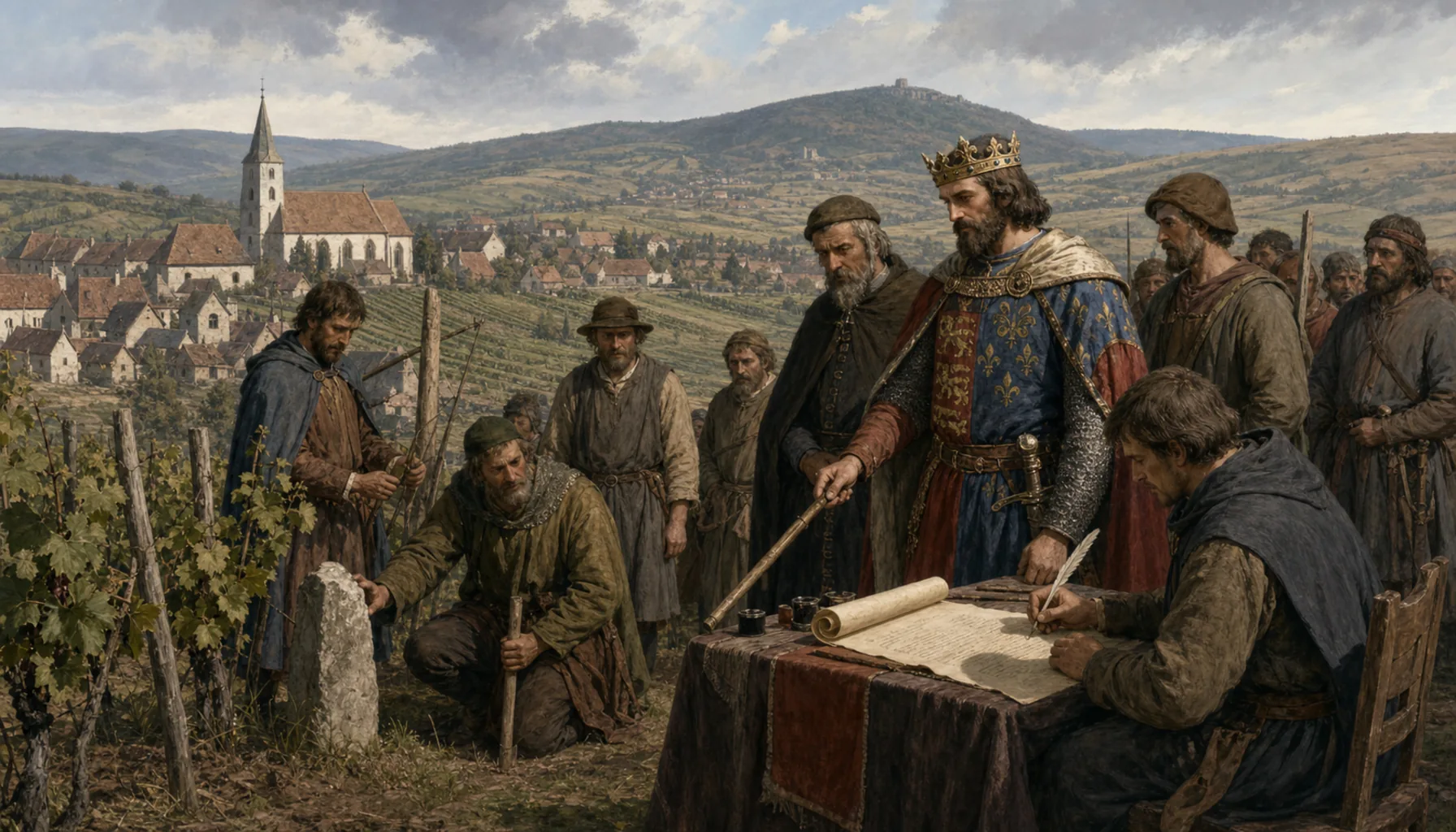
In 1287 King Ladislaus IV had the village's boundaries written down — the medieval equivalent of a land register, and a sign that the place had become worth arguing about. Wine appears in the records in the early fourteenth century, when the estate was in the hands of Matúš Čák of Trenčín, the magnate who ruled most of what is now western Slovakia almost as a king of his own. On 25 December 1361 King Louis I issued a charter making Modra a subject town — a town with markets, a council and law of its own, but still owned by a landlord rather than by the king. Closing the gap between that and a free royal town would take Modra another two and a half centuries.V roku 1287 dal kráľ Ladislav IV. spísať chotárne hranice dediny — stredoveká obdoba katastra a znamenie, že sa už oplatilo o toto miesto sporiť. Víno sa v prameňoch objavuje začiatkom 14. storočia, keď panstvo držal Matúš Čák Trenčiansky, veľmož, ktorý ovládal takmer celé dnešné západné Slovensko skoro ako vlastný kráľ. 25. decembra 1361 vydal kráľ Ľudovít I. listinu, ktorou sa Modra stala poddanským mestom — mestom s trhmi, radou a vlastným právom, ale stále v majetku zemepána, nie kráľa. Rozdiel medzi týmto a slobodným kráľovským mestom dobiehala Modra ďalších dvaapolstoročia.