Only what belongs to Banská Bystrica — each on its own page.Len to, čo patrí k mestu Banská Bystrica — každé s vlastnou stránkou.
Pick a year to see what was happening here then.Vyberte rok a uvidíte, čo sa tu vtedy dialo.
The story of this city starts underground, and it starts very early. In the valley of Špania Dolina, ten kilometres north of the modern centre, people were digging and working copper in the older Bronze Age, around 2000–1700 BC; the stone hammers they broke the ore with have been found there in quantity. Later the Celtic Cotini and then the Germanic Quadi lived along this stretch of the river Hron. Slavs settled the place where a fast stream called the Bystrica runs into the Hron. Nobody founded Banská Bystrica in the way a king founds a town: the copper was here, and one people after another came to it.Príbeh tohto mesta sa začína pod zemou a začína sa veľmi skoro. V Španej Doline, desať kilometrov na sever od dnešného centra, ľudia ťažili a spracúvali meď už v staršej dobe bronzovej, okolo rokov 2000 – 1700 pred n. l.; kamenné mlaty, ktorými rudu rozbíjali, sa tam našli vo veľkom množstve. Neskôr v tomto úseku Pohronia žili keltskí Kotíni a po nich germánski Kvádi. Slovania sa usadili tam, kde sa bystrý potok Bystrica vlieva do Hrona. Banskú Bystricu nikto nezaložil tak, ako kráľ zakladá mesto: meď tu jednoducho bola a jeden ľud za druhým si po ňu prišiel.
When the kingdom of Hungary took in this country, the upper Hron was not a settled county of villages and lords but an enormous royal forest, administered from the castle at Zvolen. The king owned the woods, the game and — this is the part that decides everything later — whatever lay under the ground. A Slavic village called Bystrica sat by the stream, and anyone who dug ore here dug it on the king's terms, handing over a fixed share of what came out. That rule is why a mining town in Hungary dealt directly with the crown instead of with a local baron. It is the reason Banská Bystrica could later become rich and free at the same time.Keď toto územie pripadlo Uhorskému kráľovstvu, horné Pohronie nebolo usadenou stolicou dedín a zemepánov, ale obrovským kráľovským lesom spravovaným zo Zvolenského hradu. Kráľovi patrili lesy, zver a — a práve to rozhodne o všetkom ďalšom — aj to, čo ležalo pod zemou. Pri potoku stála slovanská osada Bystrica a kto tu kopal rudu, kopal ju za kráľových podmienok a odovzdával z nej pevný podiel. Preto banské mesto v Uhorsku rokovalo priamo s panovníkom, a nie s miestnym barónom. A práve preto mohla Banská Bystrica neskôr zbohatnúť a zostať slobodná zároveň.
The Mongol army that destroyed the Hungarian king's forces in 1241 stormed no castle here, because there was no castle here to storm. What the invasion did to this valley it did to the whole kingdom: it emptied it of people. Béla IV spent the years afterwards building stone castles and buying settlers, inviting hospites — 'guests' — with promises of freedom and land. In 1255 he granted wide municipal privileges to his 'guests from the new settlement of Bystrica', and German miners, many of them from Thuringia, came for the copper and silver. The first document in this town's history is therefore a consequence of the Mongols: not of what they destroyed here, but of what the king had to do everywhere afterwards.Mongolské vojsko, ktoré v roku 1241 rozdrvilo uhorské kráľovské sily, tu nedobýjalo nijaký hrad — nebolo čo dobýjať. To, čo vpád urobil tejto doline, urobil celému kráľovstvu: vyľudnil ju. Belo IV. potom roky staval kamenné hrady a kupoval si osadníkov: pozýval hostí (hospites) a sľuboval im slobody i pôdu. V roku 1255 udelil rozsiahle mestské výsady „svojim hosťom z novej osady Bystrice“ a nemeckí baníci, mnohí z Durínska, sem prišli za meďou a striebrom. Prvá listina v dejinách tohto mesta je teda dôsledkom Mongolov — nie toho, čo tu zničili, ale toho, čo musel kráľ potom robiť všade inde.
The charter turned the settlement into a free royal town: it elected its own council and judge, held markets, and answered to the king rather than to any lord. In the second half of the thirteenth century it built the Late Romanesque Church of the Virgin Mary and drew walls around it — the fortified precinct the town still calls the town castle, entered today through the barbican. It took a coat of arms modelled on the arms of the Árpád kings. And it acquired the three names it carried for centuries: Slovak Banská Bystrica, where the first word means 'mining'; German Neusohl, 'new Zvolen'; Hungarian Besztercebánya. Three names and one town, with no contradiction in it — that is what a medieval mining town in this kingdom looked like.Listina spravila z osady slobodné kráľovské mesto: volilo si vlastnú radu aj richtára, malo trhy a zodpovedalo sa kráľovi, nie zemepánovi. V druhej polovici 13. storočia postavilo neskoro románsky Kostol Panny Márie a obohnalo ho hradbami — opevnenému areálu dodnes hovoríme mestský hrad a vchádza sa doň cez barbakan. Mesto prijalo erb podľa znaku arpádovských kráľov. A dostalo tri mená, ktoré nosilo stáročia: slovenskú Banskú Bystricu, v ktorej prívlastok hovorí o baniach, nemecký Neusohl — „nový Zvolen“ — a maďarskú Besztercebányu. Tri mená, jedno mesto a nijaký rozpor v tom: presne tak vyzeralo stredoveké banské mesto v tomto kráľovstve.
In 1440 the widowed queen Elizabeth hired a Bohemian captain, Ján Jiskra of Brandýs, to hold the kingdom for her infant son, and in a short time his mercenaries held the central Slovak mining towns, Spiš and part of the east; Zvolen castle, twenty kilometres from here, was one of his seats, and the mint at Kremnica was another prize. For nearly twenty years the ore of this valley — and therefore its money — answered to him rather than to Buda. It ended when Matthias Corvinus won the argument and, in 1462, took Jiskra into his own service. Corvinus then came here himself: the five-storey late-Gothic Matthias House, built in 1479 against the wall of the town castle, is named after him, and he and his queen Beatrix stayed in it.V roku 1440 poverila ovdovená kráľovná Alžbeta českého kapitána Jána Jiskru z Brandýsa, aby udržal kráľovstvo pre jej malého syna, a jeho žoldnieri v krátkom čase ovládli stredoslovenské banské mestá, Spiš aj časť východu; jedným z jeho sídel bol Zvolenský hrad dvadsať kilometrov odtiaľto, ďalšou korisťou kremnická mincovňa. Takmer dvadsať rokov sa ruda tejto doliny — a teda aj jej peniaze — zodpovedala jemu, nie Budínu. Skončilo sa to, keď spor vyhral Matej Korvín a v roku 1462 prijal Jiskru do vlastných služieb. Korvín potom prišiel aj sem: päťpodlažný neskorogotický Matejov dom, postavený v roku 1479 pri hradbe mestského hradu, nesie meno po ňom a býval v ňom aj so svojou manželkou Beatrix.
By the end of the fifteenth century the easy ore near the surface was gone and the deep workings were filling with water. Ján Thurzo, a burgher from Spiš who had learned water-lifting engineering abroad, had the machines; the Fuggers of Augsburg, bankers to emperors, had the money. In 1494 the two families set up a joint company with its office in Banská Bystrica, known in German as the Ungarischer Handel — 'the Hungarian trade' — and sealed the partnership in 1495. German capital, Slovak ore, and a head office on this square: historians regularly call it one of the first multinational companies in Europe. For the next half-century it made a small mountain town matter in Kraków, Antwerp and Venice.Koncom 15. storočia bola ľahko dostupná ruda pri povrchu preč a hlboké banské diela zaplavovala voda. Ján Thurzo, spišský mešťan, ktorý sa v cudzine vyučil čerpaniu vody z baní, mal stroje; augsburskí Fuggerovci, bankári cisárov, mali peniaze. V roku 1494 založili obe rodiny spoločný podnik so sídlom v Banskej Bystrici, po nemecky Ungarischer Handel — „uhorský obchod“ — a v roku 1495 partnerstvo spečatili. Nemecký kapitál, slovenská ruda a riaditeľstvo na tomto námestí: historici o tejto firme bežne hovoria ako o jednej z prvých nadnárodných spoločností v Európe. Na pol storočia vďaka nej malé horské mesto niečo znamenalo v Krakove, Antverpách aj v Benátkach.
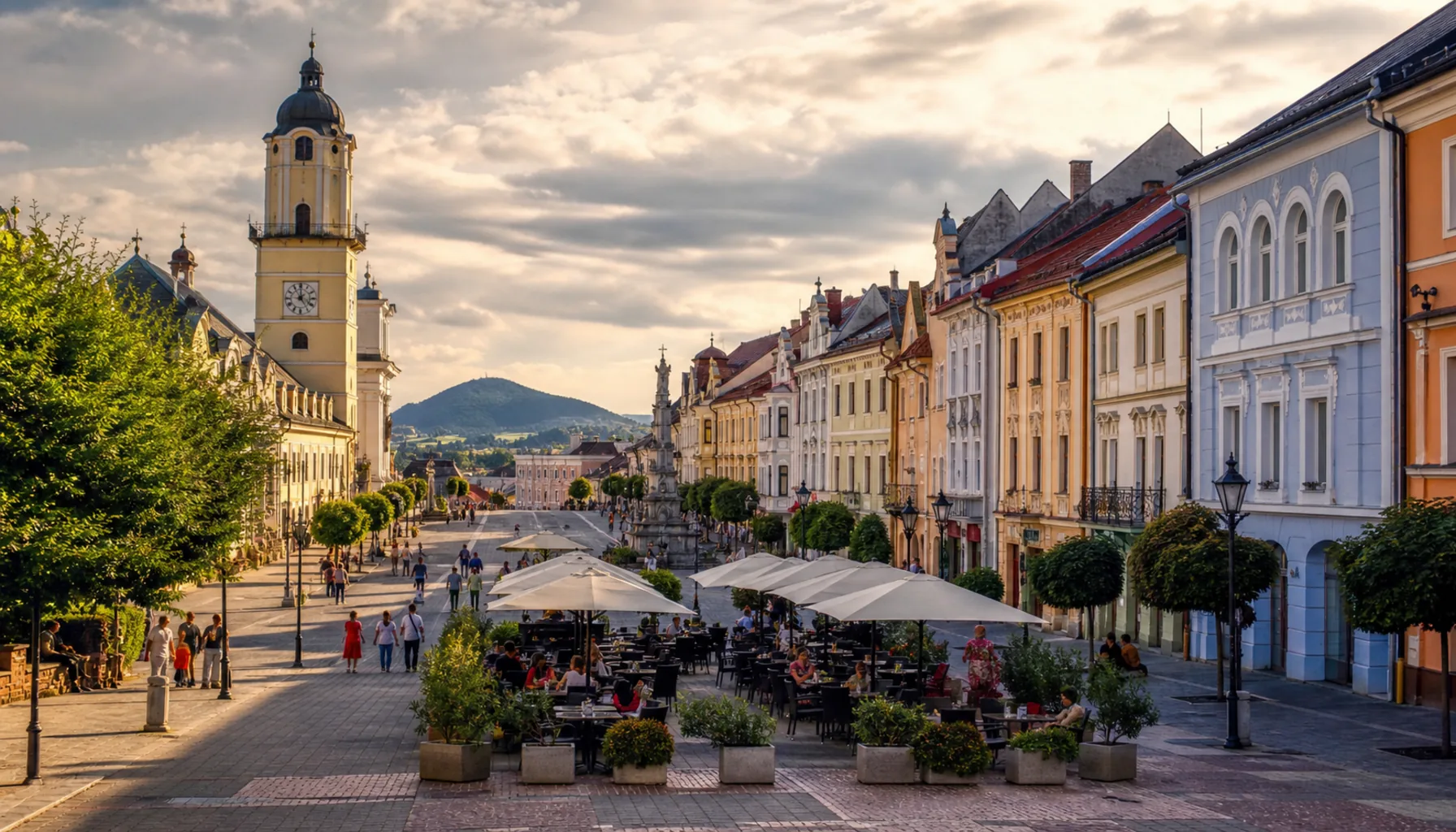
At its height the company was one of the leading copper producers in the world. Ore came down from Špania Dolina and the valleys around it, was smelted in works along the Hron, and travelled north to Kraków and Gdańsk and west to Antwerp — and from there into cannon, kettles, roofs and coins across Europe and beyond it. About a thousand people worked for the firm, and it kept an infirmary for them, which was early and unusual and tells you exactly how valuable a trained miner was. The palaces along SNP Square are that business written in stone. The Thurzo House, the company's own building, is today the Central Slovakia Museum.Vo svojom vrchole patrila spoločnosť k popredným producentom medi na svete. Ruda schádzala zo Španej Doliny a okolitých dolín, tavila sa v hutách popri Hrone a putovala na sever do Krakova a Gdanska a na západ do Antverp — a odtiaľ do diel, kotlov, striech a mincí po celej Európe i za jej hranicami. Pre firmu pracovalo asi tisíc ľudí a mala pre nich vlastnú ošetrovňu; na tú dobu to bolo nezvyčajné a najlepšie to ukazuje, akú cenu mal vyučený baník. Paláce na Námestí SNP sú tento obchod zapísaný v kameni. Thurzov dom, vlastná budova podniku, je dnes Stredoslovenským múzeom.
The German-speaking mining towns took up the Reformation quickly, and Banská Bystrica became one of the foremost Protestant centres in the kingdom of Hungary — church, school and council all Lutheran. Meanwhile the Ottoman frontier crept closer: Fiľakovo fell in 1554 and Modrý Kameň in 1575, a day's ride to the south. The Turks never took this town, but in 1589 it walled itself properly in stone against the danger. Two things everyone still photographs date from this period: the free-standing clock tower of 1552, which leans visibly out of true, and the Renaissance town hall of 1500 at the head of the square, now an art gallery.Nemecky hovoriace banské mestá prijali reformáciu rýchlo a Banská Bystrica sa stala jedným z popredných protestantských centier Uhorska — luteránsky bol kostol, škola aj mestská rada. Osmanská hranica sa medzitým blížila: v roku 1554 padlo Fiľakovo a v roku 1575 Modrý Kameň, deň jazdy na juh. Turci toto mesto nikdy nedobyli, ale v roku 1589 sa proti nebezpečenstvu poriadne opevnilo kamennými hradbami. Z tohto obdobia pochádzajú dve veci, ktoré dodnes fotografuje každý: voľne stojaca hodinová veža z roku 1552, viditeľne vychýlená zo zvislice, a renesančná radnica z roku 1500 na hornom konci námestia, dnes galéria.
Big money and hard work made a quarrel. In 1525 the miners of the Banská Bystrica district revolted over their wages and over being paid in debased coin; the rising ran on into 1526, and at its height the town council had to shut itself inside the town castle for safety. It failed, its leaders were punished, and the pits went back to work. The Thurzo share in the company ended in the 1520s, the Fuggers carried on alone, and in 1546 the Habsburg crown took the whole business over and ran it through its own mining office for the next three centuries. From then on a Banská Bystrica miner's employer was the state, and a strike was not a wage dispute but a matter for the king's officials.Veľké peniaze a ťažká práca priniesli spor. V roku 1525 sa baníci banskobystrického okruhu vzbúrili pre mzdy a pre výplatu v znehodnotenej minci; povstanie prešlo do roku 1526 a v jeho vrchole sa mestská rada musela pre istotu zavrieť do mestského hradu. Skončilo sa neúspechom, vodcov potrestali a bane sa vrátili k práci. Thurzovský podiel v spoločnosti sa skončil v dvadsiatych rokoch, Fuggerovci pokračovali sami a v roku 1546 prevzala celý podnik habsburská koruna, ktorá ho ďalšie tri storočia riadila cez vlastný banský úrad. Zamestnávateľom banskobystrického baníka bol odvtedy štát a štrajk nebol sporom o mzdu, ale vecou kráľovských úradníkov.
For a hundred years the Hungarian estates rose against their Habsburg kings, and central Slovakia — Protestant, wealthy and astride the roads — was fought over every time. The high point for this town came on 20 August 1620, when a diet meeting in Banská Bystrica elected the Transylvanian prince Gabriel Bethlen king of Hungary. He was a Protestant, and he was never crowned. Armies of one side or the other came up the Hron repeatedly over the next ninety years, mining stopped whenever they did, and the miners themselves struck again and again. The Counter-Reformation eventually won the churches back for the Catholics, and the uprisings ended with the defeat of Rákóczi's in 1711.Sto rokov sa uhorské stavy búrili proti habsburským kráľom a stredné Slovensko — protestantské, bohaté a rozkročené na cestách — sa bilo zakaždým. Vrcholom bol pre toto mesto 20. august 1620, keď snem zasadajúci v Banskej Bystrici zvolil sedmohradské knieža Gabriela Betlena za uhorského kráľa. Bol protestant a nikdy ho nekorunovali. Vojská jednej či druhej strany prichádzali Pohroním ešte deväťdesiat rokov, baníctvo zakaždým zastalo a sami baníci štrajkovali znova a znova. Protireformácia napokon získala kostoly späť pre katolíkov a povstania sa skončili porážkou toho Rákócziho v roku 1711.
The best-known man these schools produced first arrived as a pupil. Matej Bel, born in 1684 at Očová in the same county, studied at the Banská Bystrica gymnasium from 1695 and matriculated here in 1704; in 1708 he came back as its deputy head and in 1710 as its rector, teaching oriental languages and preaching in the Lutheran church. He later moved to Pressburg — today's Bratislava — and spent his life on the Notitia Hungariae novae (1735–1742), a county-by-county description of the whole kingdom: its rivers, its towns, its people, its mines. It is still where anyone studying eighteenth-century Slovakia begins. He died in 1749, and the university in this city carries his name.Najznámejší muž, akého tunajšie školy vychovali, sem najprv prišiel ako žiak. Matej Bel, narodený v roku 1684 v Očovej v tej istej stolici, študoval od roku 1695 na banskobystrickom gymnáziu a v roku 1704 tu zmaturoval; v roku 1708 sa vrátil ako jeho prorektor a v roku 1710 ako rektor, učil orientálne jazyky a kázal v evanjelickom kostole. Neskôr odišiel do Prešporka — dnešnej Bratislavy — a celý život venoval dielu Notitia Hungariae novae (1735 – 1742), opisu celého kráľovstva stolicu po stolici: jeho riek, miest, ľudí aj baní. Dodnes ním začína každý, kto skúma Slovensko 18. storočia. Zomrel v roku 1749 a univerzita v tomto meste nesie jeho meno.
The ore did not last for ever. By the eighteenth century the deposits that had made the town famous were largely worked out, and Banská Bystrica had to become something other than a copper town. It became a town of crafts and offices: 149 guild workshops are counted here in 1720, and 502 in 1784. Administration filled the gap the mines left — in 1766 the town became the seat of Zvolen county, and in 1776 the seat of a new Roman Catholic bishopric. A place that had lived off what it dug up began to live off what it made, taught and administered, which is roughly what it still does.Ruda nevydržala navždy. Do 18. storočia boli ložiská, ktoré mesto preslávili, z veľkej časti vyťažené a Banská Bystrica sa musela stať niečím iným než medeným mestom. Stalo sa mestom remesiel a úradov: v roku 1720 sa tu počíta 149 cechových dielní, v roku 1784 už 502. Medzeru po baniach zaplnila správa — v roku 1766 sa mesto stalo sídlom Zvolenskej stolice a v roku 1776 sídlom nového rímskokatolíckeho biskupstva. Mesto, ktoré žilo z toho, čo vykopalo, začalo žiť z toho, čo vyrobilo, naučilo a spravovalo — a v podstate to robí dodnes.
The revolution of 1848 abolished serfdom in Hungary and began dismantling the whole medieval order of estates, guilds and town privileges — and Banská Bystrica had been living on exactly those privileges since 1255. Being a free royal mining town stopped meaning very much; the guilds were wound up by law over the following decades; a miner became simply an employee, with no old brotherhood to stand behind him. What came in their place was banking and industry: a savings bank opened here in 1845 and a credit bank in 1872. It was the end of a five-hundred-year arrangement, and the town survived it only because it had already stopped depending on the mines.Revolúcia roku 1848 zrušila v Uhorsku poddanstvo a začala rozoberať celý stredoveký poriadok stavov, cechov a mestských výsad — a Banská Bystrica žila práve z takýchto výsad už od roku 1255. Byť slobodným kráľovským banským mestom prestalo veľa znamenať, cechy v nasledujúcich desaťročiach zrušil zákon a z baníka sa stal jednoducho zamestnanec, za ktorým už nestálo staré bratstvo. Namiesto toho prišli banky a priemysel: v roku 1845 tu otvorili sporiteľňu a v roku 1872 úverovú banku. Bol to koniec päťstoročného usporiadania a mesto ho prežilo len preto, že od baní už dávno nezáviselo.
Austria-Hungary connected the town to everything. The railway arrived from Zvolen in 1873, ran on to the ironworks at Podbrezová in 1884, and climbed to the paper mill at Harmanec in 1913 — timber, paper and iron were now the business of this valley, not copper. A chamber of commerce for central Slovakia opened in 1890, a municipal power station in 1908, and the town museum as early as 1889. The population roughly doubled between 1857 and 1910, from 5,661 to 10,776. Workers organised as fast as the factories grew: a workers' relief society in 1872, a social-democratic branch in 1895, a workers' educational association in 1904.Rakúsko-Uhorsko pripojilo mesto ku všetkému. Železnica prišla zo Zvolena v roku 1873, v roku 1884 pokračovala k železiarňam v Podbrezovej a v roku 1913 vystúpila k papierni v Harmanci — obchodom tejto doliny bolo teraz drevo, papier a železo, nie meď. V roku 1890 tu otvorili obchodnú a priemyselnú komoru pre stredné Slovensko, v roku 1908 mestskú elektráreň a už v roku 1889 mestské múzeum. Počet obyvateľov sa medzi rokmi 1857 a 1910 zhruba zdvojnásobil, z 5 661 na 10 776. Robotníci sa organizovali tak rýchlo, ako rástli fabriky: podporný spolok v roku 1872, organizácia sociálnej demokracie v roku 1895, robotnícky vzdelávací spolok v roku 1904.
The other half of the Austro-Hungarian story is what the state did to language. After 1867 the Hungarian government pushed Magyarisation hard: Slovak secondary schools were closed, Slovak associations dissolved, and public life was to be conducted in Hungarian. Banská Bystrica was one of the places where that campaign was actually produced — the pro-government, anti-Slovak paper Svornosť was published here from 1873 to 1883, and Krajan did the same job from 1904 to 1918. It is worth noticing what that means. The Slovak national movement of these years was not resisting a foreign occupier; it was arguing with its own state, in its own towns, in print.Druhou polovicou rakúsko-uhorského príbehu je to, čo štát robil s jazykom. Po roku 1867 vláda tvrdo presadzovala maďarizáciu: slovenské stredné školy sa zatvárali, slovenské spolky rozpúšťali a verejný život sa mal viesť po maďarsky. Banská Bystrica bola jedným z miest, kde sa táto kampaň priamo vyrábala — provládny, protislovenský časopis Svornosť tu vychádzal v rokoch 1873 – 1883 a rovnakú prácu robil v rokoch 1904 – 1918 časopis Krajan. Stojí za to všimnúť si, čo to znamená. Slovenské národné hnutie tých rokov nevzdorovalo cudziemu okupantovi, ale sa hádalo s vlastným štátom, vo vlastných mestách a v tlači.
Austria-Hungary lost the war, and Banská Bystrica passed with the rest of the north to Czechoslovakia; the border was finally written down in the Treaty of Trianon in 1920. The town was the seat of Zvolen county until the counties were abolished in 1928. For the first time Slovak was the language of the school, the court and the office here. And the republic built: the Art Nouveau Kamenná vila in 1920, the Národný dom in 1928, a district health insurance office in 1930, a National Bank building in 1932, a teacher-training institute in 1934. Those twenty years gave a provincial mining town the institutions of a modern one — and in 1944 a rebel government would use every one of them.Rakúsko-Uhorsko vojnu prehralo a Banská Bystrica pripadla spolu s celým severom Československu; hranicu napokon spísala Trianonská zmluva v roku 1920. Mesto bolo sídlom Zvolenskej župy až do zrušenia žúp v roku 1928. Slovenčina sa tu prvý raz stala jazykom školy, súdu aj úradu. A republika stavala: secesnú Kamennú vilu v roku 1920, Národný dom v roku 1928, okresnú nemocenskú poisťovňu v roku 1930, budovu Národnej banky v roku 1932, učiteľský ústav v roku 1934. Tých dvadsať rokov dalo provinčnému banskému mestu inštitúcie moderného mesta — a v roku 1944 povstalecká vláda využila každú z nich.
In March 1939 Slovakia became a separate state, allied to Nazi Germany and governed as a one-party regime by Hlinka's Slovak People's Party; in 1940 Banská Bystrica became the seat of its new Pohronská župa. From 1941 the first resistance groups were forming here, and by 1944 the officers' Military Centre that was secretly planning an uprising was working in this town.V marci 1939 vznikol samostatný slovenský štát, spojenec nacistického Nemecka, riadený ako režim jednej strany Hlinkovou slovenskou ľudovou stranou; v roku 1940 sa Banská Bystrica stala sídlom jeho novej Pohronskej župy. Od roku 1941 tu vznikali prvé odbojové skupiny a v roku 1944 v meste pracovalo dôstojnícke Vojenské ústredie, ktoré tajne pripravovalo povstanie.
On 29 August 1944 German troops began occupying Slovakia. At about three in the afternoon the news reached the rebel command in Banská Bystrica, and at eight that evening Lieutenant Colonel Ján Golian gave the order to fight, using the agreed code words: 'Begin the eviction.' The rising had been prepared for months in secret by army officers and by the underground Slovak National Council, and this town was chosen as its base because it stood in the mountains, controlled the roads of central Slovakia and already had the offices a government needs. The next day partisan units marched in, and the Free Slovak Radio began transmitting from the town, telling the country that the Czechoslovak Republic was restored.29. augusta 1944 začali nemecké vojská obsadzovať Slovensko. Okolo tretej popoludní dorazila správa povstaleckému veleniu v Banskej Bystrici a o ôsmej večer vydal podplukovník Ján Golian rozkaz na odpor dohovoreným heslom: „Začnite s vysťahovaním!“ Povstanie mesiace tajne pripravovali armádni dôstojníci a ilegálna Slovenská národná rada a práve toto mesto si vybrali za základňu: leží v horách, drží cesty stredného Slovenska a už malo úrady, aké vláda potrebuje. Na druhý deň do mesta vstúpili partizánske jednotky a začal odtiaľto vysielať Slobodný slovenský vysielač so správou, že Československá republika je obnovená.
For two months Banská Bystrica governed the large part of central Slovakia the insurgents held. The Slovak National Council sat here as the government of the liberated territory; the insurgent army — the 1st Czechoslovak Army in Slovakia, some 60,000 soldiers after mobilisation, with partisan brigades alongside it — was commanded from here; newspapers were printed here; and Imrich Karvaš, the governor of the national bank, had three billion crowns brought into the town so that the rising could pay its way. General Rudolf Viest flew in on 7 October to take over the command from Golian. No Allied army broke through in time, the German divisions closed in from every side, and on 27 October 1944 they took the town. On the night of 27–28 October Viest ordered what was left of the army into the mountains to fight on as partisans; on 3 November he and Golian were captured at Pohronský Bukovec, and both died in German captivity.Dva mesiace spravovala Banská Bystrica veľkú časť stredného Slovenska, ktorú povstalci držali. Sídlila tu Slovenská národná rada ako vláda oslobodeného územia; odtiaľto sa velilo povstaleckej armáde — 1. československej armáde na Slovensku, po mobilizácii asi 60 000 vojakom, popri ktorých bojovali partizánske brigády; tu sa tlačili noviny a guvernér národnej banky Imrich Karvaš dal do mesta previezť tri miliardy korún, aby povstanie malo z čoho žiť. 7. októbra priletel generál Rudolf Viest, aby prevzal velenie od Goliana. Nijaká spojenecká armáda sa však včas neprebila, nemecké divízie sa zovreli zo všetkých strán a 27. októbra 1944 mesto obsadili. V noci z 27. na 28. októbra vydal Viest rozkaz, aby zvyšok armády odišiel do hôr a bojoval ďalej partizánsky; 3. novembra ho spolu s Golianom zajali v Pohronskom Bukovci a obaja zahynuli v nemeckom zajatí.
Three days after the town fell, on 30 October 1944, the president of the Slovak State, Jozef Tiso, stood on what is now SNP Square, gave a speech of thanks and decorated German soldiers for putting the Uprising down. Soviet and Romanian troops liberated the town on 25 March 1945, although some accounts give the following day.Tri dni po páde mesta, 30. októbra 1944, vystúpil prezident slovenského štátu Jozef Tiso na dnešnom Námestí SNP s ďakovným prejavom a vyznamenával nemeckých vojakov za potlačenie povstania. Mesto oslobodili sovietske a rumunské vojská 25. marca 1945, hoci niektoré pramene uvádzajú až nasledujúci deň.
Communist Czechoslovakia made Banská Bystrica an administrative and industrial centre, and the city grew more in forty years than in the previous four hundred: 13,605 people in 1950, 22,529 in 1960, 46,846 in 1970, and close to 80,000 by 1989. It was the seat of the Banská Bystrica region from 1949 to 1960 and remained a regional seat under the reorganisations that followed. The newcomers were housed in the prefabricated estates where most of the city still lives — Sásová on the northern hillside, Fončorda to the south-west — while the old square survived in the middle of it all. Trolleybuses started running in August 1989, three months before the regime that ordered them ended.Komunistické Československo urobilo z Banskej Bystrice správne a priemyselné centrum a mesto vyrástlo za štyridsať rokov viac ako za predchádzajúcich štyristo: 13 605 obyvateľov v roku 1950, 22 529 v roku 1960, 46 846 v roku 1970 a takmer 80 000 v roku 1989. V rokoch 1949 – 1960 bolo sídlom Banskobystrického kraja a krajským sídlom zostalo aj po neskorších reorganizáciách. Nových obyvateľov ubytovali panelové sídliská, na ktorých väčšina mesta býva dodnes — Sásová na severnom svahu, Fončorda na juhozápade —, kým staré námestie uprostred toho všetkého prežilo. V auguste 1989 vyšli do ulíc trolejbusy, tri mesiace predtým, než sa režim, ktorý ich objednal, skončil.
In 1969 the Museum of the Slovak National Uprising opened in a park just below the centre: one concrete block split in two, the fissure left open to the sky, designed by the architect Dušan Kuzma. It is deliberately not a triumphal arch. It is also a lesson in how history gets used — the communist state made the Uprising its founding story and told it as a communist and Soviet achievement, while the army officers, the democrats and the Western airmen who flew supplies to it were pushed to the margins or written out altogether. The exhibition was rewritten after 1989, which is why an older visitor and a younger one may have been taught two different versions of the same two months.V roku 1969 otvorili v parku pod centrom Múzeum Slovenského národného povstania: jediný betónový blok rozťatý na dve časti, s trhlinou otvorenou k oblohe, podľa návrhu architekta Dušana Kuzmu. Zámerne to nie je víťazný oblúk. Je to aj lekcia o tom, ako sa s dejinami zaobchádza — komunistický štát si z povstania urobil svoj zakladajúci príbeh a rozprával ho ako zásluhu komunistov a Sovietov, kým armádni dôstojníci, demokrati aj západní letci, ktorí mu vozili zásoby, sa dostali na okraj alebo z rozprávania celkom zmizli. Expozíciu po roku 1989 prepísali, a preto sa staršia a mladšia návštevníčka mohli o tých istých dvoch mesiacoch učiť dve odlišné verzie.
The revolution that ended communism was held on the same square. Public Against Violence, founded in Bratislava on 19 November 1989, had a branch in every Slovak town within days; the two-hour general strike of 27 November was kept here as it was everywhere; and on 29 November parliament deleted the Communist Party's leading role from the constitution. Nobody in the country was killed, which is why it is called the Velvet Revolution. Free elections followed in June 1990, and the square that had heard Tiso in 1944 and party speeches for forty years afterwards went back to belonging to whoever wanted to stand on it.Revolúcia, ktorá skončila komunizmus, sa odohrala na tom istom námestí. Verejnosť proti násiliu, založená 19. novembra 1989 v Bratislave, mala do niekoľkých dní svoju bunku v každom slovenskom meste; dvojhodinový generálny štrajk 27. novembra držala Banská Bystrica ako celá krajina a 29. novembra parlament vyškrtol z ústavy vedúcu úlohu komunistickej strany. V krajine nikto nezahynul, a preto sa jej hovorí nežná. V júni 1990 prišli slobodné voľby a námestie, ktoré počulo Tisa v roku 1944 a potom štyridsať rokov straníckych prejavov, sa vrátilo tomu, kto sa na ne chcel postaviť.
Czechoslovakia divided on 1 January 1993 and Banská Bystrica became a regional capital of the new Slovak Republic. Matej Bel University had already been founded in 1992, named after the man who was rector of the town's Lutheran school in 1710, and it turned the city into a student town. Since the administrative reform of 1996 it has been the seat of the Banská Bystrica self-governing region, the largest of the eight by area — the same span of mountains and mining valleys the copper company once worked. The population has not passed the level it reached in 1989; what has changed is what people come for. They come for the square that copper paid for and for the museum in the park, which is the history of this city in two ten-minute walks.Československo sa 1. januára 1993 rozdelilo a Banská Bystrica sa stala krajským mestom novej Slovenskej republiky. Univerzita Mateja Bela vznikla už v roku 1992 a nesie meno muža, ktorý bol v roku 1710 rektorom tunajšej evanjelickej školy; urobila z mesta študentské mesto. Od reformy verejnej správy v roku 1996 je sídlom Banskobystrického samosprávneho kraja, rozlohou najväčšieho z ôsmich — je to presne ten pás hôr a banských dolín, v ktorom kedysi pracoval medený podnik. Počet obyvateľov už neprekročil úroveň z roku 1989; zmenilo sa to, za čím sem ľudia chodia. Chodia za námestím, ktoré zaplatila meď, a za múzeom v parku — a to sú dejiny celého mesta v dvoch desaťminútových prechádzkach.
Sources consulted while researching this page. Follow them to read further — and to check us.Zdroje, z ktorých sme pri príprave tejto stránky vychádzali. Kliknite a čítajte ďalej — aj si nás overte.
Sixteen videos — history, Banská Bystrica.Šestnásť videí — dejiny, Banská Bystrica.