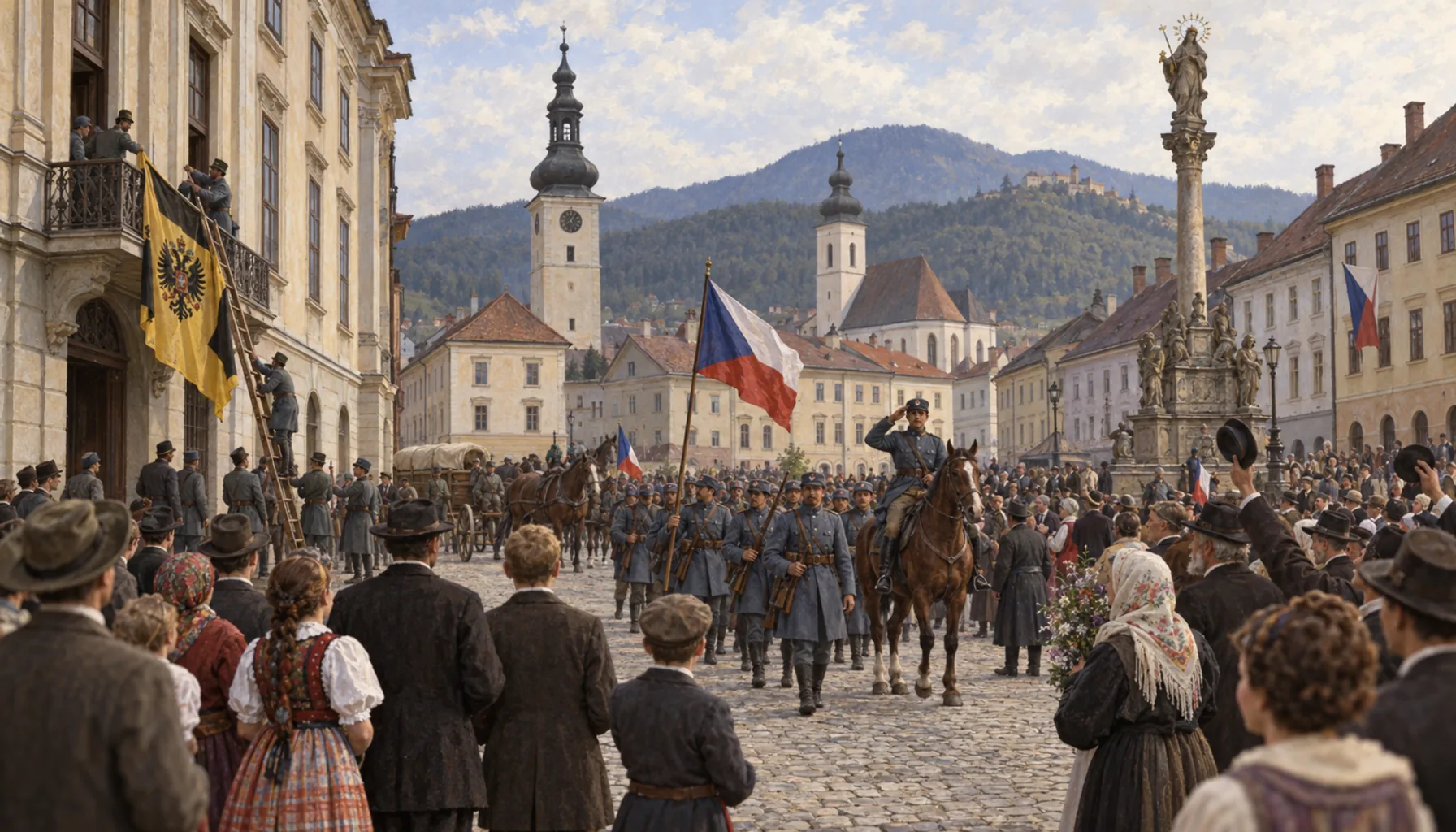
Austria-Hungary lost the war, and Banská Bystrica passed with the rest of the north to Czechoslovakia; the border was finally written down in the Treaty of Trianon in 1920. The town was the seat of Zvolen county until the counties were abolished in 1928. For the first time Slovak was the language of the school, the court and the office here. And the republic built: the Art Nouveau Kamenná vila in 1920, the Národný dom in 1928, a district health insurance office in 1930, a National Bank building in 1932, a teacher-training institute in 1934. Those twenty years gave a provincial mining town the institutions of a modern one — and in 1944 a rebel government would use every one of them.Rakúsko-Uhorsko vojnu prehralo a Banská Bystrica pripadla spolu s celým severom Československu; hranicu napokon spísala Trianonská zmluva v roku 1920. Mesto bolo sídlom Zvolenskej župy až do zrušenia žúp v roku 1928. Slovenčina sa tu prvý raz stala jazykom školy, súdu aj úradu. A republika stavala: secesnú Kamennú vilu v roku 1920, Národný dom v roku 1928, okresnú nemocenskú poisťovňu v roku 1930, budovu Národnej banky v roku 1932, učiteľský ústav v roku 1934. Tých dvadsať rokov dalo provinčnému banskému mestu inštitúcie moderného mesta — a v roku 1944 povstalecká vláda využila každú z nich.