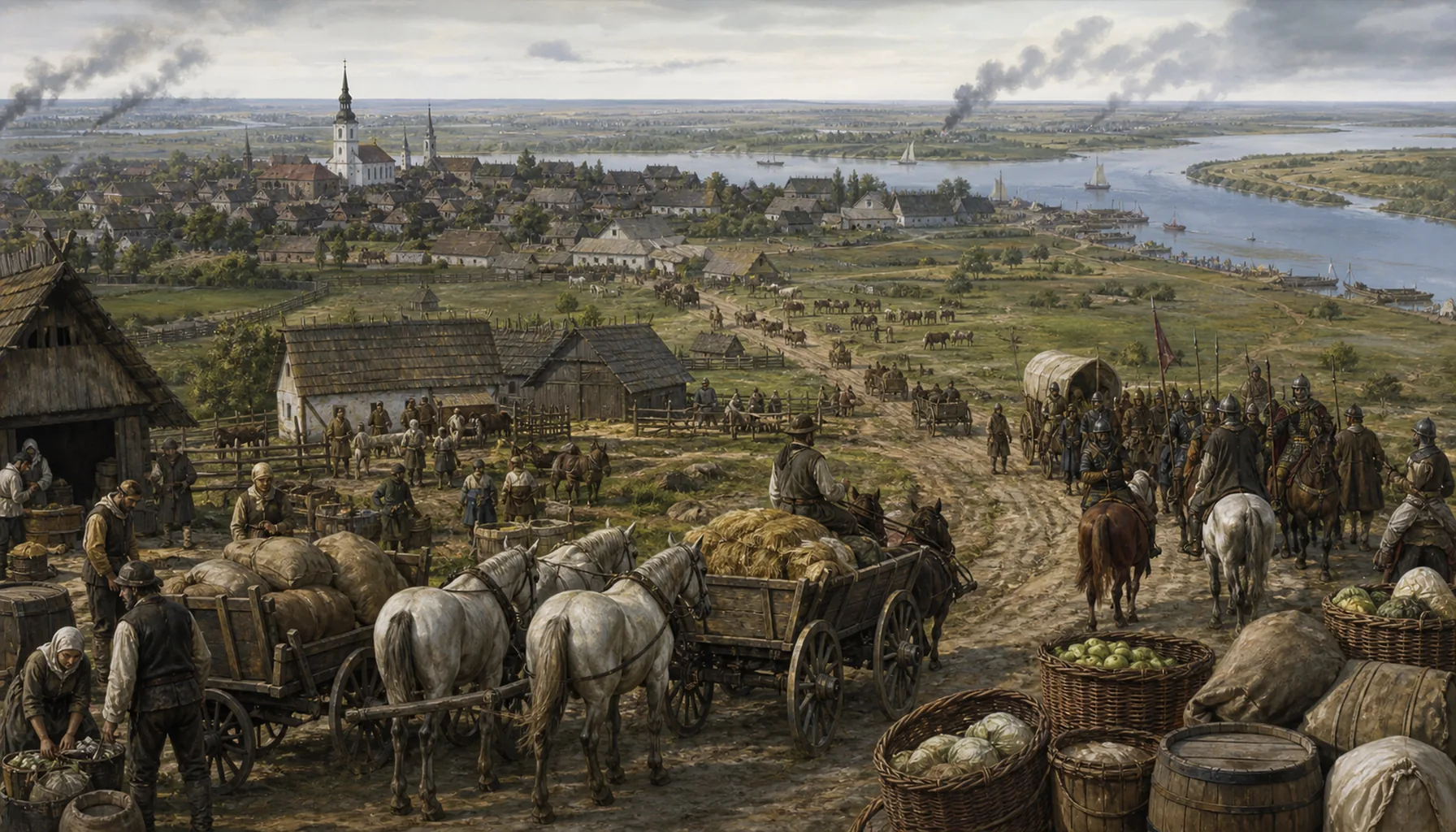
After the Hungarian army and its king were destroyed at Mohács in 1526 the kingdom broke into three, and Bratislava — forty-five kilometres upstream — became the capital and coronation town of what was left. That turned the Žitný ostrov into the capital's larder: grain, cattle, fish and flour from the island's floating water mills went up the river to feed Pozsony, its garrison and the assemblies of the kingdom that met there. In 1599 Szerdahely was granted to the Pálffy family as an entailed estate — a holding that could not legally be sold or divided, which is why it stayed with them for generations. The Ottoman frontier never crossed onto the island, but it came uncomfortably close: when the great fortress of Nové Zámky fell in 1663, Turkish-ruled territory began a day's ride from the island's eastern end.Po tom, čo roku 1526 zahynulo pri Moháči uhorské vojsko aj s kráľom, sa kráľovstvo rozpadlo na tri časti a Bratislava — štyridsaťpäť kilometrov proti prúdu — sa stala hlavným a korunovačným mestom toho, čo z Uhorska zostalo. Žitný ostrov sa tým zmenil na špajzu hlavného mesta: obilie, dobytok, ryby a múka z ostrovných lodných mlynov putovali po rieke do Bratislavy, jej posádke aj snemom, ktoré sa tam schádzali. Roku 1599 dostali Stredu Pálfiovci ako fideikomis — panstvo, ktoré sa nesmelo predať ani rozdeliť, a práve preto im zostalo po celé generácie. Osmanská hranica na ostrov nikdy neprešla, priblížila sa však nepríjemne blízko: keď roku 1663 padli Nové Zámky, turecké územie sa začínalo na deň jazdy od východného konca ostrova.