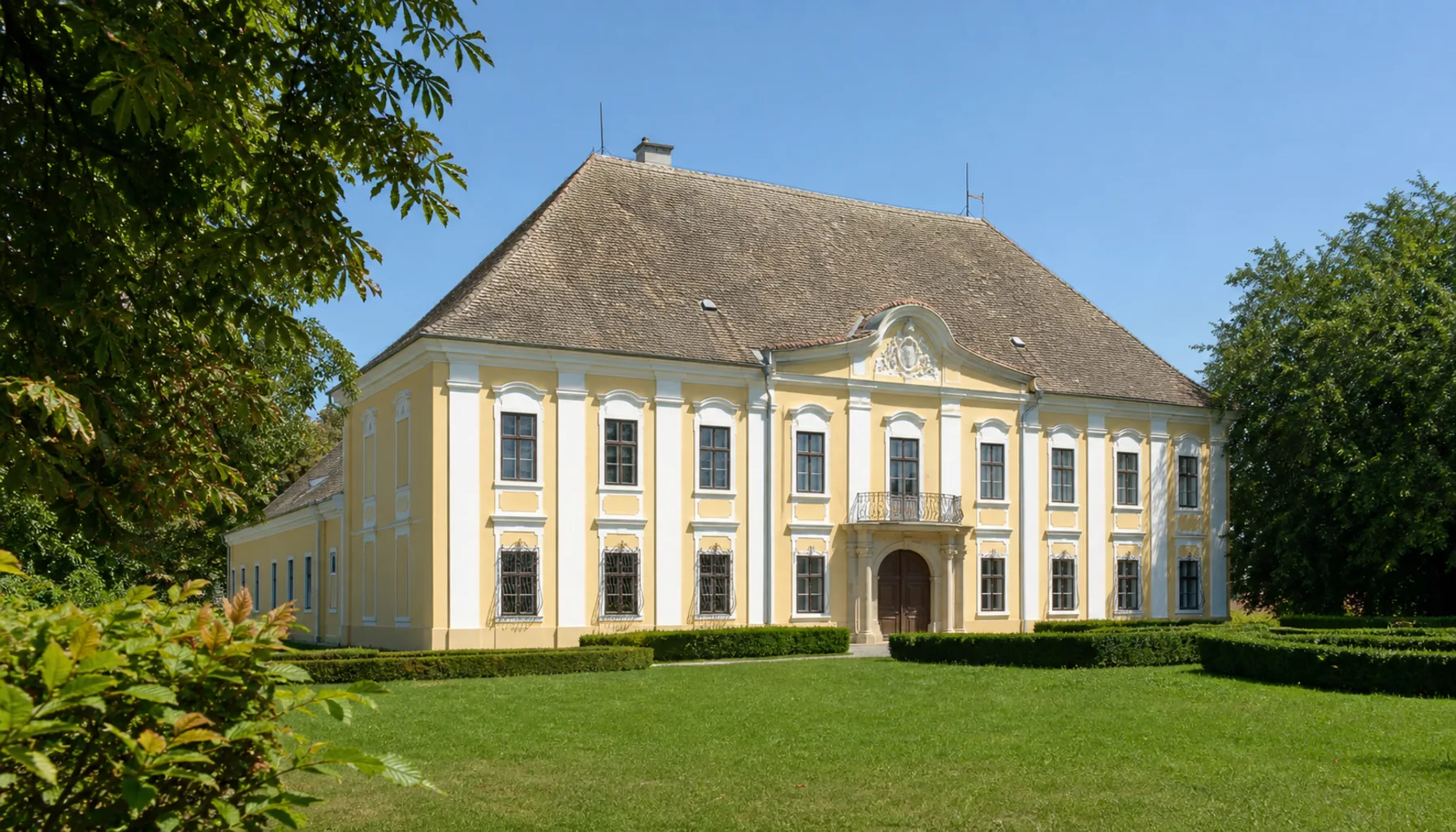
The town at the centre of the Žitný ostrov: a Hungarian-speaking market town in the middle of the Danube's island, standing on Central Europe's largest reserve of drinking groundwater, with the island's museum in a yellow baroque mansion and a football club that fills its stadium.Mesto v strede Žitného ostrova: maďarsky hovoriace trhové mesto uprostred dunajského ostrova, stojace na najväčšej zásobárni pitnej podzemnej vody v strednej Európe, s ostrovným múzeom v žltom barokovom kaštieli a futbalovým klubom, ktorý plní štadión.
The Yellow Mansion in Dunajská Streda, home of the Žitný Ostrov MuseumŽltý kaštieľ v Dunajskej Strede, sídlo Žitnoostrovného múzea
Where it standsKde leží
Dunajská Streda lies in the middle of the Žitný ostrov, the Rye Island — the largest river island in Europe, a flat wedge of gravel and silt between the Danube and the Little Danube, about forty-five kilometres east of Bratislava. Beneath it is the biggest store of drinking groundwater in Central Europe, which is why what happens on the surface here has been argued over for decades.Dunajská Streda leží uprostred Žitného ostrova — najväčšieho riečneho ostrova v Európe, plochého klina štrku a nánosov medzi Dunajom a Malým Dunajom, asi štyridsaťpäť kilometrov východne od Bratislavy. Pod ním sa nachádza najväčšia zásoba pitnej podzemnej vody v strednej Európe, a práve preto sa o tom, čo sa deje na povrchu, celé desaťročia vedú spory.
The landscape is completely level: fields, poplar rows, drainage canals and villages whose names come in two languages. Hungarian is the first language of most people in the town and in the district around it.Krajina je úplne rovinatá: polia, rady topoľov, odvodňovacie kanály a obce s názvami v dvoch jazykoch. Maďarčina je prvým jazykom väčšiny ľudí v meste aj v okolitom okrese.
The storyHistória
The town's name records its market: this was the Wednesday market place on the island, and the Hungarian name, Dunaszerdahely, says exactly the same thing. Trade in grain, cattle and produce off the island's rich soil kept it going for centuries without a castle, a mine or a garrison.Meno mesta zaznamenáva jeho trh: bolo to stredajšie trhovisko na ostrove a maďarský názov Dunaszerdahely hovorí presne to isté. Obchod s obilím, dobytkom a plodinami z úrodnej ostrovnej pôdy ho po stáročia držal pri živote bez hradu, bane či posádky.
After 1945 the town grew as the administrative centre of the island — district offices, schools, a hospital — while staying what it had always been: the place the surrounding countryside comes into.Po roku 1945 mesto rástlo ako správne stredisko ostrova — okresné úrady, školy, nemocnica — a zároveň zostalo tým, čím vždy bolo: miestom, kam prichádza okolitý vidiek.
What to seeČo vidieť
The Yellow Mansion, a late-baroque house painted the colour it is named for, holds the Žitný Ostrov Museum, whose collections cover the island's archaeology, its water management and its rural life. It is the one place that explains the island as a whole rather than a single village of it.Žltý kaštieľ, neskorobarokový dom natretý farbou, po ktorej sa volá, ukrýva Žitnoostrovné múzeum so zbierkami k archeológii ostrova, k vodnému hospodárstvu a k vidieckemu životu. Je to jediné miesto, ktoré vysvetľuje ostrov ako celok, nie len jednu jeho obec.
The town's civic passion is football. DAC Dunajská Streda plays in a modern stadium in the centre and has a following that reaches across the whole island and over the border; a match here is the most reliable way to hear what the town actually sounds like.Občianskou vášňou mesta je futbal. DAC Dunajská Streda hrá na modernom štadióne v centre a má fanúšikov na celom ostrove i za hranicou; zápas je najistejší spôsob, ako počuť, ako mesto naozaj znie.
A thermal swimming complex on the edge of town uses the same warm water as the other lowland spas. Around it the island is easy cycling country — flat lanes, the backwaters of the Little Danube, and the working water mills at Jelka and Dunajský Klátov — and the Gabčíkovo hydroelectric works on the Danube, a short drive south, is the largest engineering structure in the region.Termálny areál na okraji mesta využíva tú istú teplú vodu ako ostatné nížinné kúpaliská. Okolo neho je ostrov pohodlnou cyklistickou krajinou — rovné cesty, ramená Malého Dunaja a funkčné vodné mlyny v Jelke a v Dunajskom Klátove — a vodné dielo Gabčíkovo na Dunaji, kúsok autom na juh, je najväčšou inžinierskou stavbou v kraji.
Work and industryPráca a priemysel
Agriculture is the foundation. This is the most productive farmland in Slovakia and it is worked intensively — grain, maize, vegetables, dairy — with processors in the town and in the villages around it.Základom je poľnohospodárstvo. Ide o najúrodnejšiu pôdu na Slovensku a obrába sa intenzívne — obilie, kukurica, zelenina, mlieko — so spracovateľmi v meste aj v okolitých obciach.
Around it are food processing, engineering, building materials and a growing amount of logistics: the town is close enough to Bratislava that warehouses and light manufacturing have spread down the road towards it, and a large share of working-age people commute to the capital.Okolo neho stojí potravinárstvo, strojárstvo, výroba stavebných materiálov a čoraz viac logistiky: mesto je dosť blízko Bratislavy na to, aby sa sklady a ľahká výroba rozliali pozdĺž cesty k nej, a veľká časť ľudí v produktívnom veku dochádza do hlavného mesta.
Getting thereAko sa tam dostať
Trains on the Bratislava–Komárno line call at Dunajská Streda through the day, the expressway out of Bratislava has cut the drive considerably, and buses run to Bratislava, Šamorín and Galanta. The town is also the natural base for the cycle routes along the Danube dyke.Vlaky na trati Bratislava – Komárno zastavujú v Dunajskej Strede počas celého dňa, rýchlostná cesta z Bratislavy cestu autom výrazne skrátila a autobusy premávajú do Bratislavy, Šamorína a Galanty. Mesto je zároveň prirodzeným východiskom pre cyklotrasy po dunajskej hrádzi.
Explore Dunajská StredaObjavujte Dunajská Streda
Every part of this place with a page of its own.Každá časť tohto miesta, ktorá má vlastnú stránku.