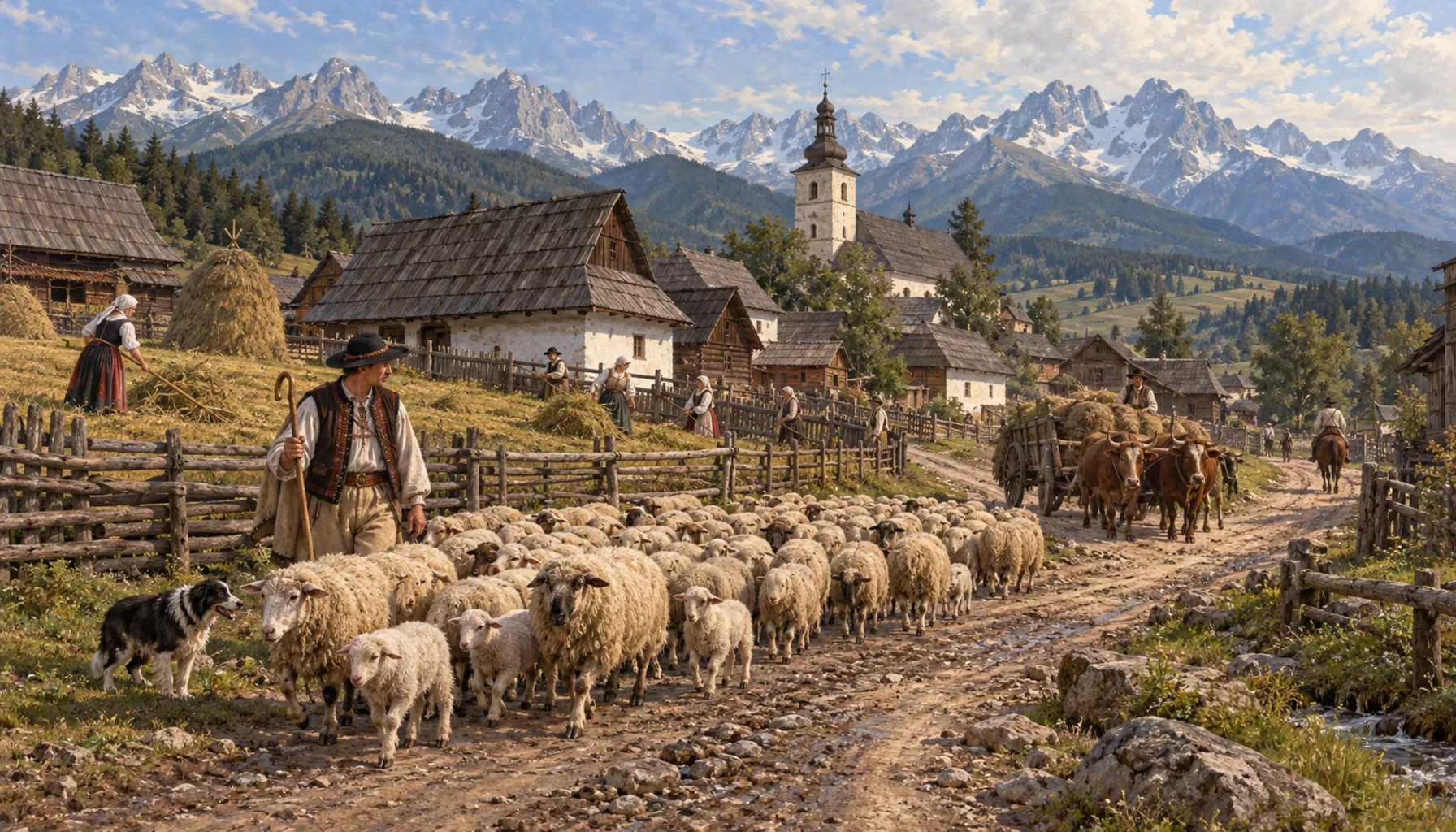
Under Austria-Hungary the economy of Osturňa stayed what it had been at the founding: agricultural and pastoral, sheep first. The Spiš highlands were among the poorest parts of the kingdom, and from the 1880s onward emigration to the United States pulled young people out of village after village across Spiš and Šariš — the standard escape from an arithmetic that no longer worked. No emigration figures for Osturňa itself are quoted on this page, because the sources used here do not give any; what is certain is that the village never again held the 1,809 people it held in 1828. The photographs of relatives who went abroad, hung on the wall of the front room, became a normal part of how a house in this valley was furnished.Za Rakúsko-Uhorska zostalo hospodárstvo Osturne také, aké bolo pri založení: poľnohospodársko-pastierske, na prvom mieste ovce. Spišské vrchy patrili k najchudobnejším častiam kráľovstva a od osemdesiatych rokov 19. storočia odsávalo vysťahovalectvo do Spojených štátov mladých ľudí z jednej spišskej a šarišskej dediny za druhou — bežné východisko z aritmetiky, ktorá už nevychádzala. Konkrétne čísla vysťahovalcov z Osturne tu neuvádzame, lebo ich použité pramene nedávajú; isté je, že obec už nikdy nemala 1 809 ľudí ako roku 1828. Fotografie príbuzných, ktorí odišli do sveta, zavesené na stene v prednej izbe, sa stali celkom bežnou súčasťou zariadenia tunajšieho domu.