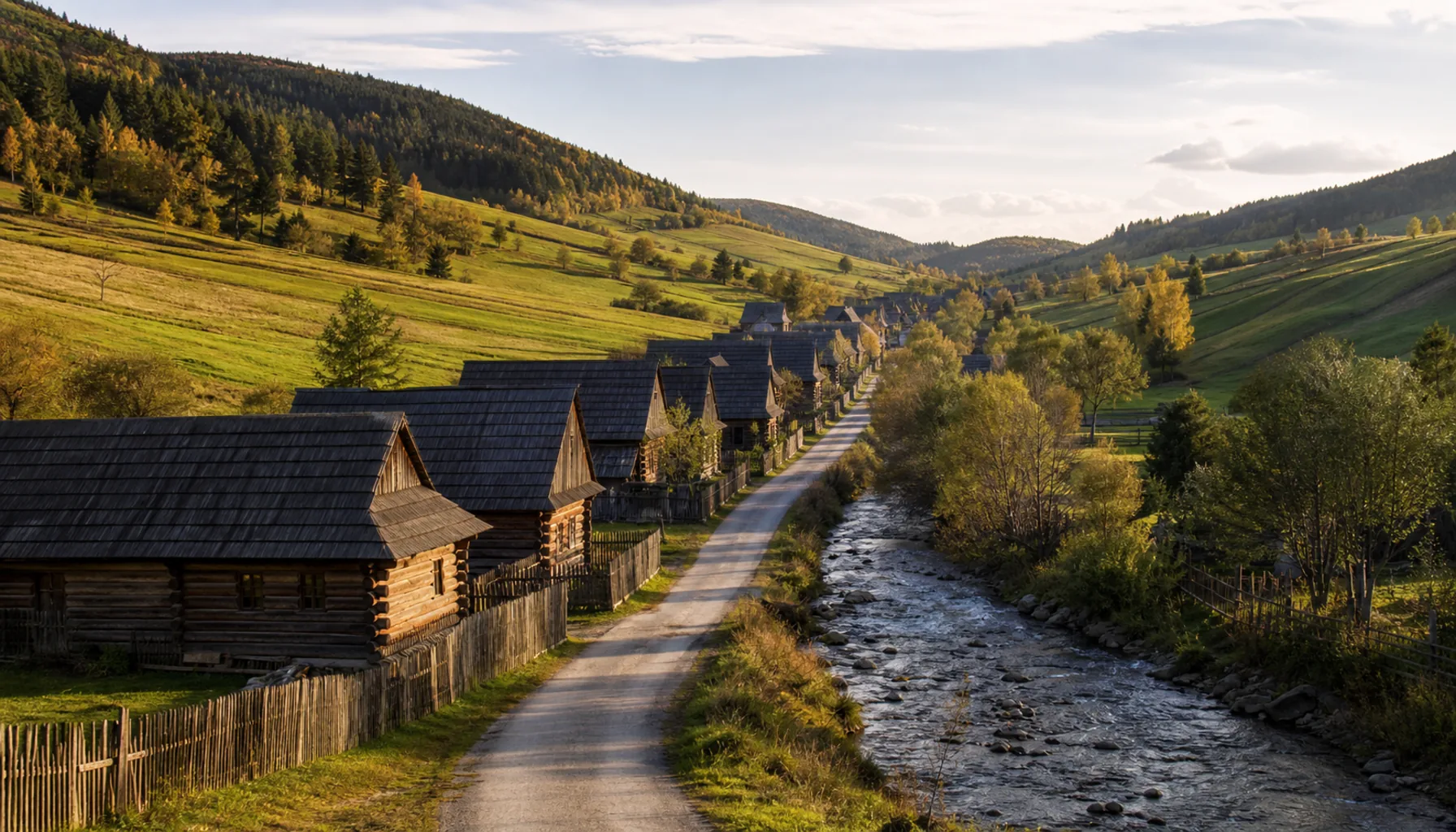
A Rusyn village in Zamagurie that runs for kilometres along a single stream — one of the longest villages in Slovakia, and protected whole as a reserve of folk architecture rather than as a handful of listed houses.Rusínska obec v Zamagurí, ktorá sa tiahne kilometre popri jedinom potoku — jedna z najdlhších dedín na Slovensku, chránená ako celok v pamiatkovej rezervácii ľudovej architektúry, nie ako hŕstka jednotlivých domov.
The single street of Osturňa running away between log houses and fieldsJediná ulica Osturne miznúca medzi zrubovými domami a poliami
Where it standsKde leží
Osturňa lies in the Spišská Magura, in the folded country between the Tatras and the Dunajec, a few kilometres short of the Polish border. There is one road and one stream and the village follows both, its houses in loose ranks along the valley floor while the fields and pasture climb the slopes on either side.Osturňa leží v Spišskej Magure, vo zvlnenej krajine medzi Tatrami a Dunajcom, pár kilometrov od poľskej hranice. Vedie tadiaľ jedna cesta a tečie jeden potok a obec sleduje oboje — domy v redších radoch po dne doliny, kým polia a pasienky stúpajú po svahoch na obe strany.
Spišská Stará Ves, the small town of Zamagurie, is down the valley to the east; over the Magura to the south-west lies Ždiar and the Tatra road.Spišská Stará Ves, mestečko Zamaguria, je dolu dolinou na východ; za Magurou na juhozápade leží Ždiar a tatranská cesta.
Why it is herePrečo práve tu
The village is a late foundation, first recorded in the seventeenth century and settled by Rusyn shepherding colonists working their way west along the Carpathian ranges. It is usually described as the westernmost Rusyn settlement in Slovakia, and it is Greek Catholic, which sets it apart from the Slovak Catholic villages one valley away.Obec je neskorou fundáciou, prvý raz doloženou v 17. storočí a osídlenou rusínskymi pastierskymi kolonistami, ktorí postupovali po karpatských pohoriach na západ. Býva označovaná za najzápadnejšie rusínske sídlo na Slovensku a je gréckokatolícka, čím sa líši od slovenských katolíckych dedín o dolinu ďalej.
Its length follows from how the land was divided. Each household held a strip running from the stream up the hillside — meadow at the bottom, arable in the middle, pasture and wood at the top — and built at the road end of its own strip. String enough of those strips together and you get a village several kilometres long with no centre to speak of.Jej dĺžka vyplýva z toho, ako bola rozdelená pôda. Každé gazdovstvo držalo pás vedúci od potoka hore do svahu — dole lúka, v strede oráčina, hore pasienok a les — a stavalo na konci vlastného pásu pri ceste. Poskladajte dosť takýchto pásov vedľa seba a vznikne obec dlhá niekoľko kilometrov, ktorá poriadny stred ani nemá.
The twentieth century emptied a great deal of it. A good number of the houses now stand unused or serve as second homes, and the protection came as the village was thinning out rather than while it was full.Dvadsiate storočie ju z veľkej časti vyprázdnilo. Nemálo domov dnes stojí nevyužitých alebo slúži ako chalupy a ochrana prišla vtedy, keď obec redla, nie keď bola plná.
What you actually seeČo naozaj uvidíte
The houses are log-built and mostly unpainted, dark with age and weather, standing gable-end to the road with the barn and the yard behind. The scale is small and the repetition is the point: the same house, the same gate, the same fence, over and over, for as long as the valley goes on.Domy sú zrubové a väčšinou nemaľované, tmavé od veku a počasia, stoja štítom k ceste a maštaľ s dvorom majú za sebou. Mierka je malá a podstatou je opakovanie: ten istý dom, tá istá bránka, ten istý plot, znova a znova, tak dlho, ako trvá dolina.
The Greek Catholic church is the one building of any scale, and it stands apart from the domestic architecture as such churches usually do here.Gréckokatolícky chrám je jedinou stavbou väčšej mierky a od obytnej architektúry sa odlišuje, ako to na týchto miestach býva.
In the woods above the village lie small lakes formed by landslips on the slopes, protected as a nature reserve and reached on marked paths. They are quiet, shallow and unspectacular, and they suit the place.V lesoch nad obcou ležia malé jazerá, ktoré vznikli zosuvmi svahov, chránené ako prírodná rezervácia a prístupné po značených chodníkoch. Sú tiché, plytké a nijako veľkolepé — a tomuto miestu to sedí.
Living village, not a museumŽivá obec, nie skanzen
Osturňa is inhabited, but thinly, and there is no visitor apparatus here at all. Nothing is ticketed, no museum house is reliably open, and the church is a working church rather than an exhibit. What the village offers is a street several kilometres long, and the way it changes as you walk it.Osturňa je obývaná, no riedko, a návštevnícku infraštruktúru tu nenájdete žiadnu. Nič sa neplatí, nijaký múzejný dom nie je spoľahlivo otvorený a chrám je funkčným chrámom, nie exponátom. To, čo obec ponúka, je ulica dlhá niekoľko kilometrov a to, ako sa mení, kým ňou idete.
Services are minimal and nothing should be counted on being open when you arrive; bring food and water. The houses are private property, including the empty ones — an unused log house is still somebody's.Služby sú minimálne a na nič sa nedá spoľahnúť, že bude po príchode otvorené; jedlo a vodu si vezmite so sebou. Domy sú súkromné vrátane tých prázdnych — nevyužitá drevenica je stále niečia.
Getting thereAko sa tam dostať
There is no railway. Buses run from Spišská Stará Ves and Kežmarok; by car it is a signposted turn off the Zamagurie road. Once there, walking or cycling the length of the village is the natural way to see it, since the whole village is the monument and no single point of it is.Železnica sem nevedie. Autobusy premávajú zo Spišskej Starej Vsi a z Kežmarku, autom ide o značenú odbočku zo zamagurskej cesty. Na mieste je prirodzené prejsť obec pešo alebo na bicykli po celej dĺžke, lebo pamiatkou je celá dedina a nie jedno jej miesto.
Explore OsturňaObjavujte Osturňa
Every part of this place with a page of its own.Každá časť tohto miesta, ktorá má vlastnú stránku.