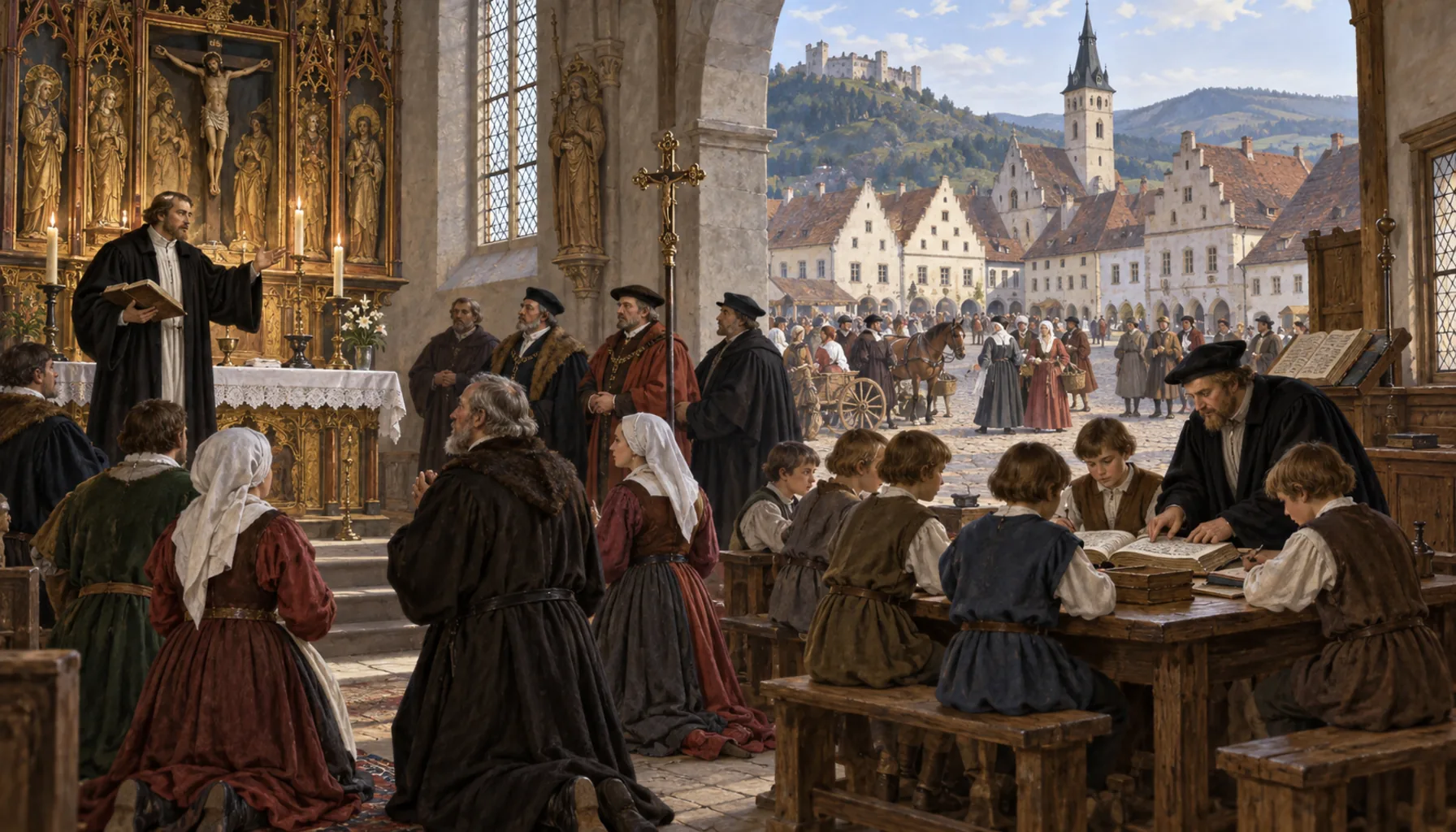
The five towns of the Pentapolitana adopted the Reformation together in the sixteenth century, and Sabinov's Lutheran school became known well beyond its own district — for a while, teaching was the thing this town was best at. In 1530 it built a lyceum, a secondary school, in the Renaissance style, and in 1657 it finished the free-standing bell tower beside the church in the plain, heavily corniced manner known as the east Slovak Renaissance; the bell hanging inside was already nearly two hundred years old, cast in 1470. The church's greatest treasure, a late Gothic winged altar from the workshop of Master Paul of Levoča, is no longer here: the original went to a museum in Budapest in the nineteenth century, and what stands in the church is the altar as it was reconstructed in the 1970s.Päť miest Pentapolitany prijalo v 16. storočí reformáciu spoločne a sabinovská evanjelická škola sa preslávila ďaleko za hranicami okresu — istý čas bolo školstvo tým, v čom bolo toto mesto najlepšie. V roku 1530 tu postavili renesančné lýceum, teda strednú školu, a v roku 1657 dokončili pri kostole voľne stojacu zvonicu v strohom slohu s výraznou atikou, ktorému sa hovorí východoslovenská renesancia; zvon v nej mal vtedy už takmer dvesto rokov, odliaty bol roku 1470. Najväčší poklad kostola, neskorogotický krídlový oltár z dielne Majstra Pavla z Levoče, tu už nie je: originál sa v 19. storočí dostal do budapeštianskeho múzea a v kostole stojí oltár v podobe, do akej ho zrekonštruovali v sedemdesiatych rokoch 20. storočia.