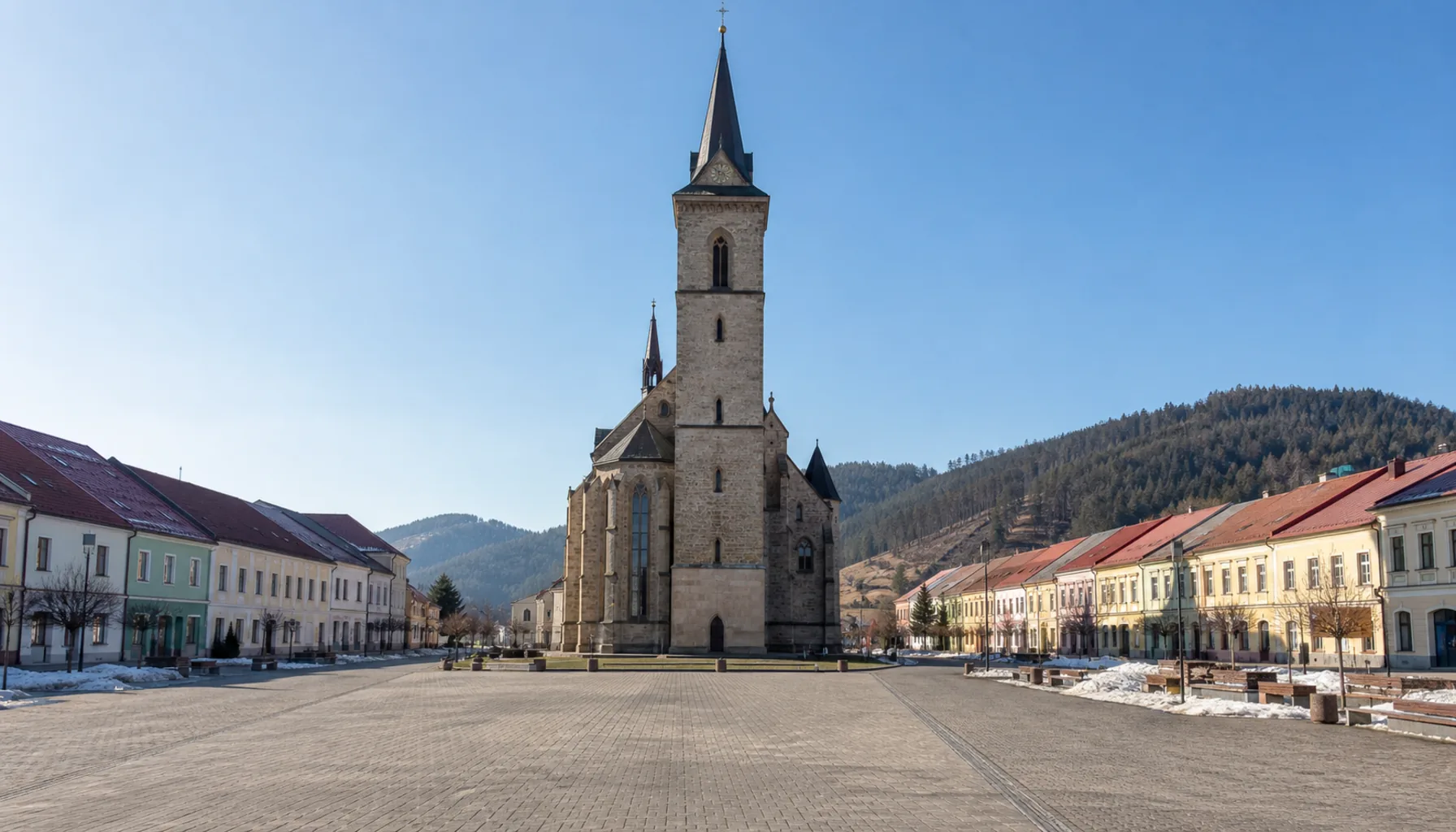
A small town on the Torysa north of Prešov, once one of the five royal free towns of upper Hungary, with a Gothic parish church standing free in its square and a long engineering tradition behind it.Malé mesto na Toryse severne od Prešova, kedysi jedno z piatich slobodných kráľovských miest horného Uhorska, s gotickým farským kostolom stojacim voľne na námestí a s dlhou strojárskou tradíciou.
The Gothic church of St John the Baptist standing free in the square at SabinovGotický Kostol svätého Jána Krstiteľa stojaci voľne na sabinovskom námestí
Where it standsKde leží
Sabinov lies on the Torysa about twenty kilometres north of Prešov, where the valley narrows between the Šariš Highlands and the Levoča Hills. The road through it is the old route from Prešov to Spiš and on to Poland.Sabinov leží na Toryse asi dvadsať kilometrov severne od Prešova, kde sa dolina zužuje medzi Šarišskou vrchovinou a Levočskými vrchmi. Cesta, ktorá ním prechádza, je stará trasa z Prešova na Spiš a ďalej do Poľska.
Prešov is close enough that Sabinov functions in part as a commuter town, but it kept its own square and its own history.Prešov je natoľko blízko, že Sabinov sčasti funguje ako mesto dochádzajúcich, no zachoval si vlastné námestie aj vlastné dejiny.
The storyHistória
Sabinov was a free royal town and, with Bardejov, Levoča, Prešov and Košice, a member of the Pentapolitana — the league of the five royal towns of upper Hungary, which acted together in trade and defence and in the sixteenth century adopted the Reformation together.Sabinov bol slobodným kráľovským mestom a spolu s Bardejovom, Levočou, Prešovom a Košicami členom Pentapolitany — zväzu piatich hornouhorských kráľovských miest, ktoré spoločne postupovali v obchode aj v obrane a v 16. storočí spoločne prijali reformáciu.
It had walls, a moat and gates, and a Lutheran school with a name beyond the district. Fires, the anti-Habsburg uprisings and the loss of the Polish trade cut it back to a country town and it stayed one; fragments of the walls and the shape of the square are what the wealthier centuries left behind.Malo hradby, priekopu a brány aj evanjelickú školu, o ktorej sa vedelo aj za hranicami okolia. Požiare, protihabsburské povstania a strata poľského obchodu ho zmenšili na vidiecke mestečko a tým aj zostalo; zo zámožnejších storočí zvyšujú úlomky hradieb a tvar námestia.
The railway up the Torysa reached the town in the later nineteenth century and pulled it back into the wider economy. What gave Sabinov its present size, though, was the industry of the twentieth: the works on the edge of town, and the housing built for the people who came to it from the villages.Železnica dolinou Torysy prišla do mesta v druhej polovici 19. storočia a vrátila ho do širšieho hospodárstva. Dnešnú veľkosť mu však dal až priemysel 20. storočia: závod na okraji mesta a byty postavené pre ľudí, ktorí do neho prišli z dedín.
What to seeČo vidieť
The Church of St John the Baptist on the square is Gothic, fourteenth- and fifteenth-century, with a tall nave and a later tower; the Renaissance building beside it housed the town school. Sections of the town wall survive at the edge of the old centre.Kostol svätého Jána Krstiteľa na námestí je gotický, zo 14. a 15. storočia, s vysokou loďou a neskoršou vežou; v renesančnej budove vedľa neho sídlila mestská škola. Na okraji starého jadra sa zachovali úseky mestských hradieb.
The square itself is the point: a long widening street of low burgher houses with the church standing free in the middle of it — the same plan as Prešov and Bardejov, at a quarter of the scale.Samotné námestie je tým hlavným: dlhá rozširujúca sa ulica nízkych meštianskych domov s kostolom stojacim voľne uprostred — rovnaký pôdorys ako v Prešove či Bardejove, len vo štvrtinovej mierke.
Sabinov works better as a base than as a destination. The Torysa valley leads north to Lipany and over the watershed into Spiš, the hills on either side carry marked trails, and the ruin of Šariš Castle, the largest in the region, stands on its hill half an hour to the south.Sabinov poslúži skôr ako základňa než ako cieľ. Dolina Torysy vedie na sever k Lipanom a cez rozvodie na Spiš, kopce po oboch stranách nesú značené chodníky a zrúcanina Šarišského hradu, najväčšia v kraji, stojí na svojom kopci pol hodiny na juh.
Work and industryPráca a priemysel
Engineering is the town's trade: the works here has built industrial gearboxes for decades and remains the best-known employer. Food processing, timber and the building trades follow, and a large share of working people commute to Prešov.Remeslom mesta je strojárstvo: tunajší závod už desaťročia vyrába priemyselné prevodovky a zostáva najznámejším zamestnávateľom. Nasleduje potravinárstvo, drevo a stavebníctvo a veľká časť pracujúcich dochádza do Prešova.
Farming in the Torysa valley is mixed — cereals and cattle on the gentler ground, forestry on the slopes — and the smaller villages of the district live off both that and work in the towns.Hospodárenie v doline Torysy je zmiešané — obilie a dobytok na miernejšom teréne, lesníctvo na svahoch — a menšie obce okresu žijú z neho aj z práce v mestách.
Getting thereAko sa tam dostať
Sabinov is on the railway from Prešov to Lipany and Plaveč, with buses running the same route more often; the main road north out of Prešov passes through the town.Sabinov leží na železnici z Prešova do Lipian a Plavča, autobusy po tej istej trase premávajú častejšie; mestom prechádza hlavná cesta z Prešova na sever.
Explore SabinovObjavujte Sabinov
Every part of this place with a page of its own.Každá časť tohto miesta, ktorá má vlastnú stránku.