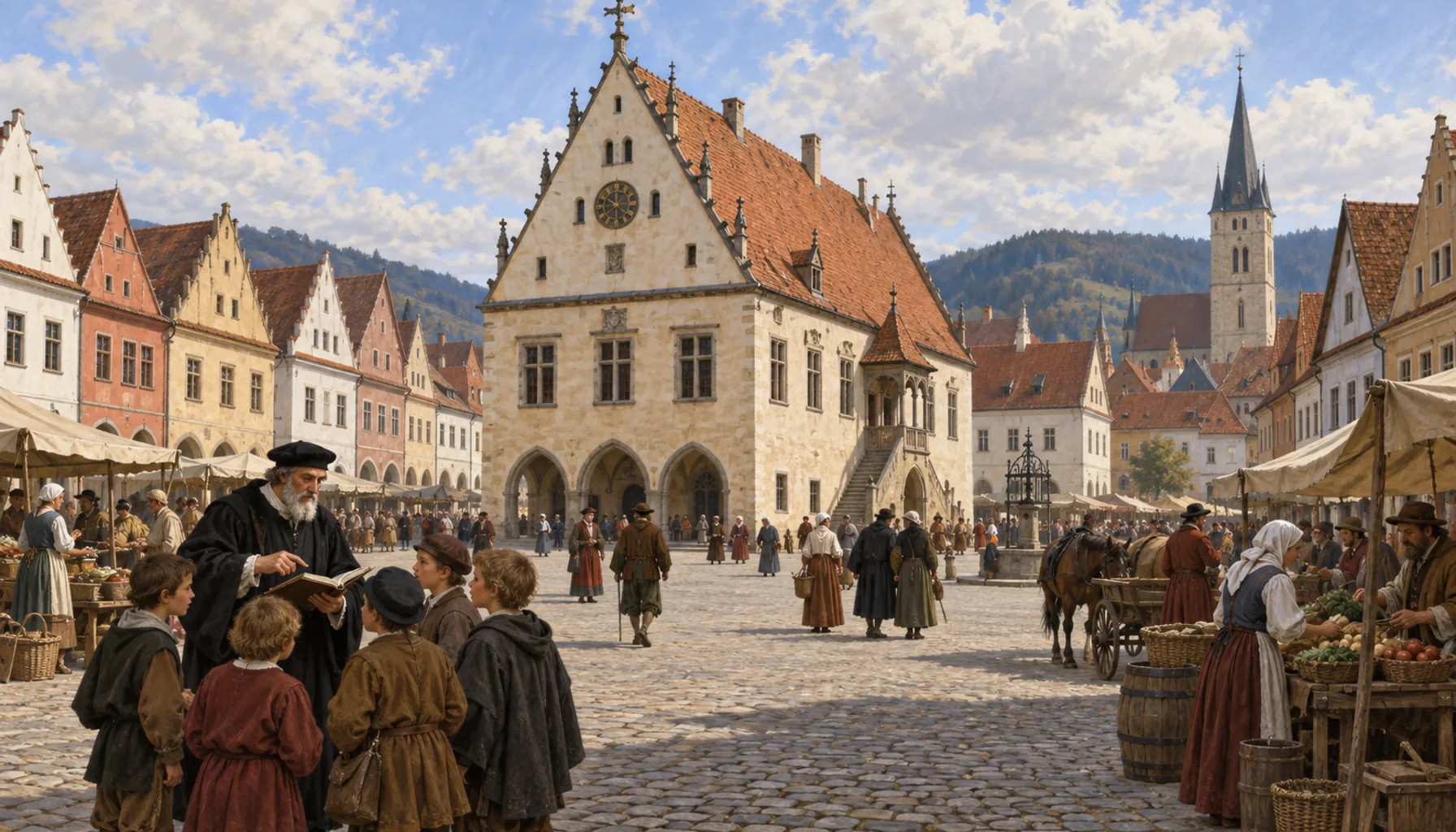
The building in the middle of the square went up from 1505, begun by a master called Alexander and finished by masters Alexius and John of Prešov. Its lower half is Gothic and its upper half Renaissance, because taste changed while it was being built, and it is usually called the first Renaissance building in Slovakia. The Reformation reached Bardejov in the same generation and the town became Lutheran. Its schoolmaster, Leonard Stöckel, was born here, studied in Wittenberg under Melanchthon, came home in 1539 to run the town school, and made it the best in Upper Hungary; in 1549 he wrote the Confessio Pentapolitana, the statement of belief of the five allied towns. One curious result of everything that came later: most towns lost their medieval altars to fire, to Baroque refitting or to sale. Bardejov, poor and out of the way once its golden age ended, kept eleven of them, and they are still standing in St Giles.Budova uprostred námestia rástla od roku 1505; začal ju majster Alexander a dokončili majstri Alexius a Ján z Prešova. Spodná časť je gotická, horná renesančná, lebo počas stavby sa zmenil vkus — a preto sa radnica bežne označuje za prvú renesančnú stavbu na Slovensku. V tej istej generácii prišla do Bardejova reformácia a mesto sa stalo evanjelickým. Jeho rektor Leonard Stöckel sa tu narodil, študoval vo Wittenbergu u Melanchthona, v roku 1539 sa vrátil domov viesť mestskú školu a urobil z nej najlepšiu v Hornom Uhorsku. V roku 1549 napísal Confessio Pentapolitana, vierovyznanie piatich spojených miest. A jeden zvláštny dôsledok všetkého, čo prišlo potom: väčšina miest o svoje stredoveké oltáre prišla — zhoreli, ustúpili baroku alebo sa predali. Bardejov, chudobný a bokom od ciest, si ich jedenásť ponechal a dodnes stoja v Bazilike svätého Egídia.