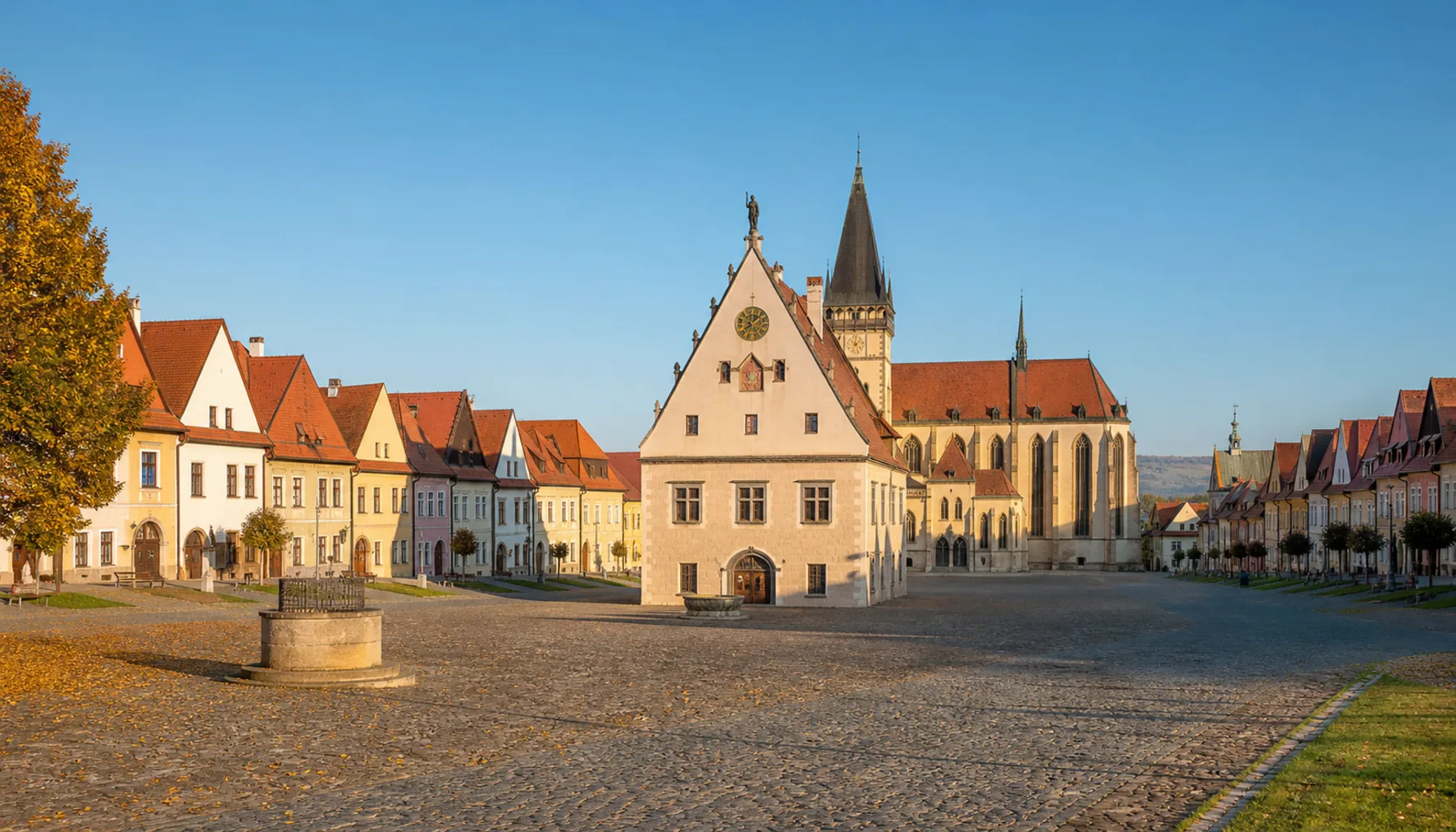
A complete medieval town centre — a long square of Gothic and Renaissance burgher houses, a basilica holding eleven winged altars, and a wall circuit nobody ever pulled down. The town is on the UNESCO World Heritage List.Kompletné stredoveké jadro — dlhé námestie gotických a renesančných meštianskych domov, bazilika s jedenástimi krídlovými oltármi a opevnenie, ktoré nikto nikdy nezbúral. Mesto je v Zozname svetového dedičstva UNESCO.
The long square of Bardejov, with the town hall in the middle and the basilica at its headDlhé bardejovské námestie s radnicou uprostred a bazilikou v jeho čele
Where it standsKde leží
Bardejov stands on the Topľa in the north of Šariš, in the foothills of the Low Beskids about forty kilometres north of Prešov and a short drive from the Polish border. The hills around it are rounded and forested, cut by narrow valleys with villages of a few hundred people in them.Bardejov leží na Topli na severe Šariša, v podhorí Nízkych Beskýd asi štyridsať kilometrov severne od Prešova a na skok od poľskej hranice. Okolité kopce sú oblé a zalesnené, popretínané úzkymi dolinami s obcami po niekoľko sto obyvateľov.
The spa, Bardejovské Kúpele, lies a few kilometres up the valley to the north and works as a separate quarter of the town, with its own park, colonnade and open-air museum.Kúpele — Bardejovské Kúpele — ležia pár kilometrov dolinou na sever a fungujú ako samostatná časť mesta s vlastným parkom, kolonádou a skanzenom.
The storyHistória
The town grew on the trade road to Poland and reached its height in the fifteenth century, when its cloth and linen merchants were wealthy enough to build the square that survives. It was a free royal town and a member of the Pentapolitana, the league of five upper-Hungarian royal towns that also included Prešov, Levoča, Sabinov and Košice.Mesto vyrástlo na obchodnej ceste do Poľska a vrchol dosiahlo v 15. storočí, keď boli jeho súkenníci a plátenníci dosť bohatí na to, aby postavili námestie, ktoré stojí dodnes. Bolo slobodným kráľovským mestom a členom Pentapolitany, zväzu piatich hornouhorských kráľovských miest, kam patrili aj Prešov, Levoča, Sabinov a Košice.
Decline came with the wars and the shifting of the trade routes, and for three centuries little was built here and less was pulled down. That is why the fifteenth- and sixteenth-century town is still legible: the restoration of the square in the 1970s and 1980s earned an international conservation award, and the historic centre was inscribed on the World Heritage List in 2000.Úpadok priniesli vojny a presun obchodných ciest a tri storočia sa tu takmer nestavalo — a ešte menej búralo. Preto je mesto 15. a 16. storočia dodnes čitateľné: obnova námestia v 70. a 80. rokoch získala medzinárodné ocenenie za pamiatkovú starostlivosť a historické jadro zapísali v roku 2000 do zoznamu svetového dedičstva.
What to seeČo vidieť
The Basilica of St Giles at the head of the square holds eleven late-Gothic winged altars — an unusual survival, since most towns lost theirs to fire, Baroque taste or sale. The tower can be climbed in season for the view over the roofs and the walls.Bazilika svätého Egídia v čele námestia ukrýva jedenásť neskorogotických krídlových oltárov — výnimočné zachovanie, veď väčšina miest o svoje prišla pri požiaroch, barokových prestavbách alebo predajom. Na vežu sa dá v sezóne vystúpiť kvôli výhľadu na strechy a hradby.
The town hall standing free in the middle of the square, finished in the first decade of the sixteenth century, mixes Gothic and Renaissance and is usually called the first Renaissance building in Slovakia; part of the Šariš Museum is inside it. The walls, with their bastions and gates, can be followed almost the whole way round the old town.Radnica stojaca voľne uprostred námestia, dokončená v prvom desaťročí 16. storočia, mieša gotiku s renesanciou a býva označovaná za prvú renesančnú stavbu na Slovensku; sídli v nej časť Šarišského múzea. Hradby s baštami a bránami sa dajú sledovať takmer po celom obvode starého mesta.
Bardejovské Kúpele adds a nineteenth-century spa park with drinking springs and the oldest open-air museum in Slovakia — Šariš farmsteads and two wooden churches moved here from the villages. Empress Elisabeth is among the guests recorded at the spa. The hills around the town hold one of the densest concentrations of wooden churches in the country; the one at Hervartov, a short drive south-west, is the oldest to survive.Bardejovské Kúpele k tomu pridávajú kúpeľný park z 19. storočia s pitnými prameňmi a najstarší skanzen na Slovensku — šarišské usadlosti a dva drevené chrámy prenesené sem z dedín. Medzi hosťami kúpeľov je zapísaná aj cisárovná Alžbeta. V kopcoch okolo mesta je jedna z najhustejších koncentrácií drevených kostolíkov v krajine; ten v Hervartove kúsok na juhozápad je najstarší zachovaný.
Work and industryPráca a priemysel
Bardejov lives off tourism, the spa, public services and light manufacturing — shoes and clothing were the town's twentieth-century trades, and engineering and food processing carry on beside them. The district is one of the country's weaker ones economically, and work abroad is common.Bardejov žije z cestovného ruchu, kúpeľov, verejných služieb a ľahkého priemyslu — obuv a odevy boli jeho remeslom v 20. storočí a popri nich pokračuje strojárstvo a potravinárstvo. Okres patrí k hospodársky slabším a práca v zahraničí je bežná.
Forestry is the background industry of the whole district; timber lorries on the valley roads are a constant.Lesníctvo je pozadím celého okresu; nákladné autá s drevom sú na dolinových cestách stálicou.
Getting thereAko sa tam dostať
A branch railway comes up from Prešov, but buses are more frequent and usually faster; the main road from Prešov continues past the town to the Polish border crossing. Bardejovské Kúpele is a few minutes out by local bus.Z Prešova sem vedie odbočná železnica, ale autobusy sú častejšie a spravidla rýchlejšie; hlavná cesta z Prešova pokračuje za mestom k hraničnému priechodu do Poľska. Do Bardejovských Kúpeľov je to mestským autobusom pár minút.
Explore BardejovObjavujte Bardejov
Every part of this place with a page of its own.Každá časť tohto miesta, ktorá má vlastnú stránku.