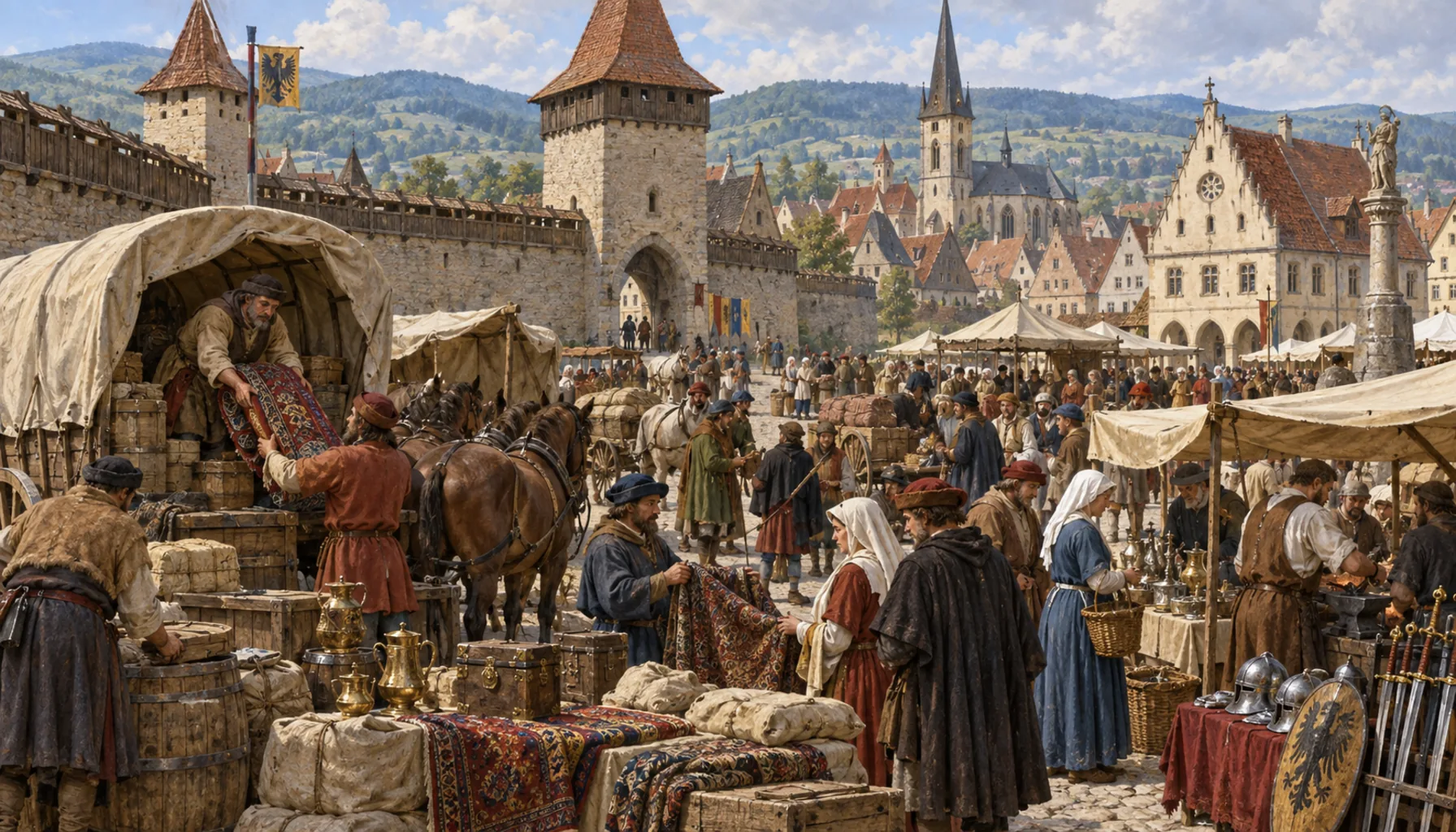
In 1402 King Sigismund gave the town the staple right: merchants passing through had to unload and offer their goods for sale in Bardejov before travelling on. It is a licence to skim every caravan on the road, and it made the town wealthy. Between 1405 and 1407 a builder from Nuremberg turned the gate tower into a small fortified castle with its own garrison, and the walls went up around the whole town. In October 1410 a Polish army defeated a Hungarian force near Bardejov in the short war that followed the great battle at Grunwald; through the 1440s and 1450s the whole east was held by Ján Jiskra of Brandýs, a Bohemian captain hired to keep it for an infant king, and the royal towns learned to bargain with whoever had soldiers. Bardejov bound itself to Košice, Levoča, Prešov and Sabinov in a league called the Pentapolitana, the five towns. At its height it had more than fifty guilds covering sixty-four separate crafts, its speciality being linen bleached in the meadows by the river, and in 1464 the great church of St Giles was finished.V roku 1402 udelil kráľ Žigmund mestu právo skladu: kupci, ktorí tadiaľto prechádzali, museli tovar v Bardejove vyložiť a najprv ho ponúknuť na predaj tu. Bola to v podstate licencia zdaniť každú karavánu na ceste a mesto na nej zbohatlo. V rokoch 1405 – 1407 prestaval majster z Norimbergu bránovú vežu na malý opevnený hrádok s vlastnou posádkou a okolo celého mesta vyrástli hradby. V októbri 1410 porazilo poľské vojsko pri Bardejove uhorský oddiel v krátkej vojne, ktorá nasledovala po veľkej bitke pri Grunwalde. V 40. a 50. rokoch držal celý východ Ján Jiskra z Brandýsa, český veliteľ najatý, aby ho udržal pre maloletého kráľa, a kráľovské mestá sa naučili vyjednávať s tým, kto mal práve vojakov. Bardejov sa spojil s Košicami, Levočou, Prešovom a Sabinovom do zväzu piatich miest, ktorý sa volal Pentapolitana. V najlepších časoch tu bolo vyše päťdesiat cechov a šesťdesiatštyri remeselných špecializácií; hlavným artiklom bolo plátno, bielené na lúkach pri rieke. V roku 1464 dokončili veľký kostol svätého Egídia.