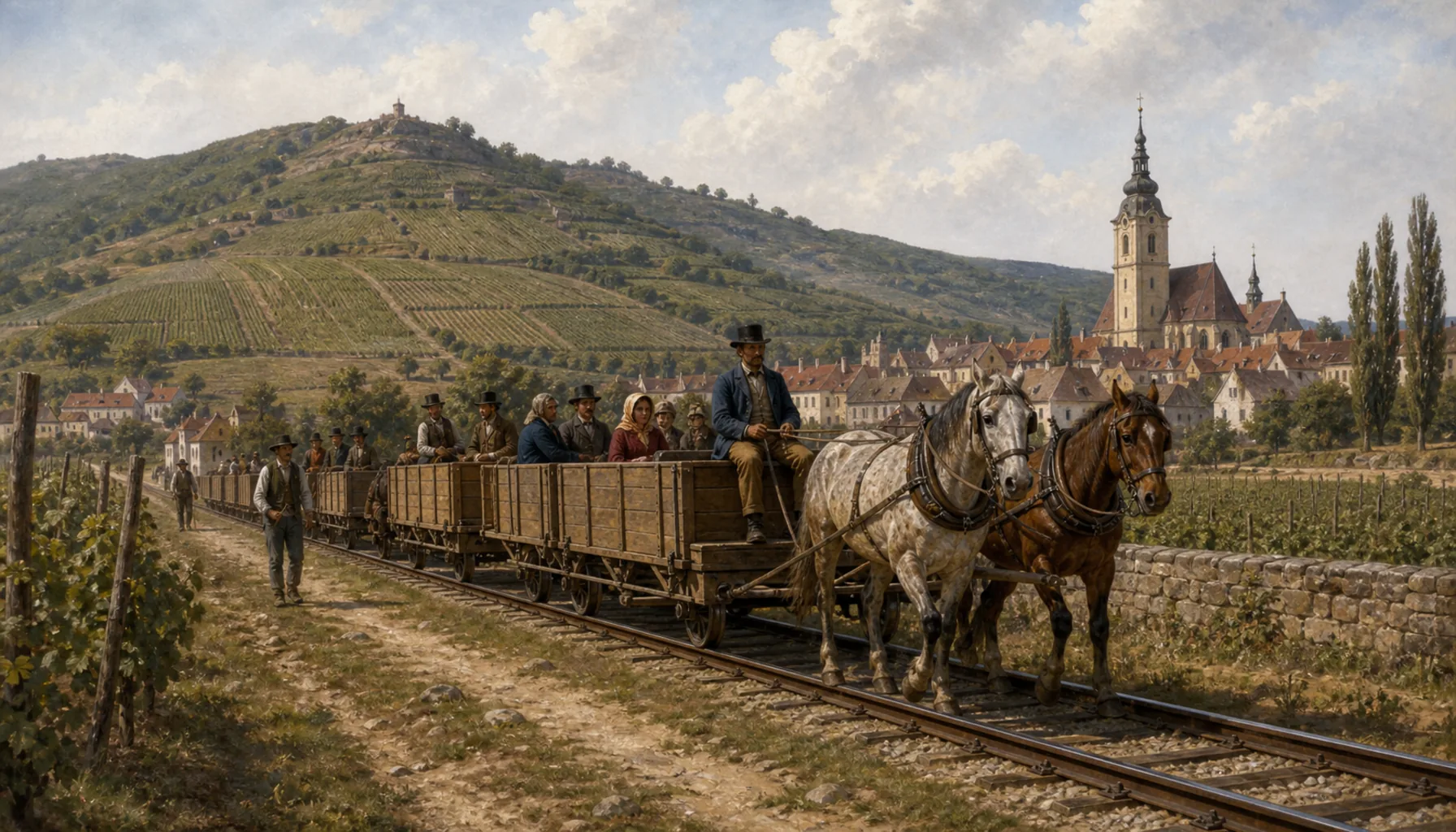
One of the first railways anywhere in the Kingdom of Hungary was laid along the foot of these hills in the 1840s: a horse-drawn line from Pressburg towards Trnava, wagons pulled along rails by horses, and today's track still follows that corridor. Being a short ride from the capital is therefore not a new condition for Svätý Jur — it has been true for nearly two centuries. Under Austria-Hungary the town stayed small and stayed on wine, while its larger neighbours Pezinok and Modra took the visible growth. Slovak, German and Hungarian were all spoken here, though German had long since stopped being the language of the majority.Jedna z prvých železníc v celom Uhorsku viedla popri úpätí týchto kopcov už v 40. rokoch 19. storočia: konská železnica z Prešporka smerom na Trnavu, vozne po koľajniciach ťahali kone — a dnešná trať ide stále tým istým koridorom. Byť na skok od hlavného mesta teda nie je pre Svätý Jur nič nové, platí to takmer dvesto rokov. Za Rakúsko-Uhorska zostalo mesto malé a zostalo pri víne, kým viditeľný rast si odniesli väčší susedia Pezinok a Modra. Hovorilo sa tu po slovensky, po nemecky aj po maďarsky, hoci nemčina už dávno nebola jazykom väčšiny.