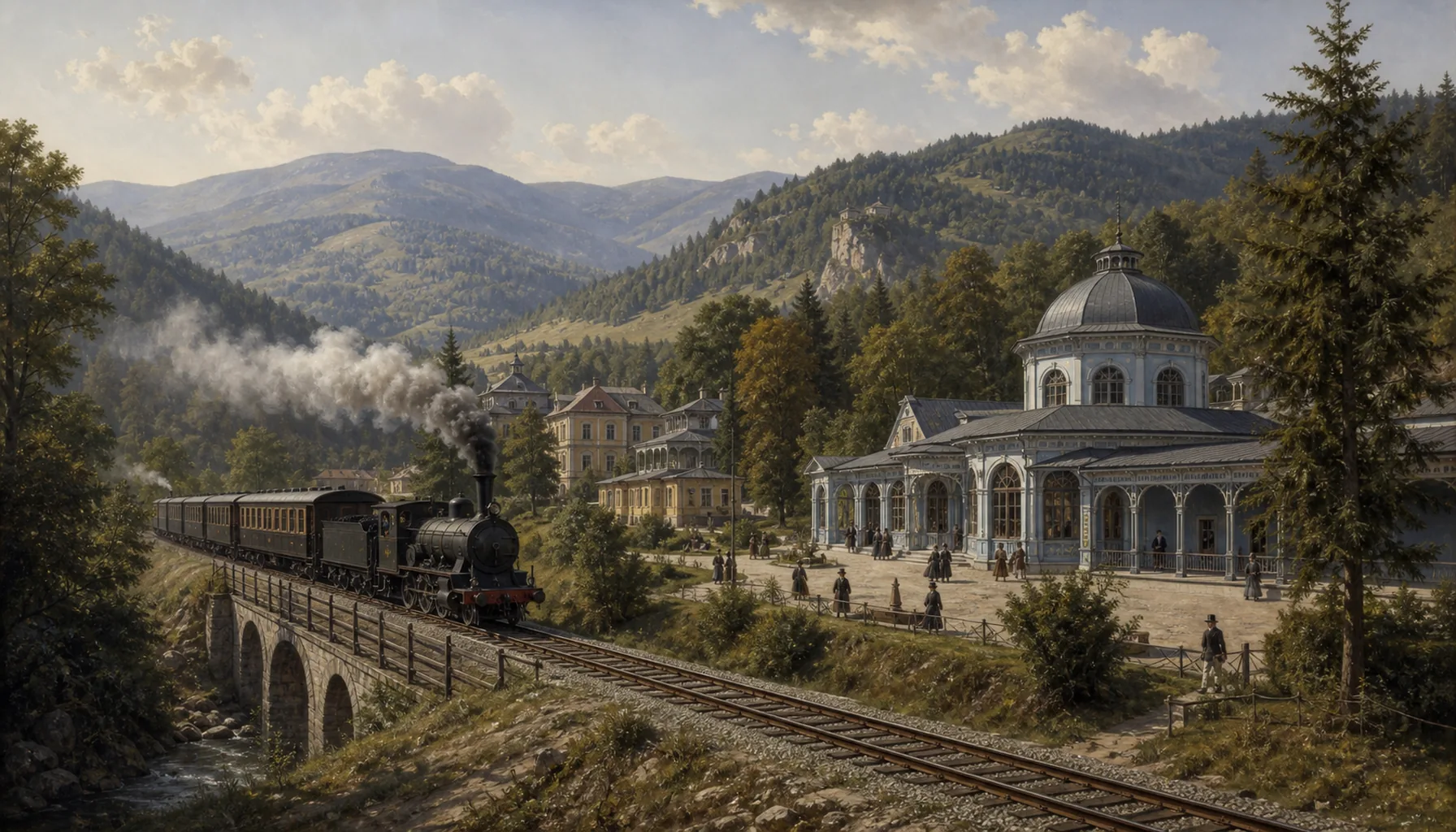
In 1872 the railway from Vrútky to Zvolen was completed, running the length of the basin and over the pass past the springs. It changed everything. A bath that had drawn guests from the neighbouring counties could now draw them from anywhere in Austria-Hungary, and the hotels around the park were built for those trains. In 1884–85 the Green Bath of 1728 was rebuilt as a polygonal domed bath house and given the name it still carries, the Modrý kúpeľ or Blue Bath; the thermal water rises into its round pool from below, through a grating in the floor. Officially the place was now Stubnyafürdő — Hungarian was the language of the state, and Slovak names were disappearing from maps and signs.V roku 1872 dokončili železnicu z Vrútok do Zvolena, ktorá vedie celou kotlinou a cez sedlo popri prameňoch. Zmenilo to všetko. Kúpeľ, ktorý dovtedy priťahoval hostí zo susedných stolíc, ich odrazu mohol mať z celého Rakúsko-Uhorska, a hotely okolo parku vyrástli práve pre tie vlaky. V rokoch 1884 – 1885 prestavali Zelený kúpeľ z roku 1728 na mnohouholníkovú kúpeľnú budovu s kupolou a dali jej meno, ktoré nesie dodnes — Modrý kúpeľ. Termálna voda doň stúpa zospodu, cez mrežu v dlážke okrúhleho bazéna. Úradne sa miesto vtedy volalo Stubnyafürdő: rečou štátu bola maďarčina a slovenské názvy sa z máp a tabúľ vytrácali.