Turčianske Teplice — The Blue Bath in the TuriecTurčianske Teplice — Modrý kúpeľ v Turci
Thermal water bathed in since the Middle Ages at the southern end of the Turiec basin, a domed bath house with a circular pool the water still rises into through the floor, and a treatment list that runs past joints to the kidneys and urinary tract.Termálna voda, v ktorej sa kúpe od stredoveku, na južnom konci Turčianskej kotliny, kúpeľný dom s kupolou a okrúhlym bazénom, do ktorého voda dodnes vystupuje cez dno, a zoznam indikácií, ktorý siaha za kĺby — k obličkám a močovým cestám.
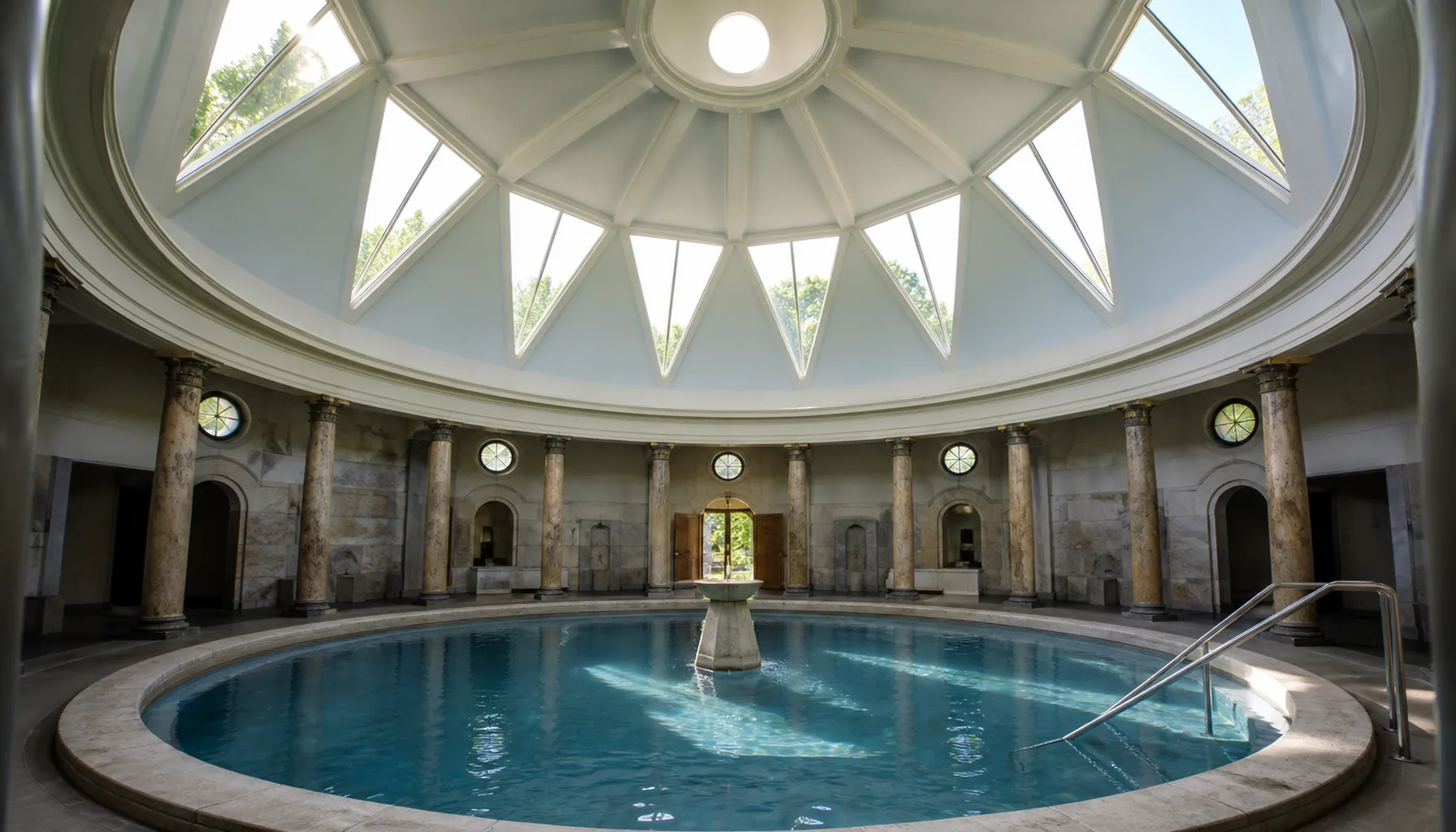
The domed Blue Bath at Turčianske Teplice.Modrý kúpeľ s kupolou v Turčianskych Tepliciach.
The basin and the waterKotlina a voda
Turčianske Teplice sits at the southern end of the Turiec basin in the Žilina region, about twenty kilometres south of Martin. Flat farmed floor, high walls: the Veľká Fatra to the east, the Žiar range west, and the pass into the Kremnica hills closing the way south.Turčianske Teplice ležia na južnom konci Turčianskej kotliny v Žilinskom kraji, asi dvadsať kilometrov južne od Martina. Ploché obrábané dno, vysoké steny: na východe Veľká Fatra, na západe pohorie Žiar a na juhu cestu uzatvára sedlo do Kremnických vrchov.
The water rises hot enough that it never needs heating — a mineralised thermal water carrying calcium, magnesium and sulphates, drawn from under the spa quarter. That is why the town is here at all, and it has been bathed in since the Middle Ages.Voda vyviera taká teplá, že ju netreba ohrievať — mineralizovaná termálna voda s vápnikom, horčíkom a síranmi, čerpaná spod kúpeľnej štvrte. Práve preto tu mesto vôbec je, a kúpe sa v nej od stredoveku.
A bath before it was a townKúpele skôr ako mesto
The place was a bath long before it was a town. Guests came from the counties around while the buildings by the water were bath houses and little else; a seventeenth-century account of the springs describes seven separate baths here, divided by social rank rather than by sex. The modern town was assembled only in the twentieth century, out of the spa settlement and the neighbouring villages.Miesto bolo kúpeľom dávno predtým, než sa stalo mestom. Hostia prichádzali z okolitých stolíc v čase, keď stavby pri vode boli kúpeľnými domami a takmer ničím iným; opis prameňov zo sedemnásteho storočia hovorí o siedmich oddelených kúpeľoch, rozdelených podľa spoločenského postavenia, nie podľa pohlavia. Dnešné mesto vzniklo až v dvadsiatom storočí spojením kúpeľnej osady so susednými obcami.
The road south did the rest. Traffic between the Turiec and the mining towns of the Hron crossed the pass towards Kremnica, the railway followed the same line, and guests reached the baths by it from across the monarchy before 1914. The older hotels around the park were built for them.O zvyšok sa postarala cesta na juh. Doprava medzi Turcom a banskými mestami na Hrone viedla cez sedlo smerom na Kremnicu, po tej istej trase potom položili železnicu a po nej prichádzali do kúpeľov pred rokom 1914 hostia z celej monarchie. Staršie hotely okolo parku postavili práve pre nich.
The Blue Bath and the parkModrý kúpeľ a park
The spa quarter and its park are effectively the town centre, and the landmark is the Modrý kúpeľ, the Blue Bath — a polygonal domed bath house of 1884–85, rebuilt on the Green Bath that the town of Kremnica had raised here in 1728 and given its present name only in that rebuilding. Inside is a circular pool the thermal water enters from below, through a grating in the floor. It is a listed national cultural monument and still a working pool rather than an emptied one.Kúpeľná štvrť a jej park sú vlastne centrom mesta a jeho dominantou je Modrý kúpeľ — polygonálna kúpeľná budova s kupolou z rokov 1884 – 1885, postavená na mieste Zeleného kúpeľa, ktorý tu dalo v roku 1728 postaviť mesto Kremnica; dnešný názov dostala až pri tejto prestavbe. Vnútri je okrúhly bazén, do ktorého termálna voda vystupuje zospodu cez mrežované dno. Je to národná kultúrna pamiatka — a stále fungujúci bazén, nie vyprázdnená pamiatka.
The name is now the older of two. The 2017 restoration joined the bath into the Royal Palace hotel, and it is marketed today as Zlatý kúpeľ, the Royal Bath, reached through the hotel rather than straight off the park.Názov Modrý kúpeľ je dnes ten starší z dvoch. Obnova v roku 2017 kúpeľ začlenila do hotela Royal Palace a dnes sa uvádza pod názvom Zlatý kúpeľ (Royal Bath); vchádza sa doň cez hotel, nie priamo z parku.
The town does two things at once. One is a treatment spa: sanatorium buildings, doctors, guests staying for weeks. The other is ordinary thermal bathing for an afternoon, indoors and out, under the name Spa & Aquapark Turčianske Teplice. Both sides belong to the same spa company. The park between them is flat enough to be walked by people who came here because walking is hard.Mesto robí dve veci naraz. Jednou sú liečebné kúpele: sanatóriá, lekári, hostia, ktorí zostávajú celé týždne. Druhou je bežné termálne kúpanie na jedno popoludnie, kryté aj vonkajšie, ktoré funguje pod názvom Spa & Aquapark Turčianske Teplice. Obe strany patria tej istej kúpeľnej spoločnosti. Park medzi nimi je dosť rovný na to, aby ho prešli aj ľudia, ktorí sem prišli práve preto, že chodenie im robí problém.
What the water is used forNa čo sa voda používa
The reputation rests on more than joints. Treatment has long been aimed at locomotor disorders, the standard work of a thermal spa, in children as well as adults — but the group that sets Turčianske Teplice apart among Slovak thermal spas is conditions of the kidneys and urinary tract. The official indication list runs wider still, taking in gynaecological, neurological, digestive and oncological conditions, and treatment here is prescribed against that list.Povesť týchto kúpeľov nestojí len na kĺboch. Liečba sa tu oddávna zameriava na ochorenia pohybového ústrojenstva, čo je bežná práca termálnych kúpeľov, a to u dospelých aj u detí — medzi slovenskými termálnymi kúpeľmi ich však odlišuje skupina ochorení obličiek a močových ciest. Oficiálny zoznam indikácií je ešte širší, patria doň aj ženské choroby a ochorenia nervové, tráviace a onkologické, a liečba sa tu predpisuje podľa tohto zoznamu.
That is what the spa is known for, not a promise about any individual. Slovak spa treatment is prescribed and medically supervised, and whether a stay would suit you is a question for a doctor. For everyone else the water is simply warm, and a winter hour in an outdoor pool under a white Veľká Fatra needs no other reason.To je to, čím sú kúpele známe, nie sľub pre kohokoľvek konkrétneho. Kúpeľná liečba sa na Slovensku predpisuje a vedie pod lekárskym dohľadom a či by vám pobyt vyhovoval, je otázka pre lekára. Pre všetkých ostatných je voda jednoducho teplá a zimná hodina vo vonkajšom bazéne pod zasneženou Veľkou Fatrou nepotrebuje iný dôvod.
Getting thereAko sa tam dostať
The railway is the straightforward way in: the town sits on the line running south from Vrútky and Martin over the pass towards Kremnica, Zvolen and Banská Bystrica, and the spa park is about ten minutes' walk from the station.Najjednoduchšie sa sem dostanete vlakom: mesto leží na trati, ktorá vedie z Vrútok a Martina na juh cez sedlo smerom na Kremnicu, Zvolen a Banskú Bystricu, a zo stanice je to do kúpeľného parku asi desať minút chôdze.
By road it is the same corridor, the main road south from Martin over the pass, and buses run up and down the basin frequently. The town itself is the other half of the visit, and the Veľká Fatra valleys open east of the basin.Autom je to ten istý koridor — hlavná cesta z Martina na juh cez sedlo — a autobusy premávajú kotlinou často. Samotné mesto je druhou polovicou návštevy a na východ od kotliny sa otvárajú doliny Veľkej Fatry.