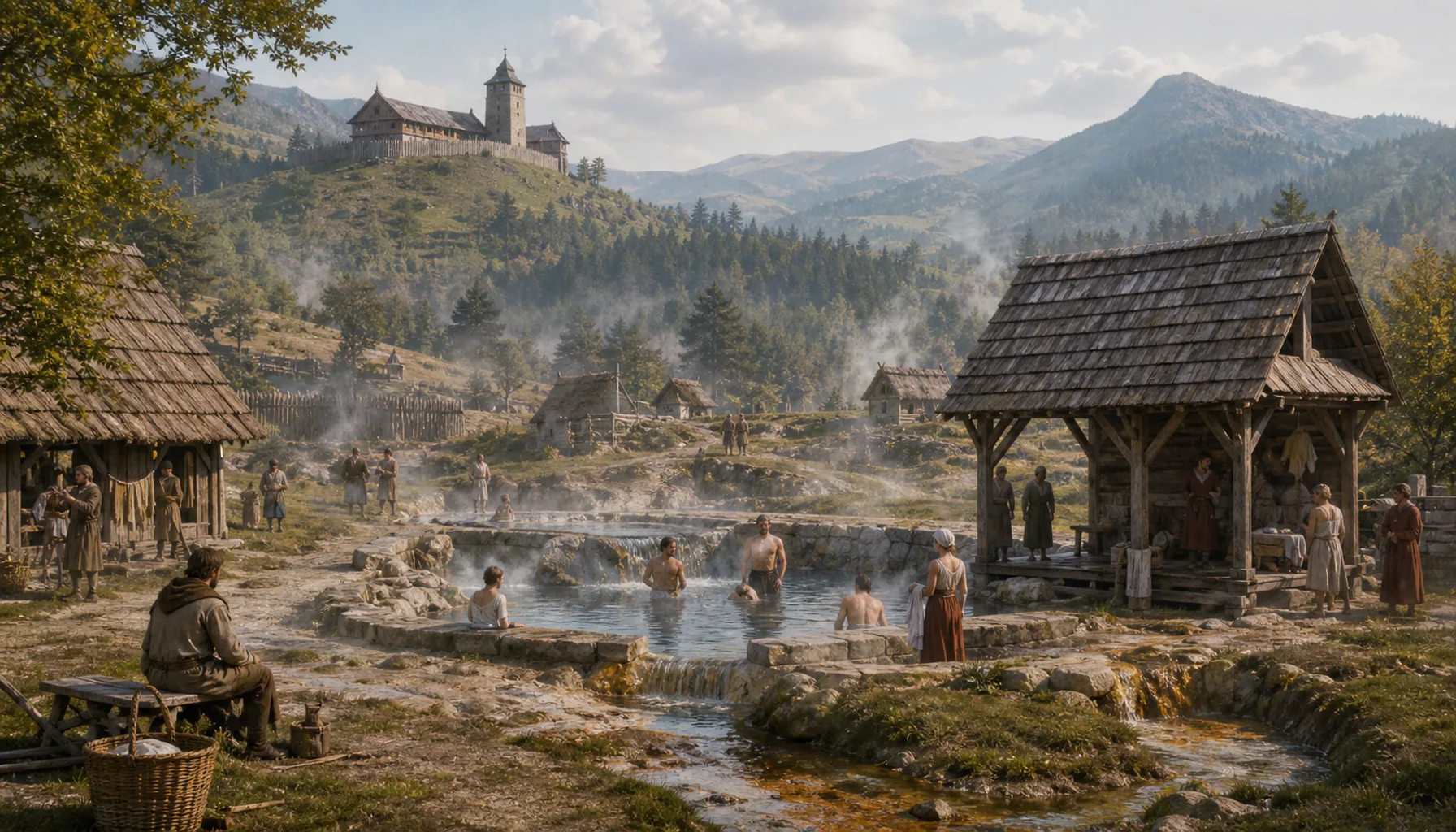
Through the fourteenth century the springs turn up in documents again and again, and every clerk spells them differently: Thopolcha in 1351, Tepliche in 1399, and in 1402 the Latin Therme Thurocienses, “the baths of Turiec”. Behind all of them is the Slavic word teplice, warm waters, which is what the neighbours had always called the place. The basin around it had just become a county of its own: in 1339 Turiec was separated from Zvolen county, with its seat at the castle of Sklabiňa in the hills to the north-east. A county, or župa, was the unit that collected the king's taxes and ran his courts — so from 1339 there was an administration in the basin, and a bath in it.Počas 14. storočia sa pramene v listinách objavujú znova a znova a každý pisár ich zapíše inak: Thopolcha v roku 1351, Tepliche v roku 1399 a v roku 1402 po latinsky Therme Thurocienses, „turčianske kúpele“. Za všetkými zápismi je slovanské slovo teplice, teplé vody, ako miestu odjakživa hovorili susedia. Kotlina okolo sa práve vtedy stala samostatnou stolicou: v roku 1339 sa Turiec oddelil od Zvolenskej stolice a jeho sídlom sa stal hrad Sklabiňa v kopcoch na severovýchode. Stolica (župa) bola jednotka, ktorá vyberala kráľove dane a súdila v jeho mene — od roku 1339 teda bola v kotline správa a v nej kúpeľ.