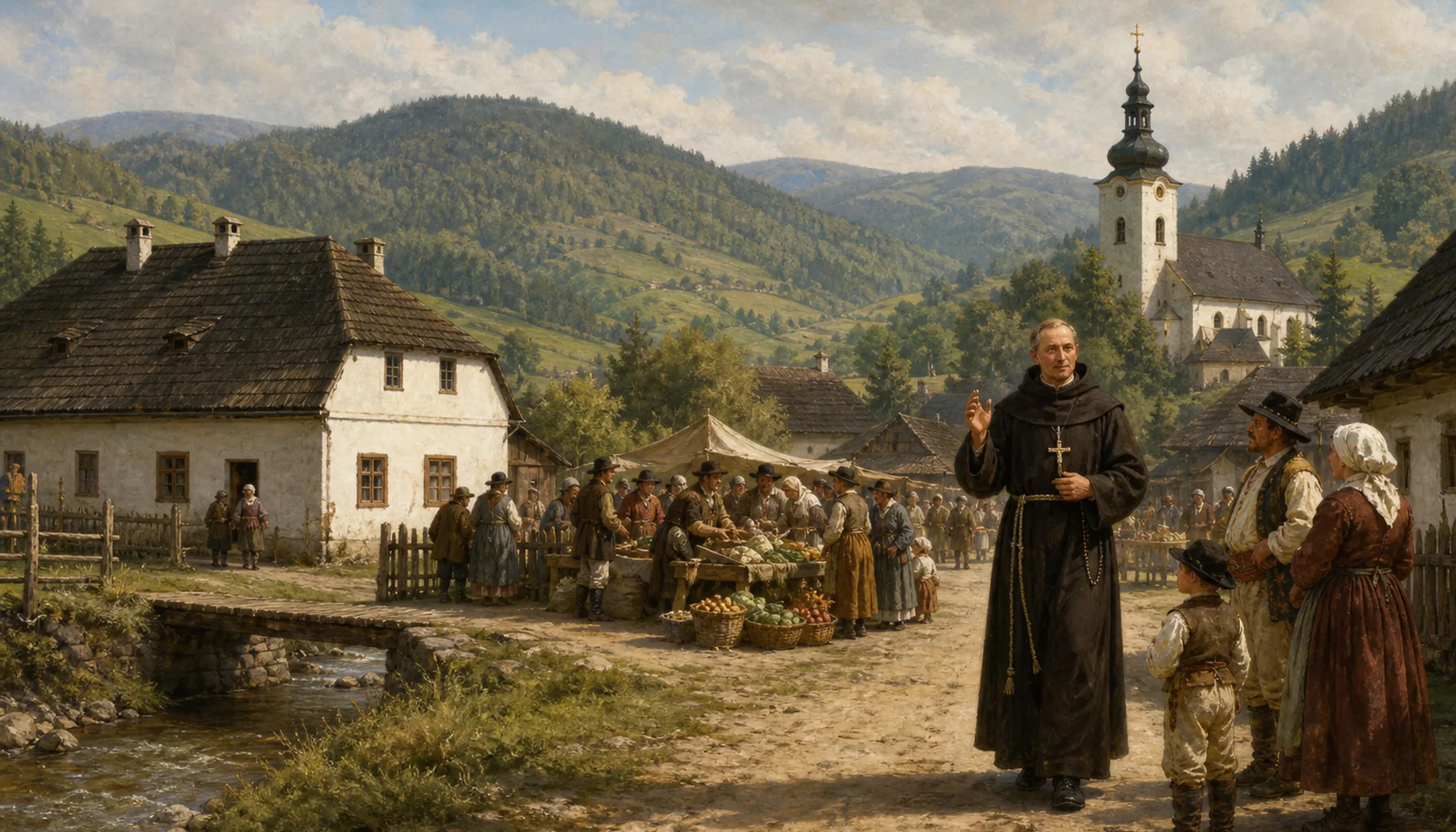
Late in the eighteenth century Franciscan friars came out from Žilina to serve the valley, and the institutions of a proper village followed in a revealing order. Father Arkádius Nadhoránsky had a parsonage built in 1794; the first market was held in 1795; a permanent parish priest arrived only in 1799. Building the house before there was anyone to live in it is exactly how a poor place gets an institution — you make the offer physical and then wait for someone to accept it. These were the decades of Maria Theresa's and Joseph II's reforms, when the state was counting its subjects, writing down their obligations and pushing schooling and record-keeping into villages that had never had either. For Krásno the practical result was that it stopped being only a cluster of farms and started being an address.Koncom osemnásteho storočia prišli do doliny slúžiť františkáni zo Žiliny a inštitúcie poriadnej dediny pribúdali v poradí, ktoré veľa prezrádza. Páter Arkádius Nadhoránsky dal v roku 1794 postaviť faru, prvý trh sa konal v roku 1795 a stály farár prišiel až v roku 1799. Postaviť dom skôr, než je preň človek, je presne ten spôsob, akým chudobné miesto získava inštitúciu — ponuku najprv postavíte z dreva a kameňa a potom čakáte, kým ju niekto prijme. Boli to desaťročia reforiem Márie Terézie a Jozefa II., keď štát rátal svojich poddaných, spisoval ich povinnosti a tlačil školu a evidenciu aj do dedín, ktoré nikdy ani jedno nemali. Pre Krásno to prakticky znamenalo, že prestalo byť len zhlukom gazdovstiev a stalo sa adresou.