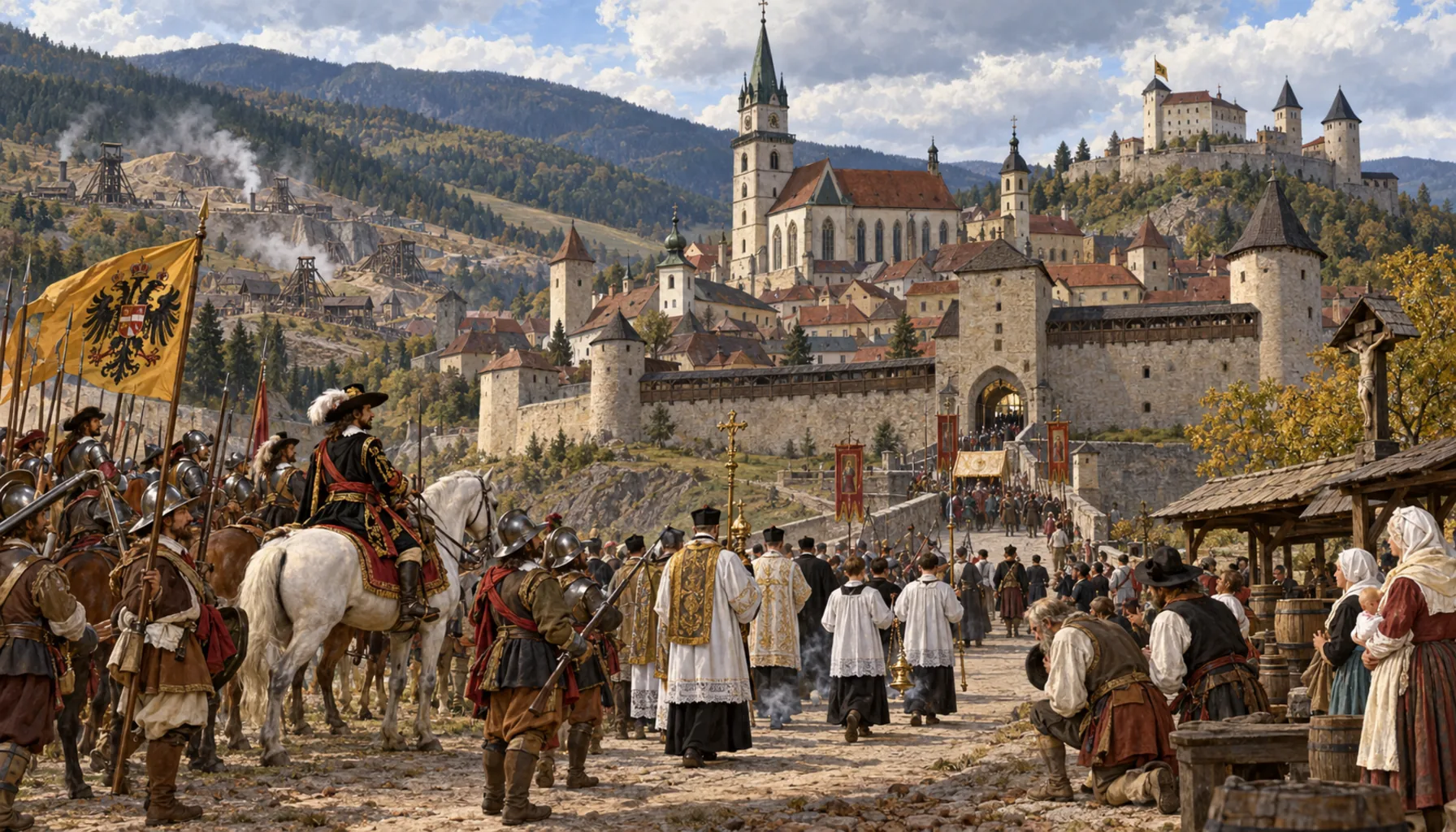
For fifty years Hungarian nobles rose repeatedly against Habsburg rule, and the mining towns — rich, and holding the mint — changed hands with every campaign. The mint's work was interrupted again and again by these wars; the last and largest of the uprisings was led by Francis II Rákóczi and ended in 1711. Like most German mining towns, Kremnica had turned Lutheran during the Reformation, and in 1709 it was re-Catholicised: its churches taken back for the Catholic side, with the state standing behind the decision. Religion here was never a private matter — it decided who could hold office, who could teach, and where you could be buried.Uhorská šľachta sa päťdesiat rokov opakovane búrila proti Habsburgovcom a banské mestá — bohaté a s mincovňou v rukách — menili majiteľa s každým ťažením. Prácu mincovne tieto vojny znovu a znovu prerušovali; posledné a najväčšie povstanie viedol František II. Rákoci a skončilo sa v roku 1711. Kremnica sa ako väčšina nemeckých banských miest stala počas reformácie luteránskou a v roku 1709 ju rekatolizovali: kostoly sa vrátili katolíkom a za rozhodnutím stál štát. Náboženstvo tu nikdy nebolo súkromnou vecou — rozhodovalo o tom, kto smie zastávať úrad, kto smie učiť a kde bude pochovaný.