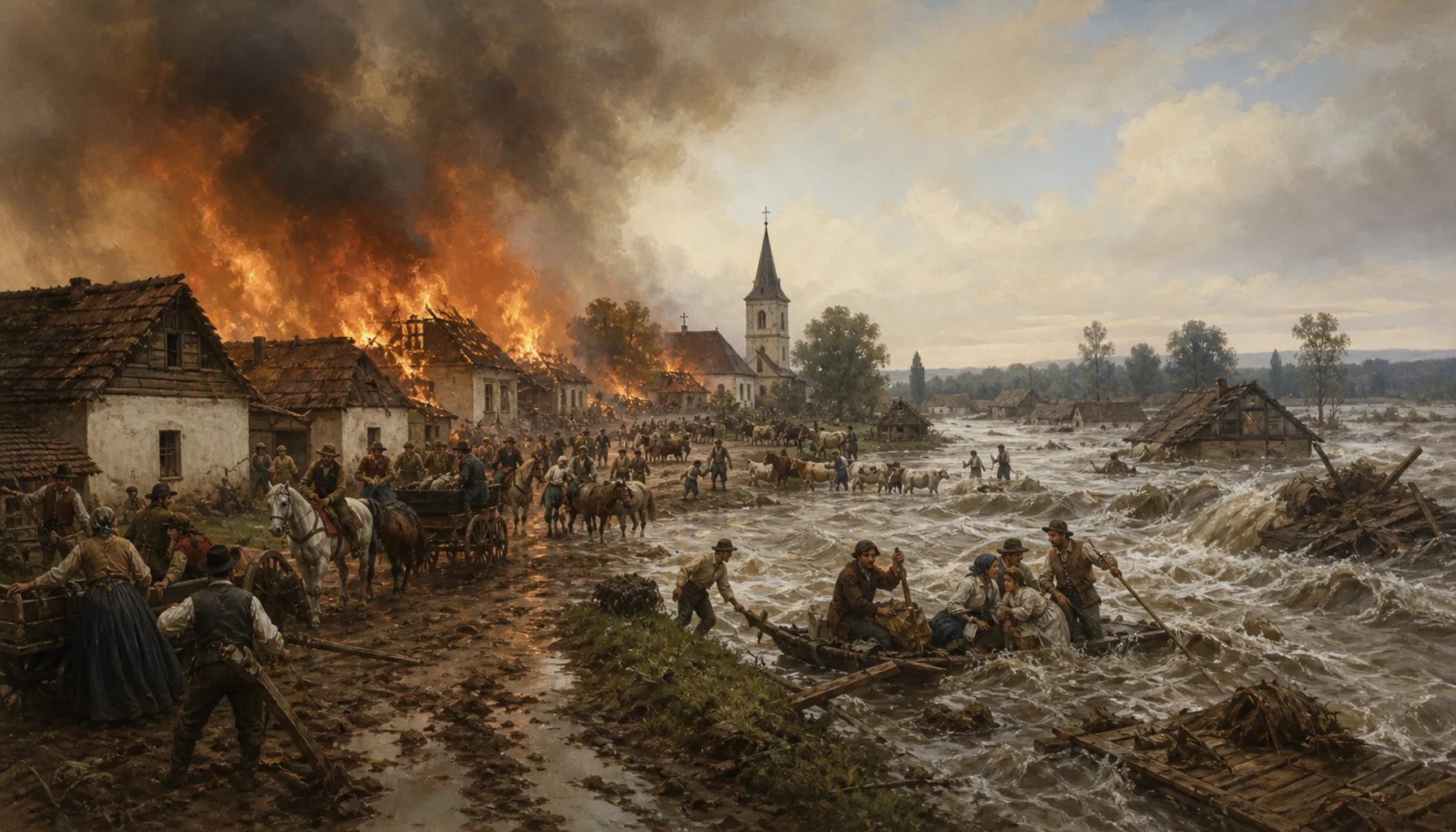
Under Austria-Hungary the village fought two enemies that had nothing to do with politics. Fire took it in 1861 and again in 1867 — thatched roofs, timber walls, no water pressure. Water took the fields in 1850, 1862, 1876 and 1878, because the Danube still shifted its arms wherever it pleased. The nineteenth-century regulation of the river, with its dykes and drainage channels, was the answer to both, and it is what turned the island from a flood plain into the most productive farmland in the country. The census of 1910 counted 2,823 people in Bős, of whom 2,805 gave Hungarian as their language.Za Rakúsko-Uhorska bojovala dedina s dvoma nepriateľmi, ktorí s politikou nemali nič spoločné. Oheň ju zachvátil v roku 1861 a znova v roku 1867 — slamené strechy, drevené steny, žiadny tlak vody. Voda zaliala polia v rokoch 1850, 1862, 1876 a 1878, lebo Dunaj si stále presúval ramená, kam sa mu zachcelo. Odpoveďou na oboch bola regulácia rieky v 19. storočí, jej hrádze a odvodňovacie kanály, a práve tá premenila ostrov zo záplavovej roviny na najúrodnejšiu pôdu v krajine. Sčítanie z roku 1910 napočítalo v Bőši 2 823 ľudí, z toho 2 805 uviedlo ako svoj jazyk maďarčinu.