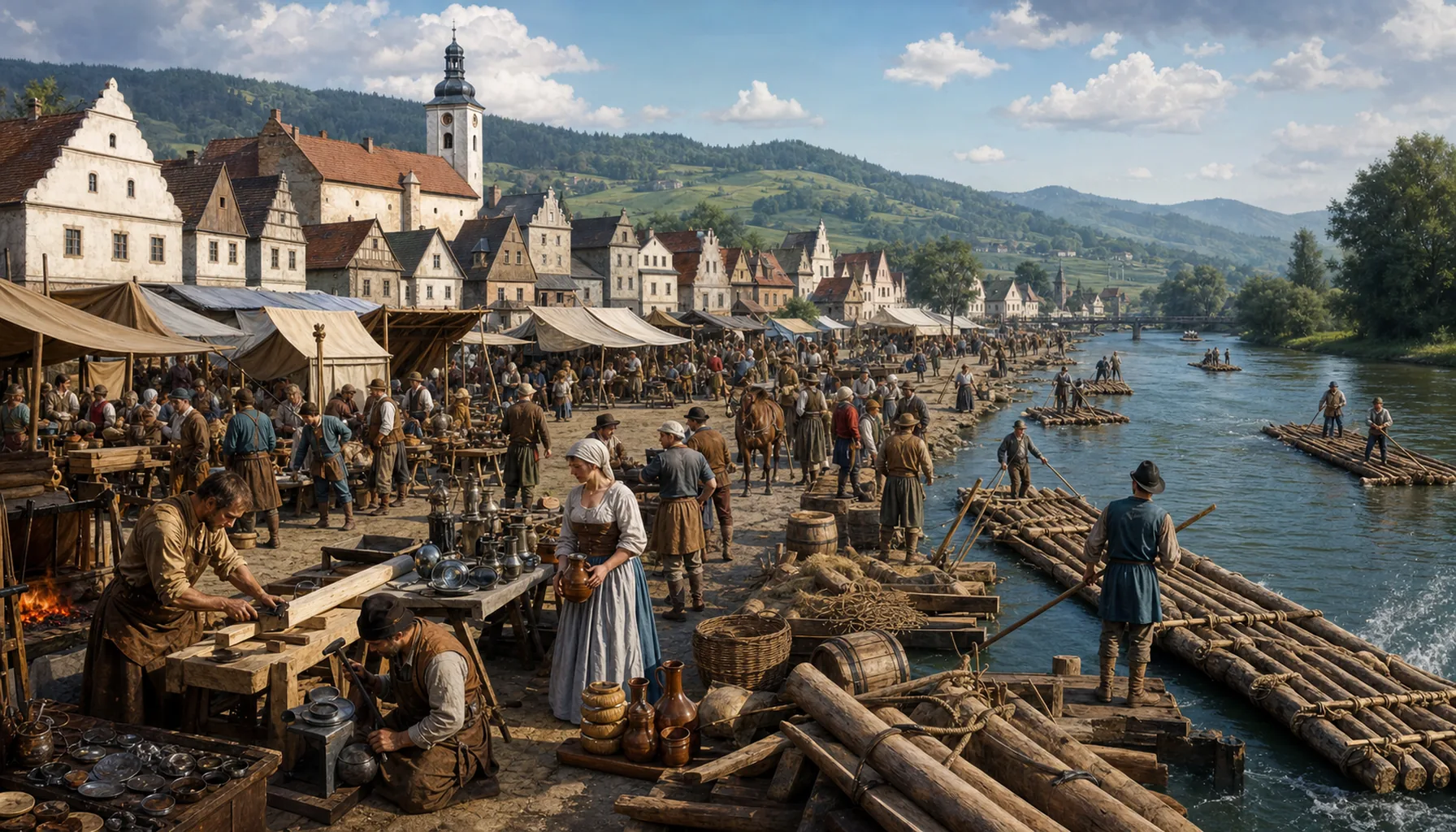
Peace let the town do what it was built for. Maximilian II had raised its annual fairs to six in 1576 and Ferdinand III to seven, adding the staple right and the mile right, which forbade a rival market within a mile. There were fifteen craftsmen here in 1533 and two hundred and twenty in sixteen guilds two centuries later, reinforced by masters from Bohemia and Moravia who crossed the border after the Battle of White Mountain in 1620. Wine went out to Vienna; flour, grain, wool, dried fruit and salt went down the Váh on timber rafts as far as Komárno. In the winter of 1805 Tsar Alexander I of Russia stopped here for lunch at the provost's residence on his way home from the lost battle of Austerlitz.Mier dovolil mestu robiť to, na čo vzniklo. Maximilián II. mu roku 1576 zvýšil počet výročných jarmokov na šesť a Ferdinand III. na sedem, k tomu pridal právo skladu a míľové právo, ktoré zakazovalo konkurenčný trh bližšie ako na míľu. Roku 1533 tu bolo pätnásť remeselníkov, o dve storočia neskôr dvestodvadsať v šestnástich cechoch, posilnených majstrami z Čiech a Moravy, ktorí po bitke na Bielej hore roku 1620 prešli cez hranicu. Víno sa vyvážalo do Viedne; múka, obilie, vlna, sušené ovocie a soľ plávali po Váhu na pltiach až do Komárna. V zime roku 1805 sa tu na prepoštskej rezidencii zastavil na obed ruský cár Alexander I. na ceste domov z prehratej bitky pri Slavkove.