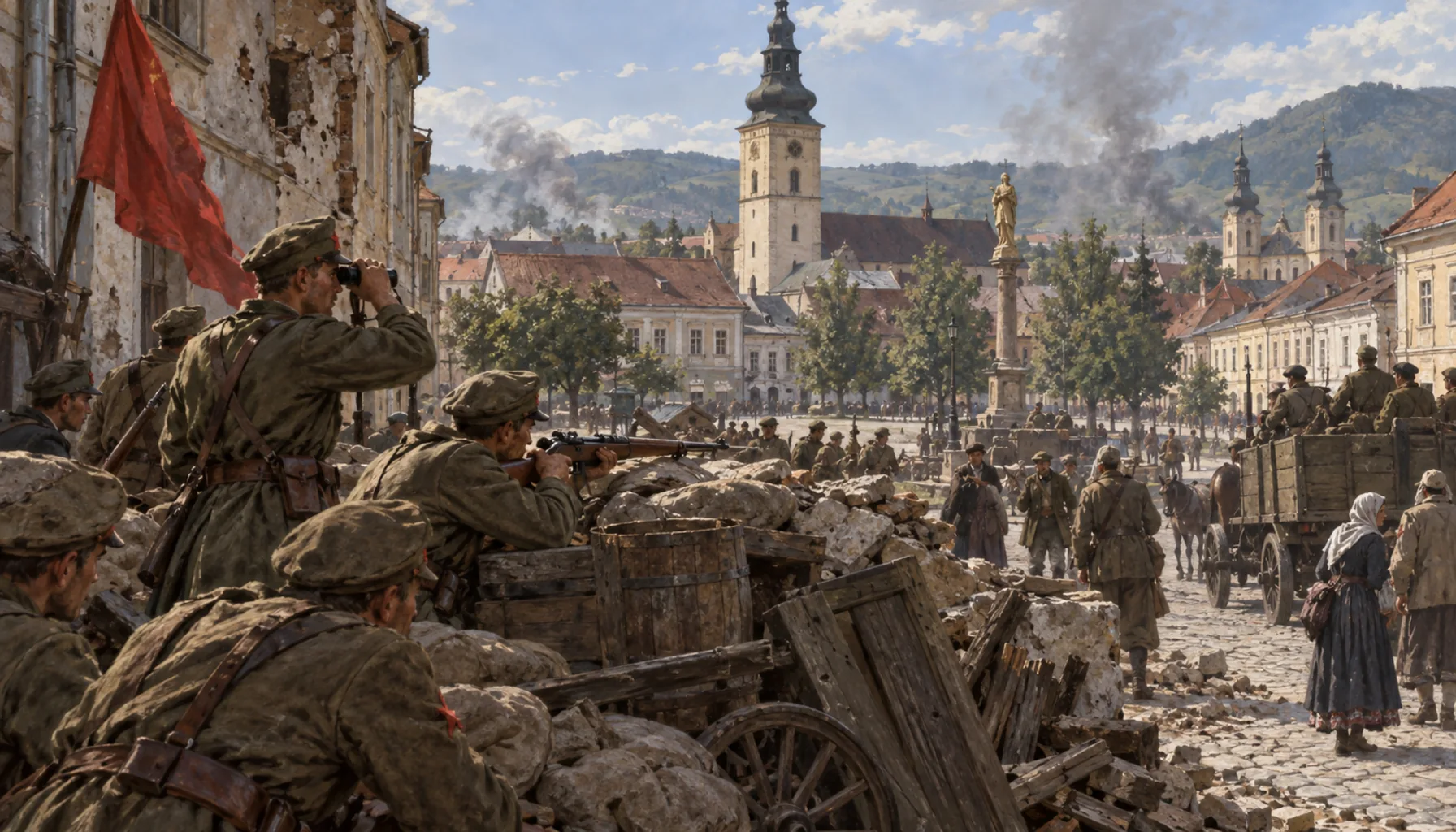
In the summer of 1919 the new border still had to be fought for. The Hungarian Red Army, the army of the communist government in Budapest, pushed north into Slovakia, taking Lučenec on 30 May and Košice on 6 June. On 16 June 1919, at a mass meeting on Hlavná in front of the town hall, a Slovak Soviet Republic was proclaimed, its Revolutionary Governing Council headed by Antonín Janoušek, a Czech communist from Kladno; it decreed the nationalisation of factories with more than twenty workers, of large estates and of the banks, replaced the courts with revolutionary tribunals and began raising a Red Army of its own. It lasted twenty-one days — under Allied pressure Budapest agreed to pull back, the Hungarian troops withdrew, and by 7 July 1919 it was finished. Whether it was a Slovak revolution or a cover for restoring Hungarian control is still argued over: it depended entirely on Budapest's soldiers, and it died the week they left.V lete 1919 sa o novú hranicu ešte stále bojovalo. Maďarská červená armáda, vojsko komunistickej vlády v Budapešti, postupovala na sever Slovenska — 30. mája obsadila Lučenec, 6. júna Košice. Na veľkom zhromaždení na Hlavnej pred radnicou vyhlásili 16. júna 1919 Slovenskú republiku rád; na čele jej revolučnej vládnej rady stál Antonín Janoušek, český komunista z Kladna. Znárodnila továrne s viac ako dvadsiatimi robotníkmi, veľkostatky aj banky, súdy nahradila revolučnými tribunálmi a začala si stavať vlastnú Červenú armádu. Vydržala dvadsaťjeden dní: pod tlakom dohodových mocností sa Budapešť zaviazala ustúpiť, maďarské vojská odišli a 7. júla 1919 bolo po nej — a či išlo o slovenskú revolúciu, alebo o zásterku pre návrat maďarskej moci, sa historici hádajú dodnes.