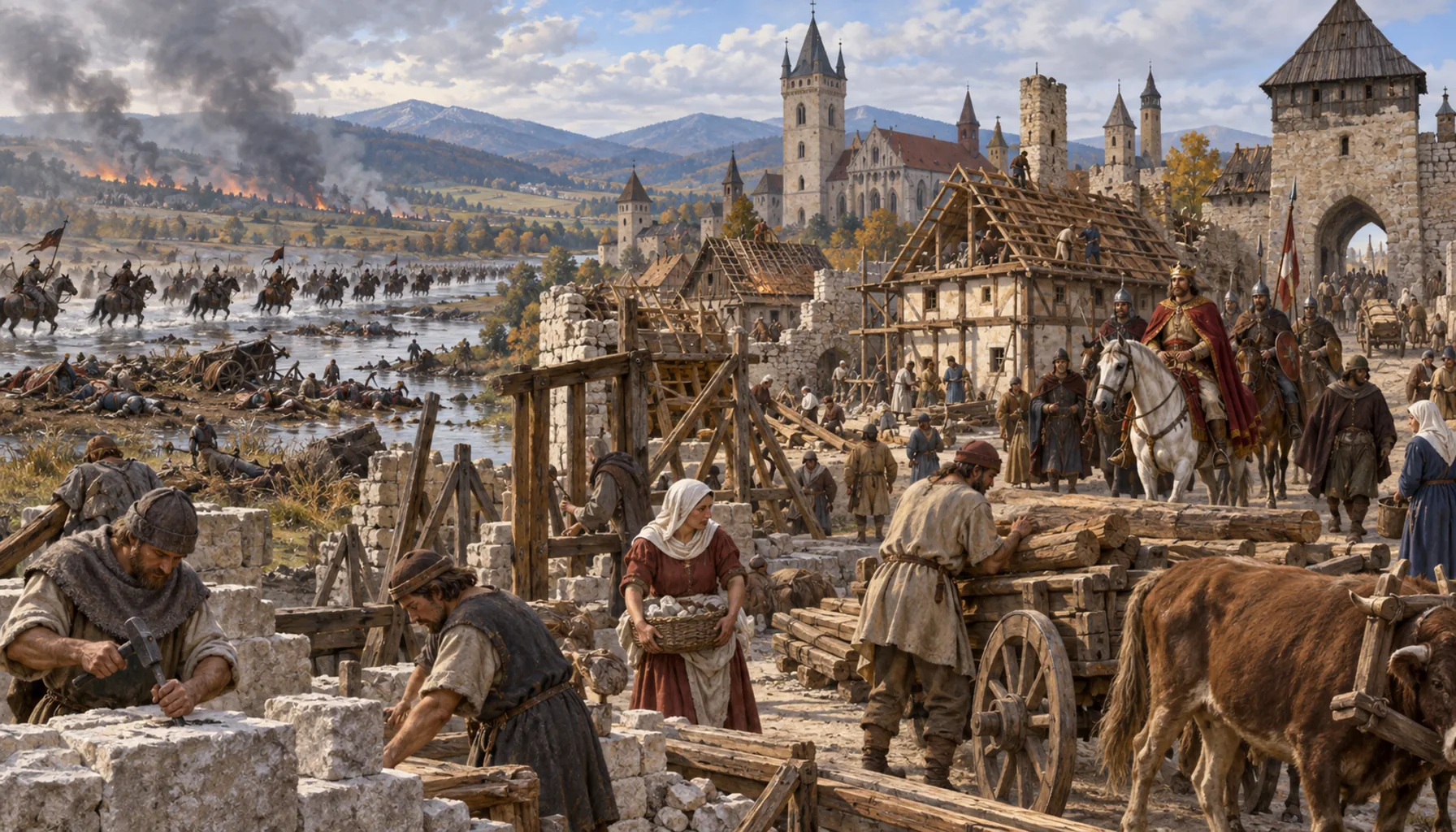
In 1241 a Mongol army destroyed the Hungarian king's forces at the river Slaná and rode across the kingdom, and Béla IV came back to a country he had to rebuild. Two things followed in the north-east: stone castles on the hilltops — Šariš, on its volcanic cone above the Torysa, is one of them — and an invitation to settlers, mostly German-speaking, to come and hold ground that was thinly held. Prešov appears in writing for the first time in 1247, six years after the invasion, in a charter of Béla IV that calls the people here Theutonici de Epuryes, the Germans of Eperjes. Read that slowly: a first mention is a fact about a document, not a founding date, and this one tells you the settlement was already there and already German-speaking. What the Mongols did to Prešov itself is nowhere recorded — what they did was force the kingdom to rebuild its north-east, and Prešov is part of that rebuilding.V roku 1241 rozdrvilo mongolské vojsko uhorské sily pri rieke Slanej a prehnalo sa kráľovstvom; Belo IV. sa vrátil do krajiny, ktorú musel postaviť nanovo. Na severovýchode z toho vzišli dve veci: kamenné hrady na kopcoch — jedným z nich je Šariš na sopečnom kuželi nad Torysou — a pozvanie pre osadníkov, väčšinou nemecky hovoriacich, aby prišli obsadiť riedko osídlenú zem. Prešov sa v písomnostiach objavuje prvý raz v roku 1247, šesť rokov po vpáde, v listine Bela IV., ktorá tunajších ľudí nazýva Theutonici de Epuryes, teda Nemci z Eperies. Stojí za to prečítať si to pomaly: prvá zmienka je údaj o listine, nie o založení mesta, a hovorí nám, že osada tu už bola a už bola nemecká. Čo Mongoli urobili priamo Prešovu, nevieme; vieme však, čo urobili kráľovstvu — donútili ho severovýchod osídliť nanovo, a Prešov k tomuto znovuosídleniu patrí.