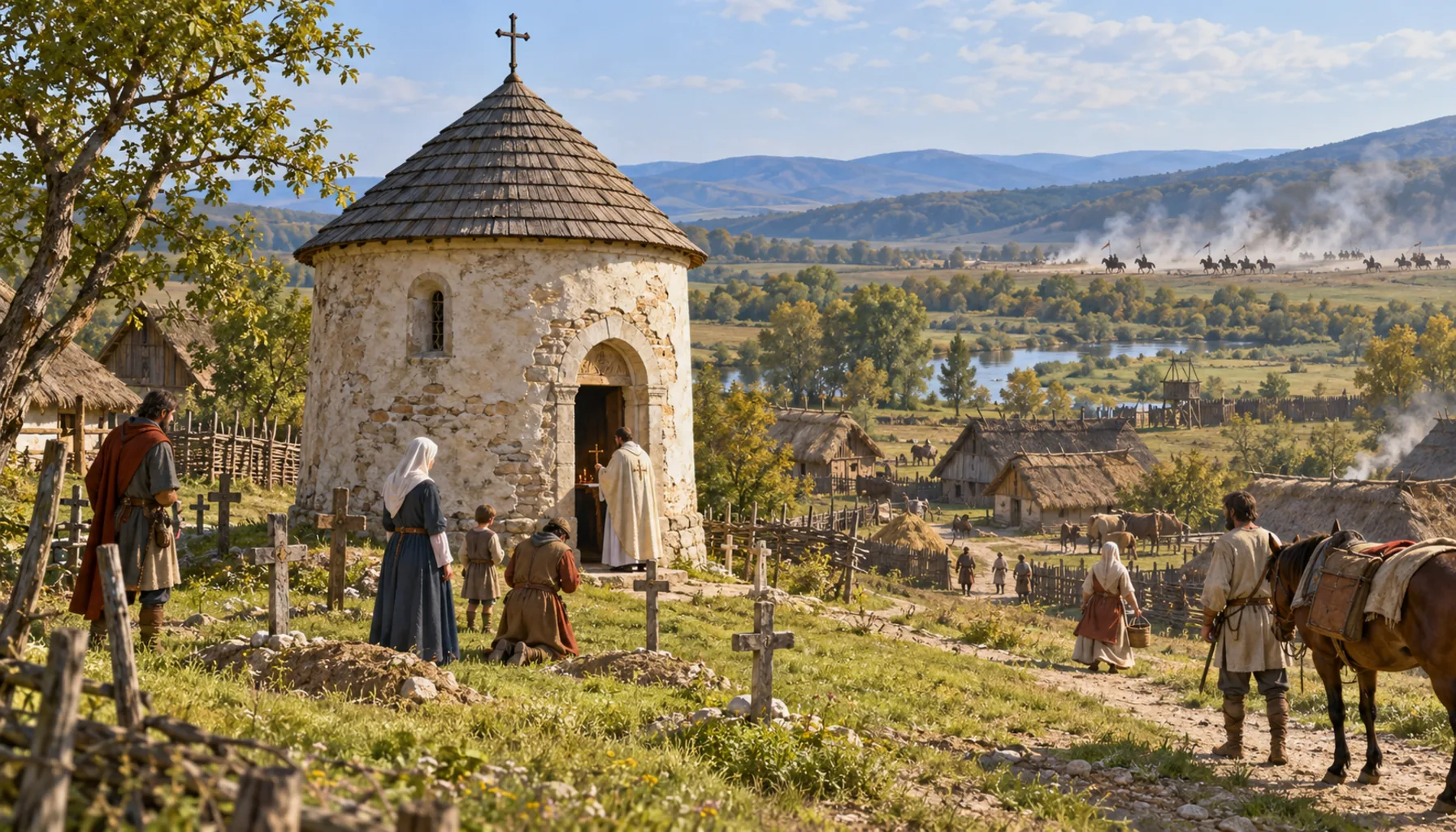
Round churches — rotundas — were built all over the medieval Kingdom of Hungary between roughly the eleventh and the thirteenth centuries, usually as a landowner's private chapel or a cemetery chapel, and almost always tiny. The one at Šivetice is dated to the second quarter of the thirteenth century, which is to say somewhere between about 1225 and 1250: it went up either just before the Mongol invasion of 1241 or during the rebuilding that followed it, and specialists differ over which. What nobody disputes is the scale — at roughly eleven metres of internal diameter it dwarfs every comparable rotunda in the region. A religious community, a landowner of unusual standing and a pilgrimage function have all been proposed to account for it, and none of them can be proved.Okrúhle kostoly — rotundy — stavali po celom stredovekom Uhorsku zhruba od jedenásteho do trinásteho storočia, väčšinou ako súkromnú kaplnku zemepána alebo ako cintorínsku kaplnku, a takmer vždy boli drobné. Šivetickú rotundu kladú do druhej štvrtiny trinásteho storočia, teda niekam medzi roky 1225 a 1250: vznikla buď tesne pred mongolským vpádom roku 1241, alebo počas obnovy, ktorá po ňom nasledovala, a odborníci sa v tom nezhodujú. O čom nikto nepochybuje, je rozmer — s vnútorným priemerom okolo jedenástich metrov prevyšuje každú porovnateľnú rotundu v kraji. Na vysvetlenie sa navrhovala rehoľná komunita, zemepán mimoriadneho postavenia aj pútnická funkcia, a nič z toho sa nedá dokázať.