Banská Bystrica region · VillagesBanskobystrický kraj · Obce
ŠiveticeŠivetice
The largest Romanesque rotunda in central Europe stands in this small Gemer village: a round church of the thirteenth century, roughly eleven metres across inside, with the legend of St Margaret painted round its wall.V tejto malej gemerskej obci stojí najväčšia románska rotunda v strednej Európe: okrúhly kostol z 13. storočia s vnútorným priemerom asi jedenásť metrov a s legendou svätej Margity vymaľovanou dokola po stene.
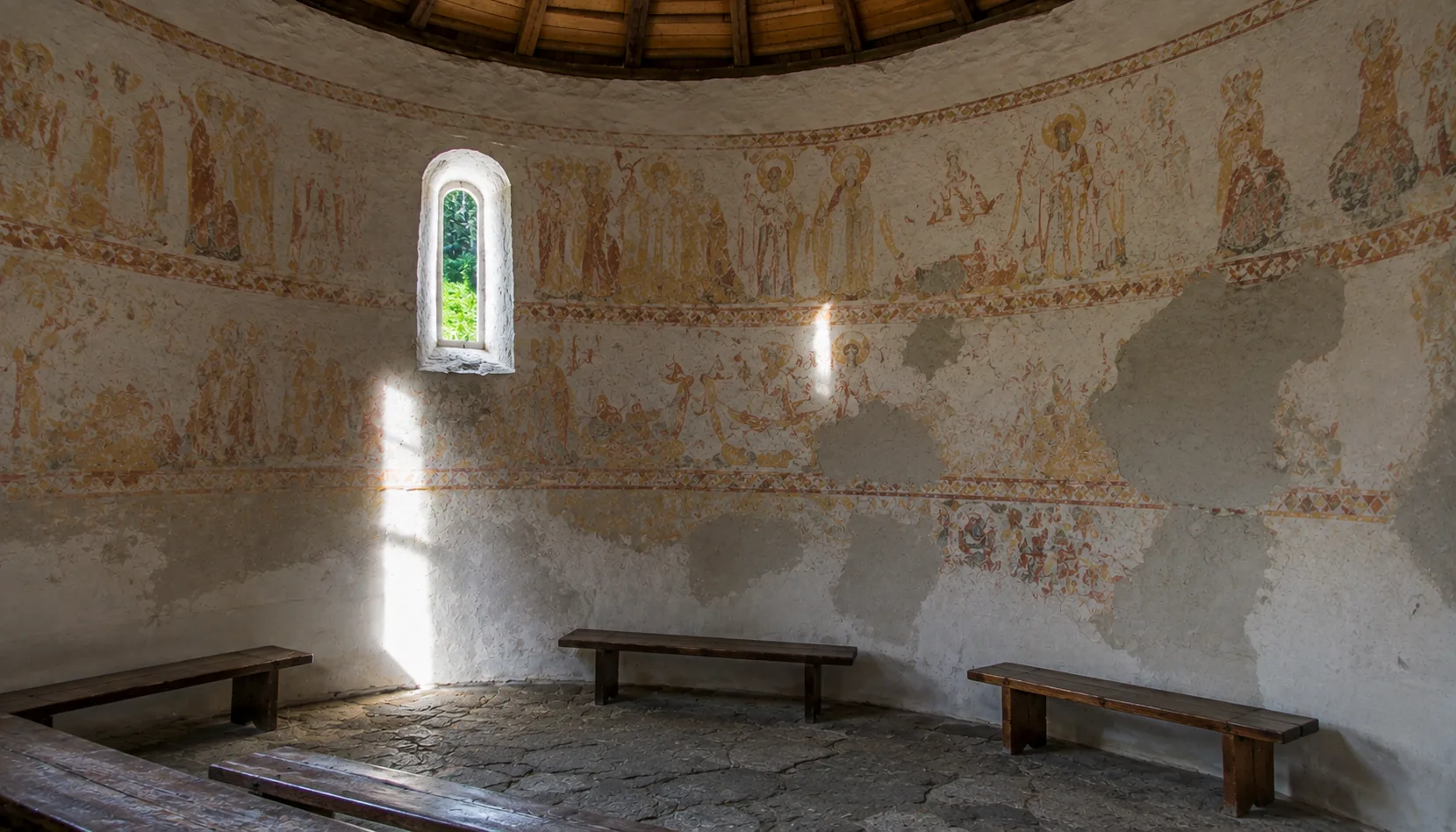
Inside the round church at Šivetice, medieval painting running round the curving wallVnútro okrúhleho kostola v Šiveticiach, stredoveká maľba bežiaca po oblej stene
Where it standsKde leží
Šivetice lie in the open, low hill country of western Gemer, north of Tornaľa and a short way south-east of Jelšava. This is the gentler half of the region — fields, pasture and scattered woods rather than mining valleys — with the magnesite works at Jelšava and Lubeník close to the north-west.Šivetice ležia v otvorenej nízkej pahorkatine západného Gemera, severne od Tornale a kúsok juhovýchodne od Jelšavy. Je to miernejšia polovica regiónu — polia, pasienky a rozptýlené lesíky namiesto banských dolín — a magnezitky v Jelšave a v Lubeníku sú neďaleko na severozápad.
Administratively it sits in the Revúca district, which puts it in a different region from Štítnik, Plešivec and the rest of the painted-church group a short drive south-east. That boundary is a modern line drawn long after the church was built; by landscape, by history and by the company its wall paintings keep, Šivetice is Gemer.Administratívne patrí do okresu Revúca, čím sa ocitá v inom kraji než Štítnik, Plešivec a zvyšok skupiny maľovaných kostolov kúsok na juhovýchod. Tá hranica je novodobá čiara nakreslená dlho po tom, čo kostol postavili; krajinou, dejinami aj spoločnosťou, do ktorej jeho nástenné maľby patria, sú Šivetice Gemerom.
Why it is herePrečo práve tu
Round churches were built across the medieval kingdom of Hungary from roughly the eleventh to the thirteenth century — small, quick to roof, usually a lord's private chapel or a cemetery chapel. Almost all of them are tiny. This one is not.Okrúhle kostoly stavali po celom stredovekom Uhorsku zhruba od 11. do 13. storočia — malé, ľahko zastrešiteľné, väčšinou ako súkromnú kaplnku zemepána alebo cintorínsku kaplnku. Takmer všetky sú drobné. Táto nie.
The rotunda here is a round room about eleven metres in internal diameter, built in the thirteenth century, and the largest of its kind known in central Europe. Why a settlement of this size received a building on that scale has never been settled: a religious community, a landowner of unusual standing and a pilgrimage function have all been argued for.Tunajšia rotunda je okrúhla miestnosť s vnútorným priemerom okolo jedenástich metrov, postavená v 13. storočí, a je najväčšou svojho druhu v strednej Európe. Prečo sídlo takejto veľkosti dostalo stavbu takého rozmeru, sa nikdy neuzavrelo: uvažovalo sa o rehoľnej komunite, o zemepánovi mimoriadneho postavenia aj o pútnickej funkcii.
The dedication is to St Margaret of Antioch, one of the most widely venerated saints of the medieval kingdom, and her legend was painted round the inside of the wall in the fourteenth century — the same generation as the painting at Štítnik and Ochtiná. Lime covered it later; it was recovered in the twentieth century.Kostol je zasvätený svätej Margite Antiochijskej, jednej z najuctievanejších svätíc stredovekého Uhorska, a jej legendu vymaľovali dokola po vnútornej stene v 14. storočí — v tej istej generácii ako maľby v Štítniku a v Ochtinej. Neskoršie vrstvy vápna ju zakryli, odkryli ju v 20. storočí.
What you actually seeČo naozaj uvidíte
From outside it is a plain drum of rendered stone under a conical roof, with a small sanctuary on the east and a few narrow windows. There is no tower and no ornament; the scale is the only thing that signals what it is, and it takes a moment to register.Zvonka je to jednoduchý valec z omietaného kameňa pod kužeľovou strechou, s malou svätyňou na východe a s pár úzkymi oknami. Nemá vežu ani výzdobu, o ktorej by sa dalo hovoriť; jediné, čo prezrádza, o čo ide, je rozmer — a chvíľu trvá, kým to človeku dôjde.
Inside, the wall curves away on both sides and the painting runs round it in bands: Margaret's legend, standing saints, the remains of larger scenes, faded to ochre and red and broken by bare plaster. Being enclosed by a painted circle is a different experience from looking at a painted wall, and it is the reason to make the detour.Vnútri sa stena na oboch stranách odkláňa a maľba beží dokola v pásoch: Margitina legenda, stojace postavy svätcov, zvyšky väčších výjavov, vybledlé do okrovej a červenej a prerušené plochami holej omietky. Byť obklopený maľovaným kruhom je iný zážitok než pozerať sa na maľovanú stenu — a práve preto sa oplatí zájsť sem.
There is not much else in the village, and there does not need to be. Šivetice are a one-building visit, best combined with the painted churches of the Štítnik valley to the east, on the same touring route.V obci toho viac nie je a ani to netreba. Šivetice sú návštevou pre jednu stavbu a najlepšie sa spájajú s maľovanými kostolmi Štítnickej doliny na východe, ktoré ležia na tej istej okružnej trase.
Living village, not a museumŽivá obec, nie skanzen
The rotunda is a consecrated church, not a museum: no ticket desk, no staff, normally locked, opened on request through the parish or by asking in the village. Conservation on a building of this importance goes on in phases and access can be closed for a season without notice, so confirm before travelling.Rotunda je vysvätený kostol, nie múzeum: bez pokladne, bez personálu, bežne zamknutá, otvára sa na požiadanie cez farský úrad alebo po opýtaní v obci. Na pamiatke takéhoto významu prebiehajú reštaurátorské práce po etapách a prístup môže byť aj celú sezónu zatvorený bez veľkého ohlásenia, takže si to overte pred cestou, nie po nej.
The village itself is small and residential. The magnesite plants at Jelšava and Lubeník are the nearest large employers, and unemployment is as high as anywhere in Gemer. Nothing has been arranged for visitors and nothing needs to be.Samotná obec je malá a obytná. Najbližšími veľkými zamestnávateľmi sú magnezitky v Jelšave a v Lubeníku a nezamestnanosť je tu rovnako vysoká ako kdekoľvek v Gemeri. Pre návštevníkov nie je nič pripravené a ani to netreba.
Getting thereAko sa tam dostať
By car it is a short turn off the road between Tornaľa and Jelšava, and buses run on that route. The nearest station with a passenger service is Tornaľa, on the Zvolen–Košice line; the branch lines of this part of Gemer carry no passengers.Autom je to krátka odbočka z cesty medzi Tornaľou a Jelšavou a autobusy po nej premávajú. Najbližšia stanica s osobnou dopravou je Tornaľa na trati Zvolen – Košice; odbočné trate tejto časti Gemera už osobné vlaky nevozia.
Explore ŠiveticeObjavujte Šivetice
Every part of this place with a page of its own.Každá časť tohto miesta, ktorá má vlastnú stránku.