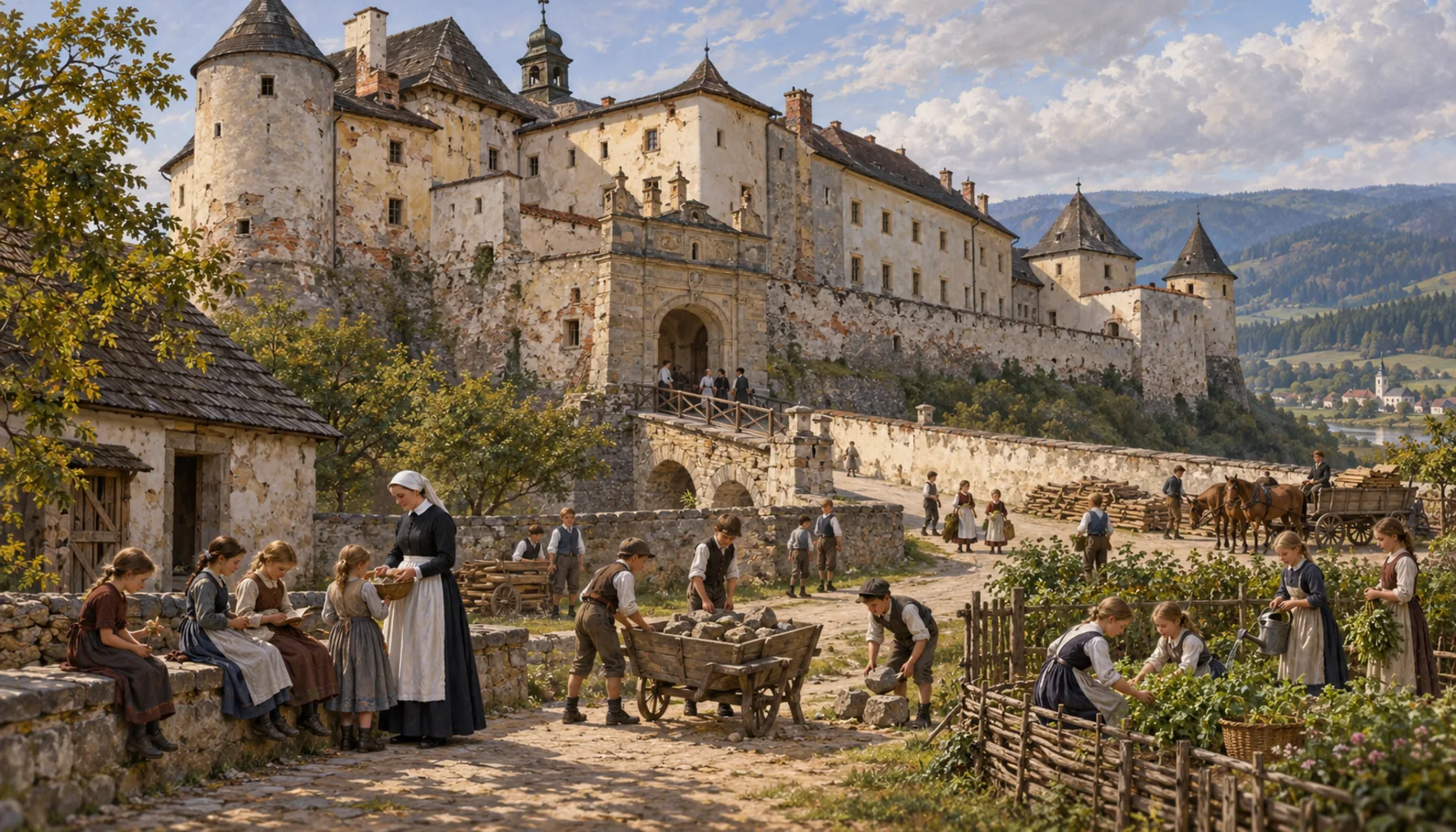
By the 1870s the castle was quietly falling apart, and what rescued it was social policy. On 31 March 1873 the Hungarian government announced a home for the orphaned children of state workers, to be paid for out of the proceeds of a charity state lottery — about 100,000 gold pieces, with 1,000 added by the emperor himself. Franz Joseph agreed that it should be named after his daughter, Archduchess Gisela, who was about to be married. The first children moved into the upper castle that same year. In 1893 a three-storey "Gisela house" was added to raise the capacity to a hundred, with a gymnasium in the short wing and a hall holding a portrait of the archduchess painted by Dominik Skutecký. The building works were laid out around the old linden in the lower courtyard rather than through it.V sedemdesiatych rokoch 19. storočia sa hrad ticho rozpadával a zachránila ho sociálna politika. 31. marca 1873 ohlásila uhorská vláda útulok pre osirelé deti štátnych robotníkov, financovaný z výnosu dobročinnej štátnej lotérie — asi sto tisíc zlatých, ku ktorým sám panovník pridal ďalších tisíc. František Jozef súhlasil, aby ústav niesol meno jeho dcéry, arcikňažnej Gizely, ktorá sa práve vydávala. Prví chovanci sa do horného hradu nasťahovali ešte v tom istom roku. V roku 1893 pribudol trojpodlažný Gizelin dom, ktorý zvýšil kapacitu na sto detí, s telocvičňou v kratšom krídle a so sálou, v ktorej visel portrét arcikňažnej od Dominika Skuteckého. Stavby obišli starú lipu na dolnom nádvorí, namiesto toho aby ju odstránili.