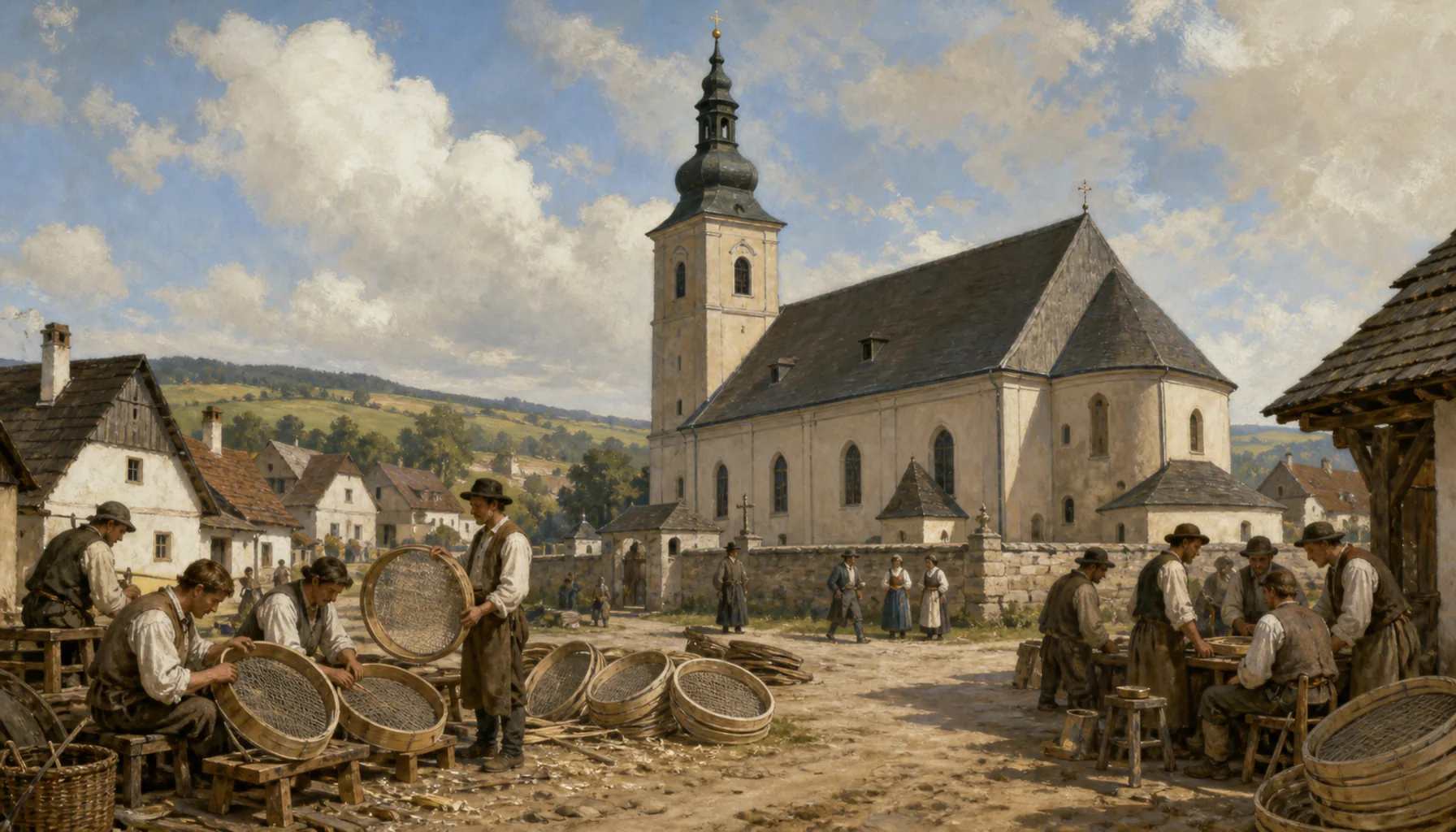
The church took from 1697 to 1729 to finish, with its tower going up in 1723 — and then, in 1731, the Counter-Reformation took it away: the Lutherans who had built it had to hand it over to Catholic worshippers, and it is the Roman Catholic church of St Stephen today. Myjava still calls it Krman's church. The same pastor encouraged the town's crafts, and new guilds appeared: shoemakers, weavers, butchers, and above all the pytlikári, who made the sieve-cloth used in flour mills and sold it right across the monarchy. After Emperor Joseph II's Patent of Toleration of 1781 allowed Protestants to build again, the Lutherans put up a new church in 1784–85; the tower that dominates the town was added in 1854–56.Kostol sa staval od roku 1697 do roku 1729, vežu dostal v roku 1723 — a potom, v roku 1731, mu ho protireformácia vzala: evanjelici, ktorí ho postavili, ho museli odovzdať katolíckym veriacim a dnes je to rímskokatolícky kostol svätého Štefana. Myjavčania mu aj tak hovoria Krmanov kostol. Ten istý farár podporoval remeslá a v meste vznikli nové cechy: ševcovský, tkáčsky, mäsiarsky a predovšetkým cech pytlikárov, ktorí vyrábali mlynárske sitá a predávali ich po celej monarchii. Keď Tolerančný patent Jozefa II. z roku 1781 dovolil protestantom opäť stavať, evanjelici si v rokoch 1784 – 1785 postavili nový kostol; veža, ktorá dnes mestu dominuje, k nemu pribudla v rokoch 1854 – 1856.