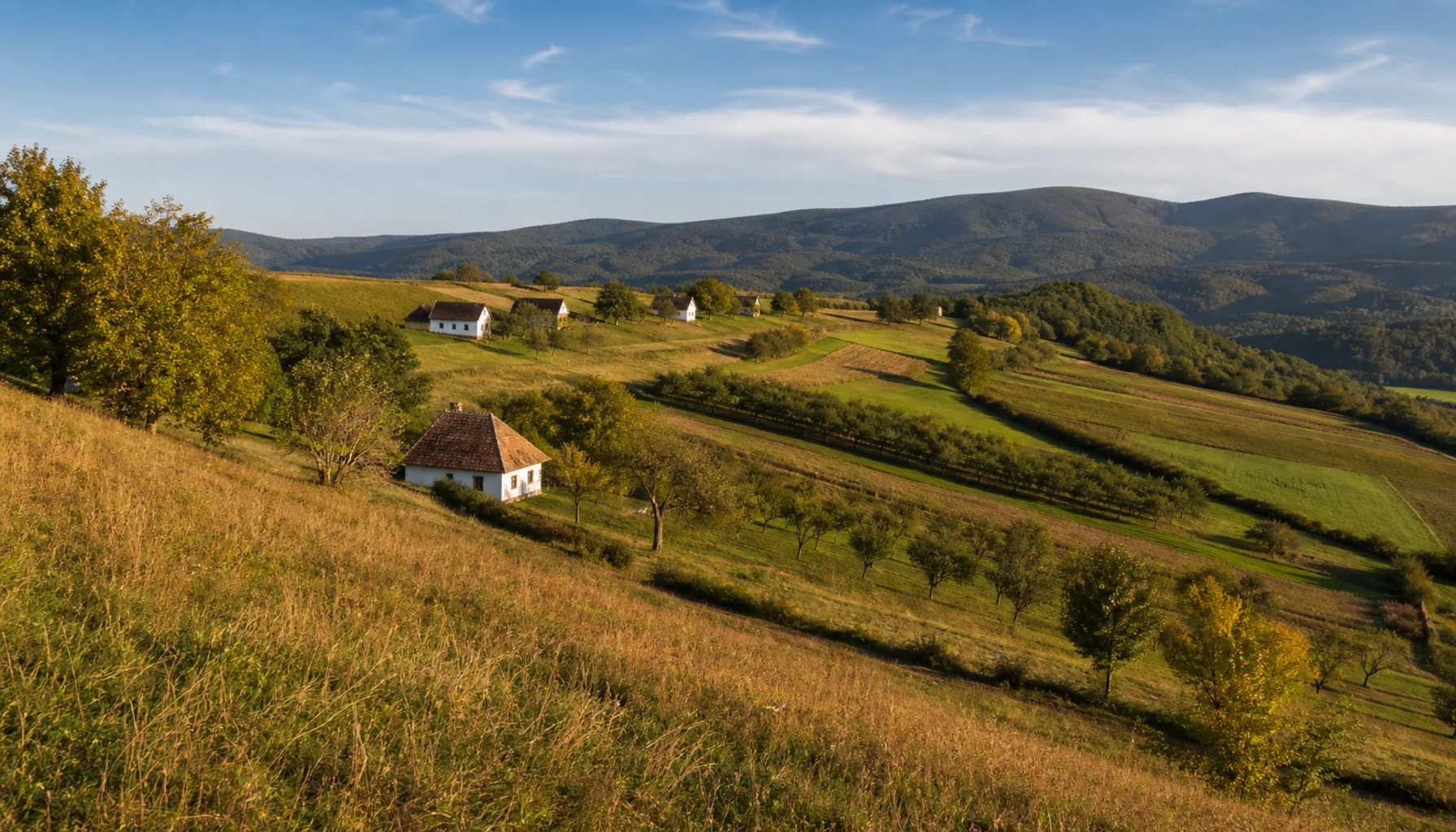
The town at the centre of the Kopanice — the scattered-farmstead country of the Myjava uplands under the White Carpathians — and the place where the first Slovak National Council was constituted in September 1848.Mesto v strede kopaníc — kraja roztratených usadlostí na Myjavskej pahorkatine pod Bielymi Karpatmi — a miesto, kde sa v septembri 1848 ustanovila prvá Slovenská národná rada.
Scattered kopanice farmsteads on the ridges of the Myjava uplandsRoztratené kopaničiarske usadlosti na chrbtoch Myjavskej pahorkatiny
Where it standsKde leží
Myjava lies in the west of the region, in upland country between the White Carpathians and the Little Carpathians, close to the Moravian border and about twenty kilometres west of Nové Mesto nad Váhom over the hills. Nothing here is flat and nothing is very high; it is a landscape of long grassy ridges and shallow valleys.Myjava leží na západe kraja, v kopcovitom kraji medzi Bielymi a Malými Karpatmi, blízko moravskej hranice a asi dvadsať kilometrov západne od Nového Mesta nad Váhom cez kopce. Nič tu nie je rovina a nič nie je veľmi vysoké; je to krajina dlhých trávnatých chrbtov a plytkých dolín.
The settlement pattern is what makes the area unmistakable. From the sixteenth and seventeenth centuries, settlers cleared the ridges and built single farmsteads scattered across them instead of gathering into villages. Those kopanice survive — white houses standing alone among plum orchards and grass — and Myjava is the one real centre among them.Nezameniteľným robí tento kraj spôsob osídlenia. Od 16. a 17. storočia si osadníci klčovali chrbty a stavali si jednotlivé usadlosti roztratené po nich namiesto toho, aby sa zhlukovali do dedín. Tieto kopanice pretrvali — biele domy stojace osamote medzi slivkovými sadmi a trávou — a Myjava je medzi nimi jediným skutočným centrom.
The storyHistória
In September 1848 the first Slovak National Council was constituted in Myjava, in the house of the widow Anna Kolényová, with Ľudovít Štúr, Jozef Miloslav Hurban and Michal Miloslav Hodža at its head. From here it called the surrounding country to rise against Hungarian authority.V septembri 1848 sa v Myjave, v dome vdovy Anny Kolényovej, ustanovila prvá Slovenská národná rada na čele s Ľudovítom Štúrom, Jozefom Miloslavom Hurbanom a Michalom Miloslavom Hodžom. Odtiaľto vyzvala okolitý kraj na povstanie proti uhorskej vrchnosti.
The rising was beaten within weeks, but the choice of Myjava was not accidental: the Kopanice were Lutheran, literate, well organised through their congregations and ready to listen. The house is a museum today and the events of that autumn are the town's central story.Povstanie porazili v priebehu týždňov, no voľba Myjavy nebola náhodná: kopanice boli evanjelické, gramotné, dobre organizované cez svoje cirkevné zbory a ochotné počúvať. Dom je dnes múzeom a udalosti tej jesene sú ústredným príbehom mesta.
Otherwise the uplands lived hard: thin soils, steep fields, and a long tradition of seasonal work and emigration. That history is why the folk culture here was recorded so thoroughly — it was already visibly under pressure when the collectors arrived.Inak sa na kopaniciach žilo ťažko: chudobné pôdy, strmé polia a dlhá tradícia sezónnej práce a vysťahovalectva. Práve preto je tunajšia ľudová kultúra tak dôkladne zaznamenaná — keď prišli zberatelia, bolo už viditeľné, že je pod tlakom.
What to seeČo vidieť
The museum in the Kolény house tells the 1848 story and the history of the Kopanice, and is the reason most visitors come into the town itself.Múzeum v Kolényovskom dome rozpráva príbeh roku 1848 aj dejiny kopaníc a je dôvodom, prečo väčšina návštevníkov zájde priamo do mesta.
The international folklore festival held here each June is one of the largest in Slovakia, and one of the few where the material comes from the surrounding hills rather than from a national programme — the town's amphitheatre and streets fill for several days.Medzinárodný folklórny festival, ktorý sa tu koná každý jún, patrí k najväčším na Slovensku a k tým pár, kde repertoár prichádza z okolitých kopcov, a nie z celoštátneho programu — amfiteáter a ulice mesta sa zaplnia na niekoľko dní.
Bradlo, about ten kilometres away above Brezová pod Bradlom, carries the monument to Milan Rastislav Štefánik — a great terraced barrow of local stone built in 1928 to Dušan Jurkovič's design, standing alone on an open ridge. It is one of the finest pieces of commemorative architecture in the country and the single best reason to come to this corner of Slovakia.Na Bradle asi desať kilometrov odtiaľto, nad Brezovou pod Bradlom, stojí mohyla Milana Rastislava Štefánika — veľká terasovitá mohyla z miestneho kameňa, postavená v roku 1928 podľa návrhu Dušana Jurkoviča, osamotená na otvorenom hrebeni. Je to jedno z najlepších diel pamätníkovej architektúry v krajine a najsilnejší dôvod prísť do tohto kúta Slovenska.
Work and industryPráca a priemysel
The uplands never fed their people well, and the twentieth century put light industry into the town instead: precision engineering, tooling, and later plastics and components for the car industry. Stará Turá, half an hour east, adds metering and medical instruments to the same local labour market.Kopanice svojich ľudí nikdy poriadne neuživili a dvadsiate storočie prinieslo do mesta namiesto toho ľahký priemysel: presné strojárstvo, nástrojárstvo a neskôr plasty a diely pre automobilový priemysel. Stará Turá pol hodiny na východ pridáva do toho istého trhu práce meraciu a zdravotnícku techniku.
Farming continues on the ridges, but at a smaller scale than the number of buildings would suggest — many kopanice are now weekend houses.Na chrbtoch sa naďalej hospodári, no v menšej miere, než by počet stavieb naznačoval — mnohé kopanice sú dnes chalupami na víkend.
Getting thereAko sa tam dostať
Myjava is on the branch railway from Nové Mesto nad Váhom to Vrbovce and on into the Czech Republic. Buses run from Nové Mesto, Senica, Brezová pod Bradlom and Trenčín, and the road over the hills from the Váh valley is the usual approach by car.Myjava leží na odbočnej trati z Nového Mesta nad Váhom do Vrboviec a ďalej do Česka. Autobusy premávajú z Nového Mesta, Senice, Brezovej pod Bradlom a Trenčína a autom sa sem obvykle prichádza cestou cez kopce z považskej doliny.
Explore MyjavaObjavujte Myjava
Every part of this place with a page of its own.Každá časť tohto miesta, ktorá má vlastnú stránku.