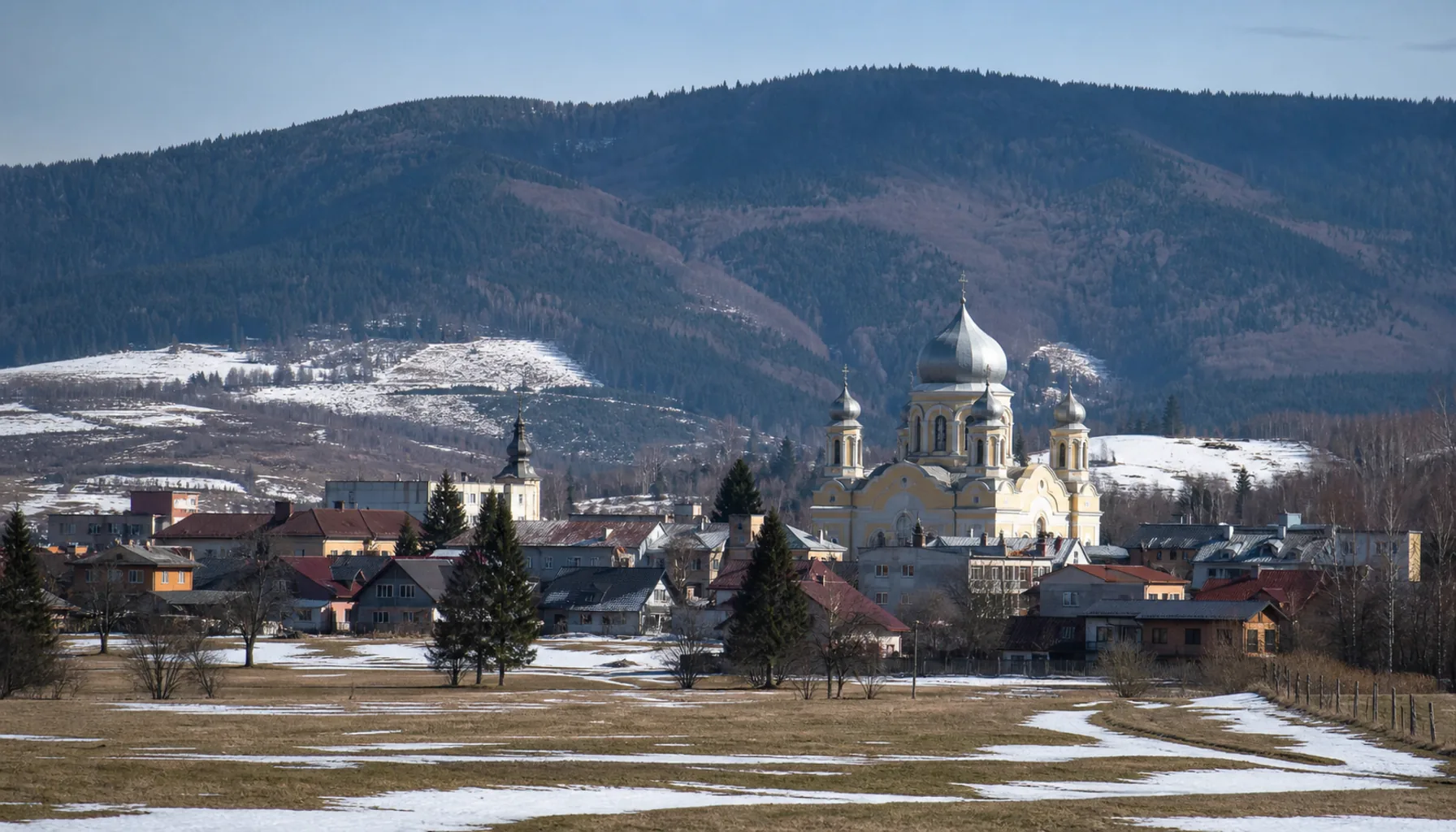
A small town in the upper Laborec valley near the Polish border, Rusyn and Greek Catholic in character, with a museum of modern art holding original works by Andy Warhol — whose parents came from a village a few kilometres away.Malé mesto v hornej doline Laborca pri poľskej hranici, rusínske a gréckokatolícke, s múzeom moderného umenia, ktoré vlastní originálne diela Andyho Warhola — jeho rodičia pochádzali z dediny pár kilometrov odtiaľ.
Onion domes above the main street of Medzilaborce, in the upper Laborec valleyCibuľové kupoly nad hlavnou ulicou Medzilaboriec v hornej doline Laborca
Where it standsKde leží
Medzilaborce lies in the upper Laborec valley in the Low Beskids, close to the Polish border and about forty kilometres north of Humenné. The hills around are long, wooded and thinly settled; the railway crosses into Poland through a tunnel a short way up the valley.Medzilaborce ležia v hornej doline Laborca v Nízkych Beskydách, blízko poľskej hranice a asi štyridsať kilometrov severne od Humenného. Okolité kopce sú dlhé, zalesnené a riedko osídlené; železnica prechádza kúsok dolinou vyššie tunelom do Poľska.
This is Rusyn country: the villages have Greek Catholic or Orthodox churches, many of them of wood, and Rusyn is still heard in the streets.Toto je rusínsky kraj: v dedinách stoja gréckokatolícke alebo pravoslávne chrámy, mnohé z dreva, a po rusínsky sa tu stále hovorí.
The storyHistória
The town began as a village on the road up to the Carpathian passes and stayed small. Its worst years were 1914 and 1915, when the front line of the First World War moved back and forth across these ridges; the fighting wrecked much of the valley and left military cemeteries in the villages around it.Mesto vzniklo ako dedina na ceste ku karpatským priesmykom a dlho zostalo malé. Najhoršie roky preň boli 1914 a 1915, keď sa cez tieto hrebene sem a tam presúvala frontová línia prvej svetovej vojny; boje zničili veľkú časť doliny a v okolitých obciach po nich zostali vojenské cintoríny.
Through the twentieth century the district lost people steadily to emigration — first to America, later to the Czech lands and to the west. Andy Warhol's parents, Ondrej and Júlia Varchola, left the village of Miková, some fifteen kilometres away, before he was born in Pittsburgh in 1928.Počas 20. storočia okres postupne strácal ľudí, ktorí odchádzali — najprv do Ameriky, neskôr do českých krajín a na západ. Rodičia Andyho Warhola, Ondrej a Júlia Varcholovci, odišli z dediny Miková asi pätnásť kilometrov odtiaľto ešte predtým, než sa im v roku 1928 v Pittsburghu narodil syn.
The museum opened in 1991, two years after the change of regime and four after Warhol's death, with works given by the Andy Warhol Foundation and by his brothers. Putting a collection of American pop art in a town of a few thousand people in the eastern Carpathians was a deliberate act, and it has kept the place on the map ever since.Múzeum otvorili v roku 1991, dva roky po prevrate a štyri roky po Warholovej smrti, s dielami, ktoré darovali Nadácia Andyho Warhola a jeho bratia. Umiestniť zbierku amerického popartu do niekoľkotisícového mesta vo východných Karpatoch bol zámerný čin a mesto sa vďaka nemu drží na mape dodnes.
What to seeČo vidieť
The museum holds original screenprints and paintings alongside family photographs, documents and objects from Miková — the point of the collection is precisely that connection. The outsized soup cans outside the entrance are the town's landmark.Múzeum vlastní originálne serigrafie a maľby a popri nich rodinné fotografie, dokumenty a predmety z Mikovej — zmyslom zbierky je práve to spojenie. Nadrozmerné polievkové konzervy pred vchodom sú miestnym orientačným bodom.
The large Orthodox church on the main street, with its onion domes, is the other building that catches the eye, and the valleys around hold some of the finest wooden churches in Slovakia. Miková itself is a small village up a side valley, with little to see beyond the fact of it.Druhou stavbou, ktorá upúta, je veľký pravoslávny chrám s cibuľovými kupolami na hlavnej ulici, a v okolitých dolinách stoja niektoré z najkrajších drevených chrámov na Slovensku. Samotná Miková je malá dedina v bočnej doline, kde okrem toho faktu niet čo vidieť.
Down the valley at Krásny Brod stand the ruins of a Basilian monastery, still a place of Greek Catholic pilgrimage, and the hills on both sides carry the small walled cemeteries of the 1914 and 1915 fighting — Austro-Hungarian, German and Russian dead buried where they fell. Between them they explain the town better than the museum does.Nižšie v doline v Krásnom Brode stoja zrúcaniny baziliánskeho kláštora, dodnes miesto gréckokatolíckych pútí, a na kopcoch po oboch stranách sú malé ohradené cintoríny z bojov rokov 1914 a 1915 — rakúsko-uhorskí, nemeckí aj ruskí padlí pochovaní tam, kde padli. Spolu vysvetľujú toto mesto lepšie než múzeum.
Work and industryPráca a priemysel
There is little industry: forestry and timber, small workshops, public services and the museum. The district is one of the smallest and least populated in Slovakia, long-term work abroad supports many households, and traffic across the Polish border is part of the local economy.Priemyslu je tu málo: lesníctvo a drevo, malé prevádzky, verejné služby a múzeum. Okres patrí k najmenším a najredšie osídleným na Slovensku, mnohé domácnosti drží nad vodou dlhodobá práca v zahraničí a súčasťou miestneho hospodárstva je aj pohyb cez poľskú hranicu.
The museum is the town's one national institution, and the visitors it brings — including a steady trickle from abroad — support the handful of places to eat and stay. That a Warhol collection should be the economic engine of a Carpathian border town is odd, and everyone here knows it.Múzeum je jedinou celoštátnou inštitúciou mesta a návštevníci, ktorých privádza — aj stály tenký prúd zo zahraničia — udržiavajú tú hŕstku podnikov, kde sa dá najesť a prespať. Že motorom hospodárstva karpatského pohraničného mesta je warholovská zbierka, je zvláštne — a vedia to tu všetci.
Getting thereAko sa tam dostať
The railway up the Laborec valley from Humenné reaches Medzilaborce and continues to the Polish border beyond it; buses follow the same valley, and a second road comes over the hills from Stropkov in the west.Železnica z Humenného dolinou Laborca prichádza do Medzilaboriec a za nimi pokračuje k poľskej hranici; tou istou dolinou premávajú autobusy a druhá cesta prichádza cez kopce od Stropkova na západe.
Explore MedzilaborceObjavujte Medzilaborce
Every part of this place with a page of its own.Každá časť tohto miesta, ktorá má vlastnú stránku.