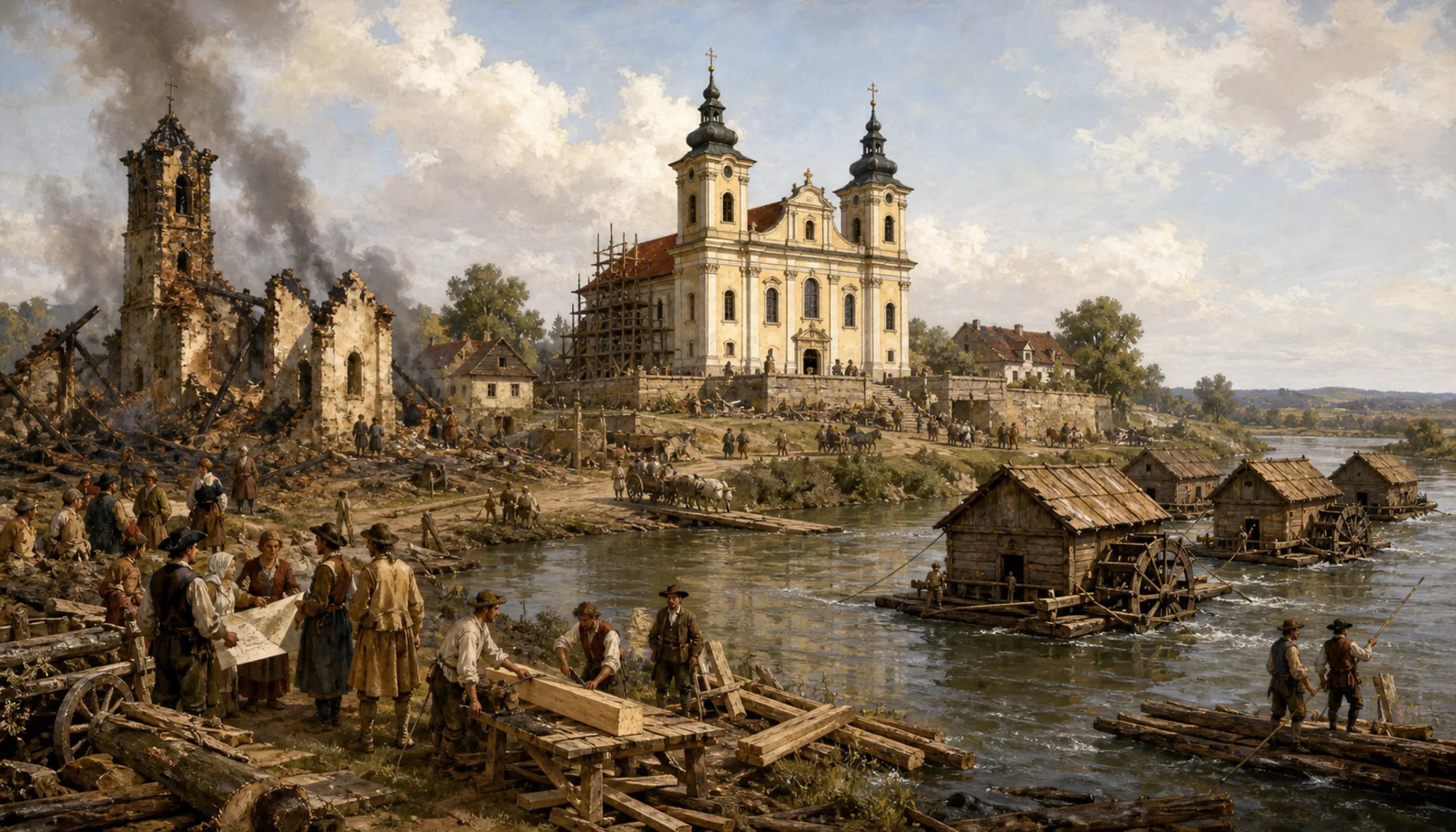
The medieval church burned down in 1715, and its Baroque replacement, the church of the Assumption, was built in 1723–24 and enlarged later in the century. Between 1803 and 1808, with Napoleon's armies moving about central Europe, the old earthworks were put back in order. A statue of St Vendelín, the patron saint of herdsmen, went up in 1835 — this was cattle and reed country, not vineyard country. Through all of it the town lived off the water: ship mills, two hulls with a paddle wheel turning between them, were moored in the current of the Little Danube and the Danube and were shifted whenever the river shifted.Stredoveký kostol v roku 1715 vyhorel a jeho barokového nástupcu, Kostol Nanebovzatia Panny Márie, postavili v rokoch 1723 – 1724 a neskôr v tom istom storočí rozšírili. V rokoch 1803 až 1808, keď sa po strednej Európe pohybovali Napoleonove vojská, dali staré zemné opevnenie znova do poriadku. Socha svätého Vendelína, patróna pastierov, tu stojí od roku 1835 — bol to kraj dobytka a trstiny, nie viníc. Po celý ten čas žilo mesto z vody: lodné mlyny, dva trupy s vodným kolesom otáčajúcim sa medzi nimi, kotvili v prúde Malého Dunaja aj Dunaja a presúvali sa vždy, keď sa presunula rieka.