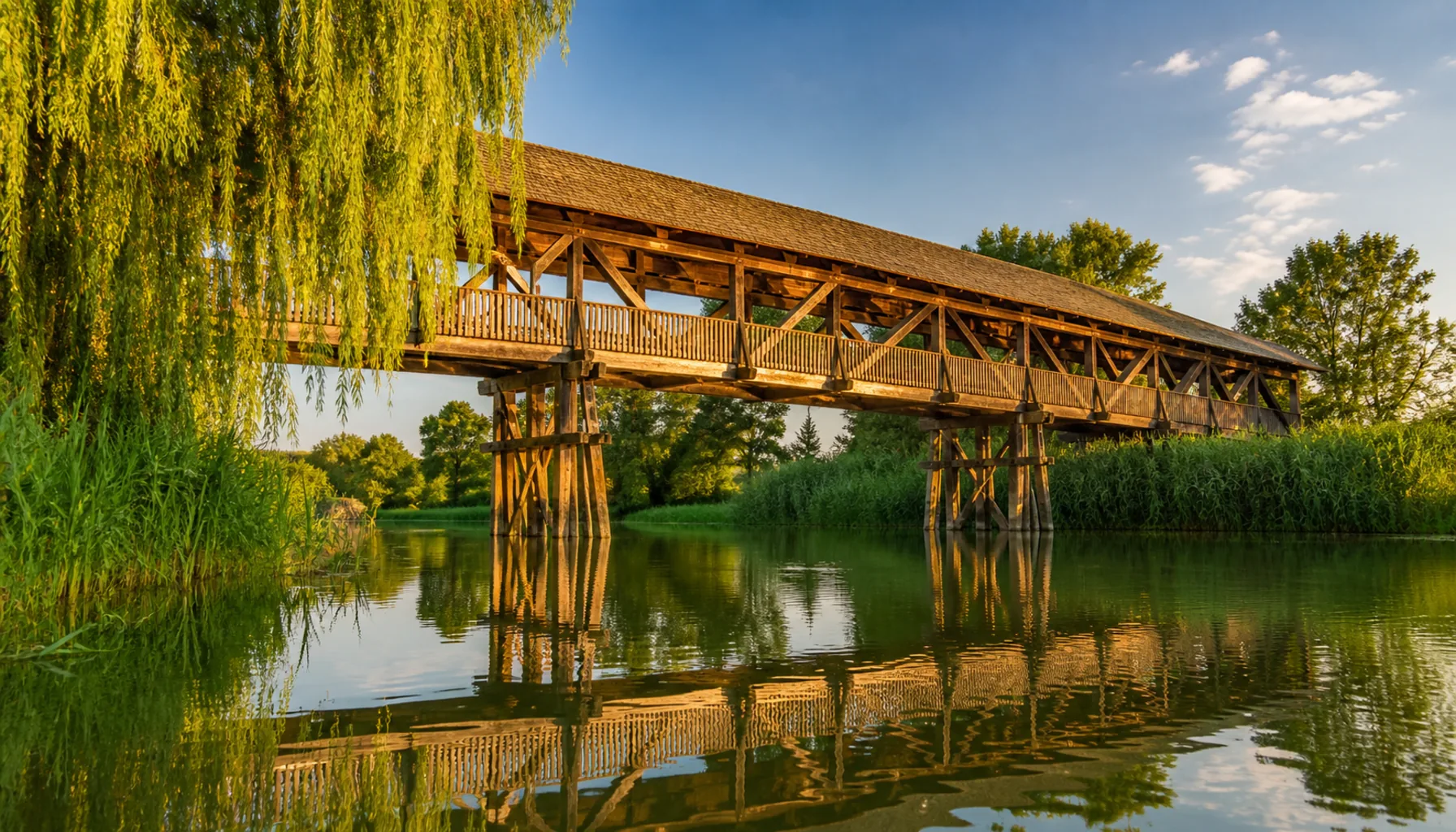
A town where the Little Danube joins the Váh at the eastern tip of the Rye Island, known for a covered wooden footbridge said to be among the longest of its kind in Europe and for the floating mill moored beside it.Mesto na sútoku Malého Dunaja a Váhu na východnom cípe Žitného ostrova, známe krytým dreveným mostom, ktorý sa pokladá za jeden z najdlhších svojho druhu v Európe, a lodným mlynom zakotveným pri ňom.
The covered wooden bridge over the Little Danube at KolárovoKrytý drevený most cez Malý Dunaj v Kolárove
Where it standsKde leží
Kolárovo lies where the Little Danube finishes its long slow loop across the lowland and joins the Váh, a short way north of Komárno. This is the eastern tip of the Rye Island, the flat alluvial country between the Danube and the Little Danube: not a hill in any direction, and beneath the fields the largest reserve of groundwater in Central Europe.Kolárovo leží tam, kde Malý Dunaj končí svoju dlhú pomalú slučku cez nížinu a vlieva sa do Váhu, kúsok na sever od Komárna. Je to východný cíp Žitného ostrova, rovinatej naplaveninovej krajiny medzi Dunajom a Malým Dunajom: nikde ani kopec a pod poliami najväčšia zásoba podzemnej vody v strednej Európe.
The town is Hungarian-speaking in the great majority. Its older name, Gúta, is what most people here still use; the present one was given in 1948 after the poet Ján Kollár.Mesto je v prevažnej väčšine maďarsky hovoriace. Starším menom Gúta ho tu väčšina ľudí nazýva dodnes; dnešný názov dostalo v roku 1948 podľa básnika Jána Kollára.
The storyHistória
Water made the place and repeatedly unmade it. The settlement belonged to the estate of Komárno castle and lived off the river: fishing, ferrying, cutting reed in the backwaters and grazing meadows that went under every spring. Flooding was not an occasional disaster here but a fixture of the calendar, until embankments were built along the Váh and the Little Danube.Miesto stvorila voda a opakovane ho aj brala. Osada patrila k panstvu komárňanského hradu a žila z rieky: z rybárstva, prievozu, rezania trstiny v ramenách a z pasenia na lúkach, ktoré sa každú jar zaliali. Povodne tu neboli občasným nešťastím, ale pevnou súčasťou kalendára — až kým na Váhu a Malom Dunaji nepostavili hrádze.
Grain was ground on the water itself. Ship mills — two hulls with a paddle wheel turning between them, moored in the current and shifted whenever the river shifted — worked the Little Danube and the Danube in numbers, and the last of them went out of use in the twentieth century.Obilie sa mlelo priamo na vode. Lodné mlyny — dva trupy s kolesom otáčajúcim sa medzi nimi, ukotvené v prúde a presúvané vždy, keď sa pohla rieka — pracovali na Malom Dunaji a na Dunaji vo veľkých počtoch a posledné z nich vyšli z prevádzky až v 20. storočí.
Kolárovo became a town in the modern period rather than the medieval one, and the centre shows it: this is a large lowland market village that grew into a town, with wide streets, single-storey houses and a scale set by carts rather than by burghers.Kolárovo sa stalo mestom až v novoveku, nie v stredoveku, a na jeho centre to vidno: je to veľká nížinná trhová dedina, ktorá vyrástla na mesto, so širokými ulicami, prízemnými domami a mierkou, ktorú určili vozy, nie mešťania.
What to seeČo vidieť
The covered wooden bridge over the Little Danube is the town's set piece — a timber-framed span with a shingled roof, built in the early 1990s and commonly called the longest river bridge in Europe built entirely of wood: 86 metres, and not a concrete pier in it. It carries walkers and cyclists only, and it leads to the recreation ground on the far bank.Krytý drevený most cez Malý Dunaj je vizitkou mesta — drevená konštrukcia so šindľovou strechou, postavená začiatkom 90. rokov a bežne označovaná za najdlhší riečny most v Európe postavený výhradne z dreva: 86 metrov bez jediného betónového piliera. Chodia po ňom len peší a cyklisti a končí pri rekreačnom areáli na druhom brehu.
Moored below it is a working replica of a floating mill, built to the pattern of the ones that once ground grain here, its wheel turning in the current and the milling gear housed in the hull. Opening is seasonal, so check before you plan a day around it.Pod ním je zakotvená funkčná replika lodného mlyna, postavená podľa vzoru tých, ktoré tu kedysi mleli obilie; koleso sa točí v prúde a mlynské zariadenie je v trupe. Prevádzka je sezónna, preto si ju pred plánovaním dňa overte.
The rest of a visit is water and flat country: the confluence itself, the embankments, the backwaters and gravel pits used for fishing, and the thermal pool on the edge of town. Upstream the Little Danube is one of the best canoeing rivers in Slovakia — slow, shaded and almost entirely free of rapids.Zvyšok návštevy tvorí voda a rovina: samotný sútok, hrádze, mŕtve ramená a štrkoviská využívané na rybárčenie a termálne kúpalisko na okraji mesta. Malý Dunaj proti prúdu je jednou z najlepších vodáckych riek na Slovensku — pomalý, tienistý a takmer bez perejí.
Work and industryPráca a priemysel
Farming is the base. This is some of the most fertile soil in the country, worked intensively for cereals, maize, vegetables and seed crops, with irrigation drawn from a shallow water table. Food processing, agricultural services and haulage follow from it.Základom je poľnohospodárstvo. Ide o jednu z najúrodnejších pôd v krajine, intenzívne obrábanú na obilie, kukuricu, zeleninu a osivá, so závlahami z plytkej hladiny podzemnej vody. Nadväzuje naň potravinárstvo, poľnohospodárske služby a doprava.
Reed cut from the wetlands was a local trade for generations, worked into mats, thatch and board, and it is still cut on a smaller scale. Most other work is in Komárno and Nové Zámky, both within commuting distance.Trstina rezaná v mokradiach bola po generácie miestnym remeslom — robili sa z nej rohože, došky aj dosky — a v menšom rozsahu sa reže dodnes. Väčšina ostatnej práce je v Komárne a Nových Zámkoch, kam sa dá denne dochádzať.
Getting thereAko sa tam dostať
Kolárovo has no regular passenger train service, so the approach is by road: north from Komárno, west from Nové Zámky, or across the lowland from Šaľa. Buses run from Komárno and Nové Zámky, and the flat country and quiet lanes make the ride in by bicycle genuinely pleasant.Do Kolárova nepremávajú pravidelné osobné vlaky, takže sa tam ide po ceste: od Komárna na sever, od Nových Zámkov na západ alebo nížinou od Šale. Autobusy premávajú z Komárna a Nových Zámkov a rovina s tichými cestičkami robí príchod na bicykli naozaj príjemným.
Explore KolárovoObjavujte Kolárovo
Every part of this place with a page of its own.Každá časť tohto miesta, ktorá má vlastnú stránku.