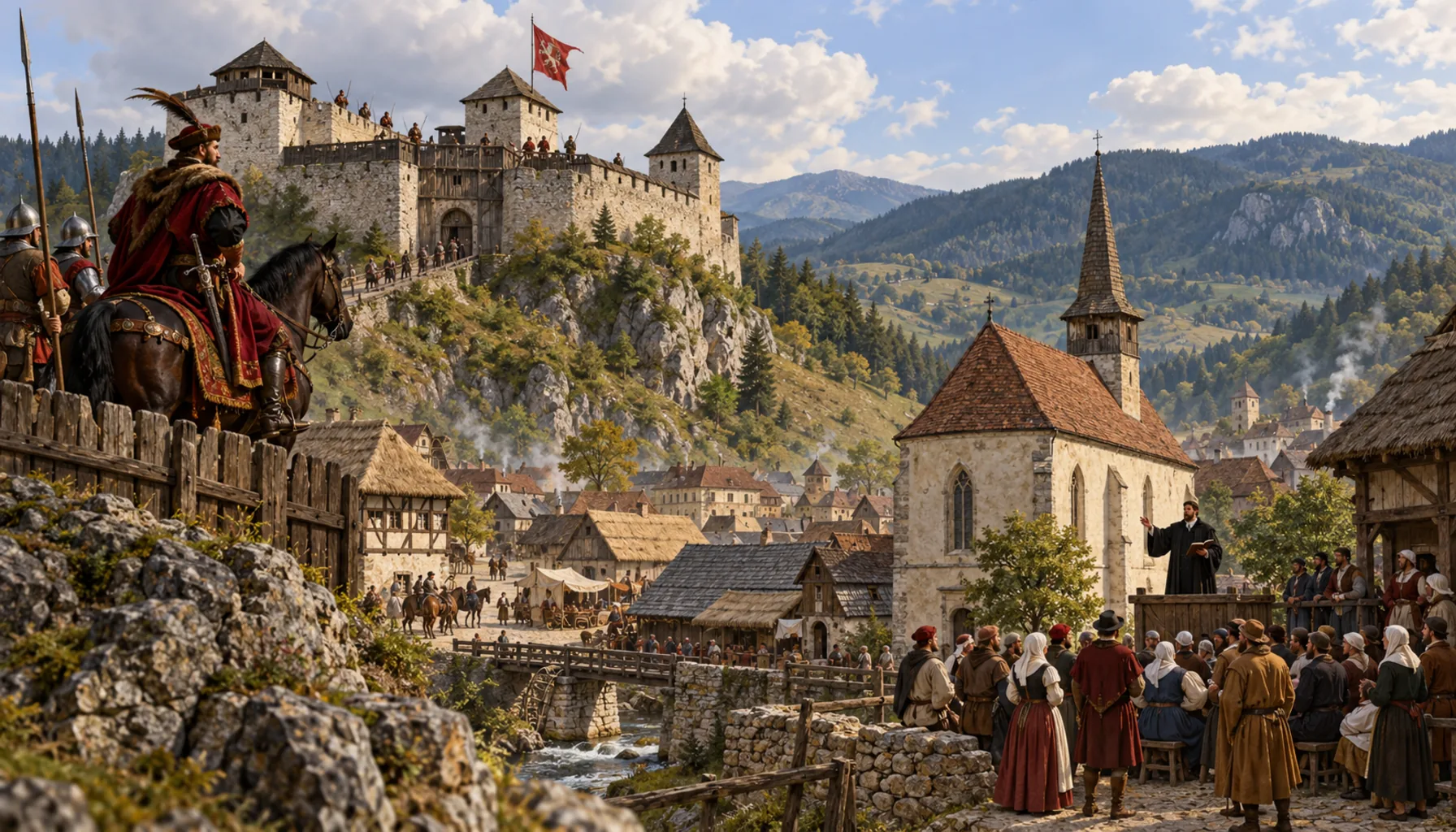
After the Hungarian army was destroyed at Mohács in 1526 the kingdom broke into pieces, and the pieces were held by whoever had a castle. At Muráň that was Matej Bašo, who took the rock in 1529 and used it for twenty years as a base for raiding across Gemer — he burned Levoča and Dobšiná — until a royal army finally stormed the castle in 1549, which Bašo did not survive. The Ottoman frontier then came closer still: Fiľakovo fell in 1554 and Ottoman tax collectors reached into the Muráň valley. Through all of it Revúca went over to the Lutheran Reformation, and it is that congregation, not the lordship, that made the town's later history.Po zničení uhorského vojska pri Moháči roku 1526 sa kráľovstvo rozpadlo na kusy a tie kusy držal ten, kto mal hrad. Na Muráni to bol Matej Bašo: skalu obsadil roku 1529 a dvadsať rokov z nej podnikal nájazdy po celom Gemeri — vypálil Levoču aj Dobšinú — kým hrad roku 1549 nedobylo kráľovské vojsko, čo už Bašo neprežil. Osmanská hranica sa potom priblížila ešte väčšmi: roku 1554 padlo Fiľakovo a osmanskí výbercovia daní siahli aj do Muránskej doliny. Popri tom všetkom prijala Revúca luteránsku reformáciu — a práve tento cirkevný zbor, nie panstvo, urobil neskoršie dejiny mesta.