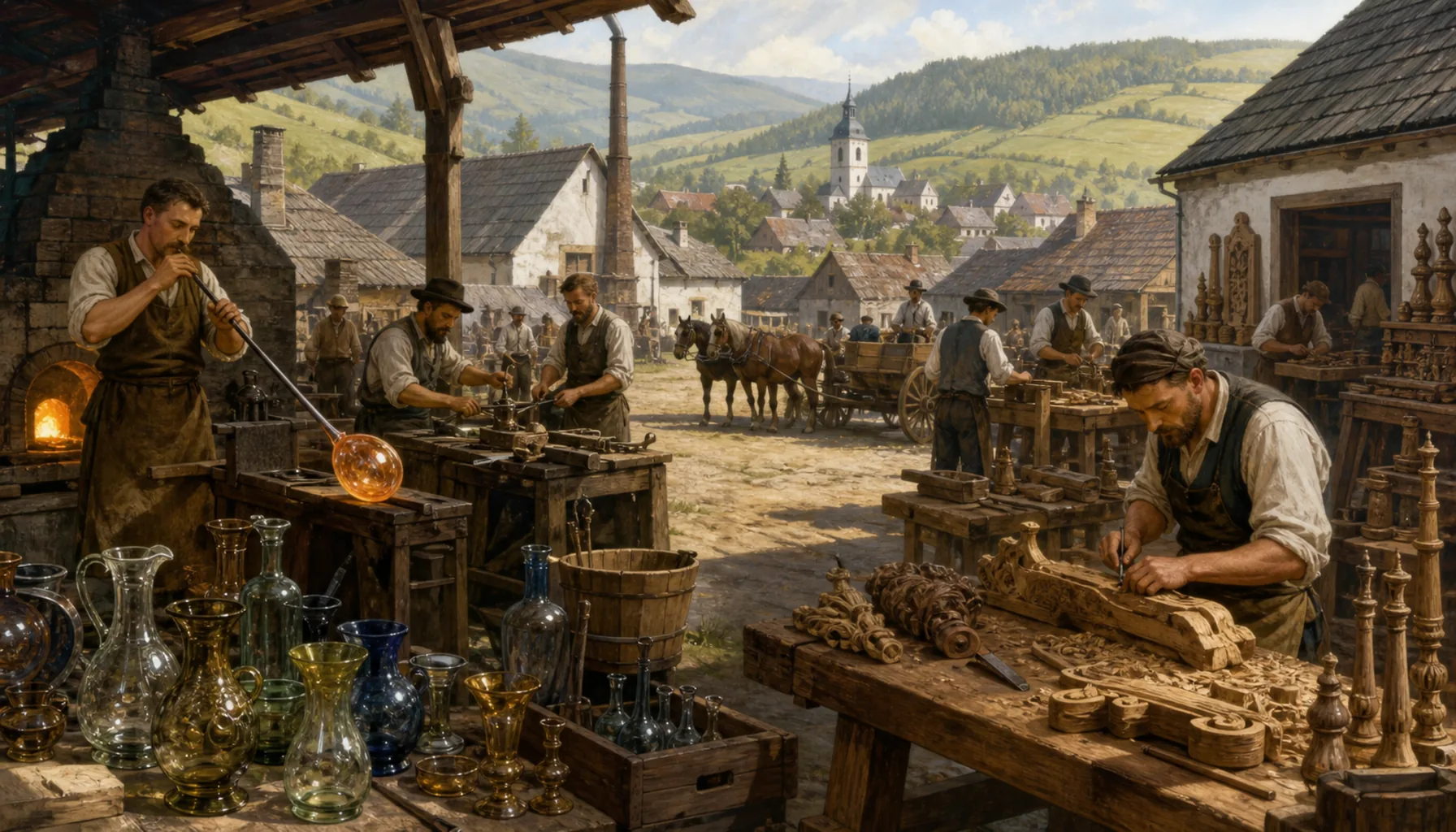
Under Austria-Hungary the estate village tried its hand at industry. Small works had been opening since the first half of the nineteenth century, and the most important of them was a glassworks that ran from 1874 until 1914. A wood-carving school was founded in 1875 and taught at the level of a secondary school of applied art, which for a village in the hills was remarkable. Neither survived: the glassworks closed as the First World War began and never reopened. These were also the decades of Magyarisation, when Hungarian was pushed into schools and offices — and the village still carried its landlords' name, Zay-Ugróc.Za Rakúska-Uhorska skúsila poddanská obec priemysel. Menšie závody tu vznikali už od prvej polovice devätnásteho storočia a najdôležitejším z nich bola skláreň, ktorá fungovala od roku 1874 do roku 1914. V roku 1875 vznikla rezbárska škola na úrovni umeleckej priemyslovky, čo bolo na dedinu v kopcoch pozoruhodné. Ani jedno nevydržalo: skláreň zanikla so začiatkom prvej svetovej vojny a už sa neotvorila. Boli to zároveň desaťročia maďarizácie, keď sa maďarčina tlačila do škôl a úradov — a obec stále niesla meno svojich zemepánov, Zay-Ugróc.