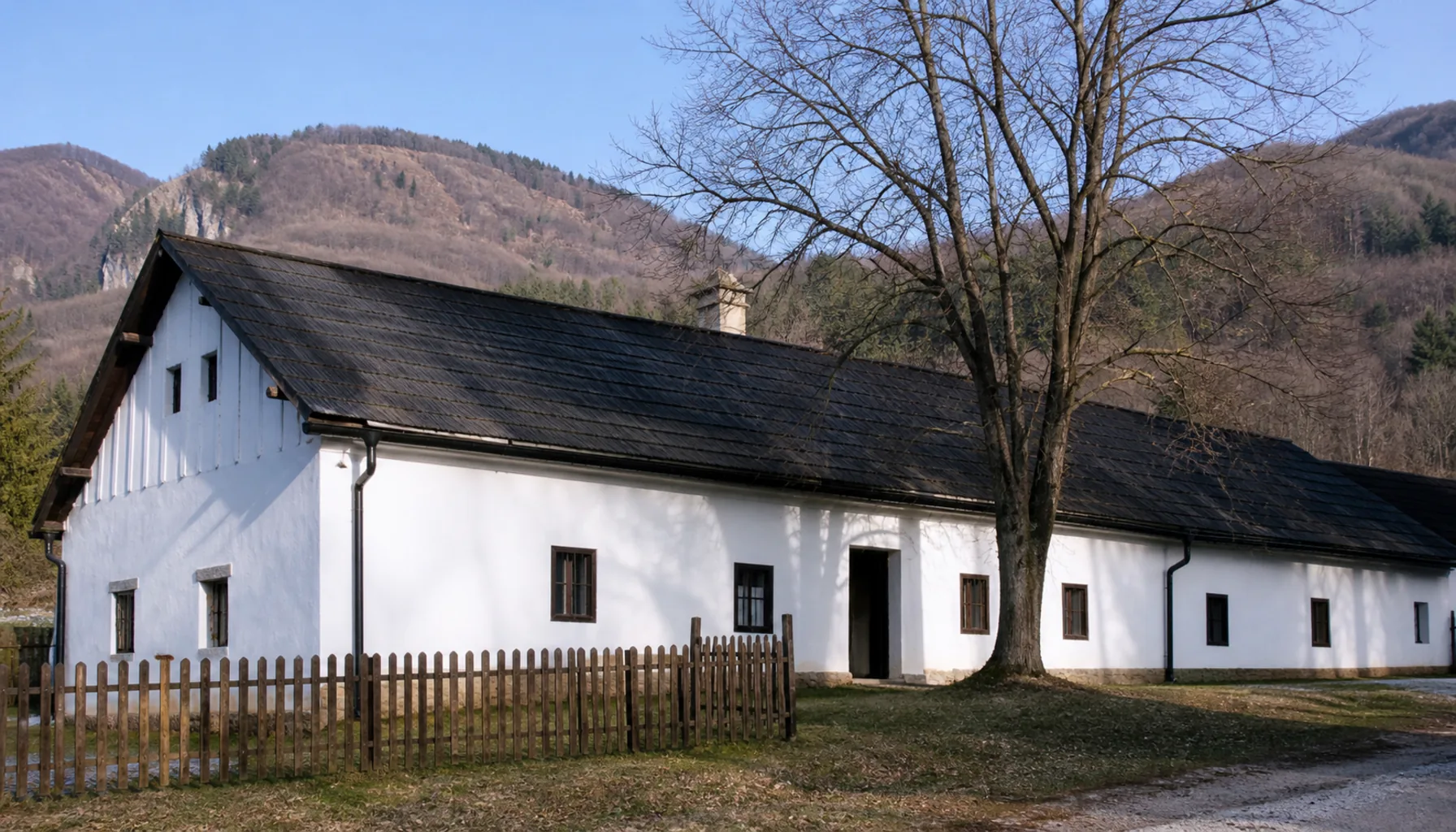
Ľudovít Štúr was born in this Bebrava valley village in 1815 and Alexander Dubček in the same building in 1921 — a coincidence with no parallel anywhere else in Slovakia, and the reason the house is a museum.V tejto obci v doline Bebravy sa v roku 1815 narodil Ľudovít Štúr a v tom istom dome sa v roku 1921 narodil Alexander Dubček — zhoda, ktorá inde na Slovensku nemá obdobu, a dôvod, prečo je z domu múzeum.
The birth house at Uhrovec, where Ľudovít Štúr was born in 1815 and Alexander Dubček in 1921Rodný dom v Uhrovci, kde sa v roku 1815 narodil Ľudovít Štúr a v roku 1921 Alexander Dubček
Where it standsKde leží
Uhrovec lies in the upper Bebrava valley, a dozen kilometres north-east of Bánovce nad Bebravou, where the fields narrow and the Strážov Hills close in. Beech woods rise behind the last houses, and the ruin of Uhrovec castle stands on the ridge above.Uhrovec leží v hornej časti doliny Bebravy, tucet kilometrov severovýchodne od Bánoviec nad Bebravou, tam, kde sa polia zužujú a Strážovské vrchy sa priblížia. Za poslednými domami stúpajú bučiny a na hrebeni nad obcou stojí zrúcanina Uhrovského hradu.
The Bebrava runs south to the Nitra rather than west to the Váh, so the village drains away from the region it belongs to, and the road up the valley thins out into the hills.Bebrava tečie na juh do Nitry, nie na západ do Váhu, takže voda z obce odteká preč od kraja, do ktorého patrí, a cesta dolinou sa stráca v kopcoch.
Why it is herePrečo práve tu
The village grew as the estate settlement of the Uhrovec domain. The castle above was built in the thirteenth century to hold the valley; when it was given up, the lords came down and built a manor house below. From the mid-sixteenth century the estate belonged to the Zay family, whose name it carried until 1918 — Zay-Ugróc.Obec vyrástla ako poddanská osada uhrovského panstva. Hrad nad ňou postavili v trinástom storočí, aby držal dolinu; keď ho opustili, páni zišli dolu a postavili si kaštieľ pod ním. Od polovice šestnásteho storočia patrilo panstvo Zayovcom, ktorých meno obec niesla až do roku 1918 — Zay-Ugróc.
The Lutheran school stood in the village with quarters for the teacher, and Samuel Štúr taught there. His son Ľudovít was born in the building in October 1815 — the man who three decades later codified written Slovak and led the national movement into the revolution of 1848. Karol Zay, who held the estate in Štúr's lifetime, was general inspector of the Lutheran church in Hungary and a determined Magyariser: landlord and schoolmaster's son on opposite sides of one argument.V obci stála evanjelická škola s bytom pre učiteľa a učil v nej Samuel Štúr. Jeho syn Ľudovít sa v tej budove narodil v októbri 1815 — muž, ktorý o tri desaťročia neskôr kodifikoval spisovnú slovenčinu a doviedol národné hnutie do revolúcie roku 1848. Karol Zay, ktorý panstvo držal za Štúrovho života, bol generálnym inšpektorom evanjelickej cirkvi v Uhorsku a presvedčeným maďarizátorom: zemepán a učiteľov syn na opačných stranách jedného sporu.
In November 1921 Alexander Dubček was born in the same house, by then divided into dwellings. He led the Communist Party of Czechoslovakia through the reforms of 1968 and became the public face of the Prague Spring, then spent twenty years out of public life after the Soviet-led invasion. Two men of that weight out of one building is why anyone outside the district knows the name Uhrovec.V novembri 1921 sa v tom istom dome, vtedy už rozdelenom na byty, narodil Alexander Dubček. Viedol Komunistickú stranu Československa cez reformy roku 1968 a stal sa verejnou tvárou Pražskej jari, po sovietskej invázii potom strávil dvadsať rokov mimo verejného života. Dvaja muži takej váhy z jednej budovy — preto meno Uhrovec pozná aj niekto mimo okresu.
What you actually seeČo naozaj uvidíte
The birth house is a long, low, whitewashed building at the edge of the village, and it is a museum, a branch of the Trenčín museum. Part of it is furnished as a village teacher's household of the early nineteenth century; the rest sets out the two lives.Rodný dom je dlhá, nízka, obielená budova na okraji obce a je z nej múzeum, pobočka trenčianskeho múzea. Časť je zariadená ako domácnosť dedinského učiteľa zo začiatku devätnásteho storočia, zvyšok predstavuje dva životy.
The castle is the walk. A marked path climbs through beech woods to the ridge, an hour or so of steady going, and the walls at the top are substantial — gate, keep and palace ranges, held up by volunteer conservation. There is no ticket office and no railing.Hrad znamená túru. Značený chodník stúpa bučinami na hrebeň, hodinku pravidelného výstupu, a hore zostalo z múrov dosť — brána, veža a palácové krídla, držané dobrovoľníckym konzervovaním. Niet tam pokladne ani zábradlia.
In the village stand the Lutheran church and the Zay manor house with its park, which is not open to visitors. A few kilometres away the memorial at Jankov vŕšok marks ground where partisans fought in the autumn of 1944 during the Slovak National Uprising.V obci stojí evanjelický kostol a Zayovský kaštieľ s parkom, ktorý nie je prístupný verejnosti. Pár kilometrov odtiaľ označuje pamätník na Jankovom vŕšku miesto, kde na jeseň roku 1944 bojovali partizáni počas Slovenského národného povstania.
Living village, not a museumŽivá obec, nie skanzen
The museum is one house in a working village, with fixed hours and a closed day; out of season, check before travelling. The Lutheran church is a working church, the manor admits nobody, and the path to the castle is open hillside with no facilities at either end.Múzeum je jedným domom vo fungujúcej obci, s pevnými hodinami a jedným zatvoreným dňom; mimo sezóny si otváranie vopred overte. Evanjelický kostol je funkčným kostolom, kaštieľ nepúšťa dnu nikoho a chodník na hrad je otvoreným svahom bez zázemia na oboch koncoch.
Both men are still argued over in Slovakia — Štúr's language politics and Dubček's part in what came after 1968 are live questions rather than settled history. Outside the anniversary weeks the village is quiet, the yards are private and the fields are worked.O oboch mužoch sa na Slovensku stále vedú spory — Štúrova jazyková politika aj Dubčekov podiel na tom, čo prišlo po roku 1968, sú živé otázky, nie uzavreté dejiny. Mimo výročných týždňov je v obci ticho, dvory sú súkromné a polia sa obrábajú.
Getting thereAko sa tam dostať
There is no railway in the valley. Buses run up from Bánovce nad Bebravou, itself reached by bus from Trenčín, Prievidza and Topoľčany; by car it is the valley road north-east out of Bánovce.V doline nie je železnica. Autobusy chodia hore z Bánoviec nad Bebravou, kam sa dá dostať autobusom z Trenčína, Prievidze a Topoľčian; autom je to cesta dolinou na severovýchod z Bánoviec.
Explore UhrovecObjavujte Uhrovec
Every part of this place with a page of its own.Každá časť tohto miesta, ktorá má vlastnú stránku.