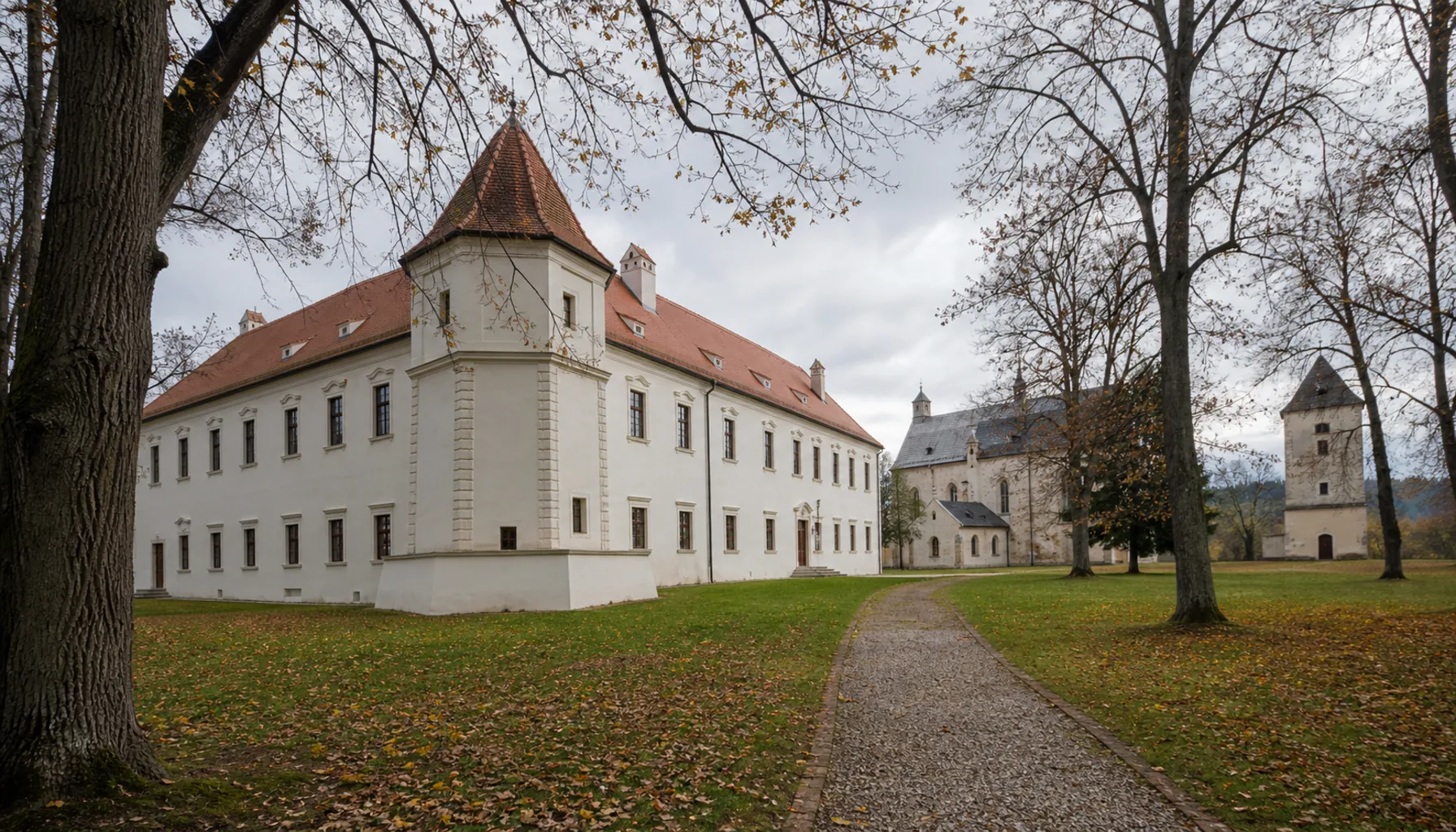
A Spiš town under the Belianske Tatry with a free-standing Renaissance bell tower, the birthplace of the optics pioneer Jozef Maximilián Petzval, and the Strážky manor house on its southern edge.Spišské mesto pod Belianskymi Tatrami so samostatne stojacou renesančnou zvonicou, rodisko priekopníka optiky Jozefa Maximiliána Petzvala a kaštieľ v Strážkach na jeho južnom okraji.
The Renaissance manor house at Strážky in its park on the edge of Spišská BeláRenesančný kaštieľ v Strážkach v parku na okraji Spišskej Belej
Where it standsKde leží
Spišská Belá stands on the Poprad river a few kilometres north of Kežmarok, at the foot of the Belianske Tatry — the limestone eastern wing of the range, quite different in character from the granite peaks west of it. The road north out of the town runs through Ždiar to the Polish border at Lysá Poľana.Spišská Belá leží na rieke Poprad pár kilometrov severne od Kežmarku, na úpätí Belianskych Tatier — vápencového východného krídla pohoria, ktoré má celkom iný ráz než žulové štíty na západ od neho. Cesta na sever z mesta vedie cez Ždiar k poľskej hranici na Lysej Poľane.
Strážky, once a separate village with its own manor, church and bell tower, is now part of the town — and is the reason a good many visitors come at all.Strážky, kedysi samostatná obec s vlastným kaštieľom, kostolom a zvonicou, sú dnes súčasťou mesta — a práve pre ne sem nemálo návštevníkov vôbec prichádza.
The storyHistória
The town was founded by German settlers in the Spiš colonisation and is recorded from the thirteenth century. It belonged to the association of Spiš towns and was among those pawned to the Polish crown in 1412, returning to Hungarian administration only in 1772 — the same long detour that shaped Poprad and Podolinec. Its living came from crafts, brewing, milling and the carting trade on the road to Poland.Mesto založili nemeckí kolonisti počas spišskej kolonizácie a je doložené od 13. storočia. Patrilo do spolku spišských miest a bolo medzi tými, ktoré v roku 1412 dali do zálohy poľskej korune; pod uhorskú správu sa vrátilo až v roku 1772 — tá istá dlhá obchádzka, ktorá poznačila Poprad aj Podolinec. Živilo sa remeslami, pivovarníctvom, mlynárstvom a povozníctvom na ceste do Poľska.
Jozef Maximilián Petzval was born here in 1807. He taught mathematics in Vienna and calculated the portrait lens that bears his name — an optical design so much faster than anything before it that it cut sitting times from minutes to seconds and made portrait photography a practical trade. His birth house in the town is a museum of photography.V roku 1807 sa tu narodil Jozef Maximilián Petzval. Prednášal matematiku vo Viedni a vypočítal portrétny objektív, ktorý nesie jeho meno — optický návrh natoľko svetelnejší než čokoľvek dovtedy, že skrátil čas pózovania z minút na sekundy a z portrétnej fotografie urobil praktické remeslo. V jeho rodnom dome v meste je múzeum fotografie.
A second name belongs to the mountains. Ľudovít Greiner, a forester in the service of the estates here, established by measurement in the 1830s that Gerlachovský štít, and not Lomnický štít as had been assumed, is the highest peak of the Tatras. He spent his working life in this district and is commemorated in the town.Druhé meno patrí horám. Ľudovít Greiner, lesník v službách tunajších panstiev, meraním v 30. rokoch 19. storočia zistil, že najvyšším vrchom Tatier je Gerlachovský štít, a nie Lomnický, ako sa dovtedy predpokladalo. Prežil tu celý svoj pracovný život a mesto si ho pripomína.
What to seeČo vidieť
The Gothic church of St Anthony the Abbot and the free-standing Renaissance bell tower beside it are the centre. The tower, with its decorated attic storey, is one of the better examples of a type built all over the Spiš in the sixteenth and seventeenth centuries, when towns put their bells in a separate structure rather than on the church.Centrom je gotický Kostol svätého Antona Pustovníka a vedľa neho samostatne stojaca renesančná zvonica. Veža so zdobenou atikou patrí k lepším ukážkam typu, aký sa v 16. a 17. storočí staval po celom Spiši, keď mestá umiestňovali zvony do samostatnej stavby, a nie na kostol.
Strážky, on the southern edge of the town, is a Renaissance manor house with a church and bell tower beside it and a park of old trees around it. It belonged in turn to the Horváth-Stansith and Mednyánszky families, and the painter Ladislav Mednyánszky worked there for long stretches of his life. The whole complex now belongs to the Slovak National Gallery and holds a permanent display in which his work is the centrepiece.Strážky na južnom okraji mesta sú renesančný kaštieľ s kostolom a zvonicou vedľa a s parkom starých stromov okolo. Patrili postupne Horváthovcom-Stansithovcom a Mednyánszkyovcom a maliar Ladislav Mednyánszky tam počas života dlhé obdobia pracoval. Celý areál dnes patrí Slovenskej národnej galérii a je v ňom stála expozícia, ktorej ťažiskom je práve jeho tvorba.
The Petzval museum, the manor and the bell tower make an easy morning. Above the town the Belianske Tatry are almost entirely closed to walkers for nature protection; the exceptions are signed on the ground, and the show cave at Tatranská Kotlina, a short drive west, is the way most people see the inside of this part of the range.Petzvalovo múzeum, kaštieľ a zvonica zaplnia jedno dopoludnie. Belianske Tatry nad mestom sú z dôvodov ochrany prírody pre turistov takmer úplne uzavreté; výnimky sú vyznačené priamo v teréne a sprístupnená jaskyňa v Tatranskej Kotline kúsok na západ je spôsob, akým väčšina ľudí uvidí vnútro tejto časti pohoria.
Work and industryPráca a priemysel
Timber and sawmilling, food processing, building trades and small engineering make up the local economy, and a large share of working people commute to Kežmarok and Poprad. Farming here is cold-country farming — cattle, sheep and potatoes rather than grain — and the forests of the Poprad valley are worked commercially.Miestnu ekonomiku tvorí drevárstvo a píly, potravinárstvo, stavebníctvo a malé strojárstvo a veľká časť pracujúcich dochádza do Kežmarku a Popradu. Poľnohospodárstvo je tu hospodárením v chladnom kraji — dobytok, ovce a zemiaky namiesto obilia — a lesy v doline Popradu sa obhospodarujú ťažobne.
Tourism passes through rather than stops: the town sits on the road between Poprad, the eastern Tatra resorts and the Polish crossing, and the traffic is heaviest in the ski months and in high summer.Cestovný ruch mestom skôr prechádza, než by v ňom zastavil: leží na ceste medzi Popradom, východnými tatranskými strediskami a poľským priechodom a doprava je najhustejšia v lyžiarskych mesiacoch a vo vrchole leta.
Getting thereAko sa tam dostať
Spišská Belá is on the branch railway from Poprad through Kežmarok to Podolinec, Stará Ľubovňa and Plaveč. Buses run from Kežmarok and Poprad, and the road north leads to Ždiar and the border at Lysá Poľana.Spišská Belá leží na odbočnej trati z Popradu cez Kežmarok do Podolinca, Starej Ľubovne a Plavča. Autobusy premávajú z Kežmarku a Popradu a cesta na sever vedie do Ždiaru a na hranicu na Lysej Poľane.
Explore Spišská BeláObjavujte Spišská Belá
Every part of this place with a page of its own.Každá časť tohto miesta, ktorá má vlastnú stránku.